The verbose context problem occurs when structured concepts have token-inefficient textual representations. This bottleneck is acute in population health: cohort-level analysis of longitudinal patient records requires reasoning over thousands of medically-coded events, often exceeding 400K tokens in total.
Social influence dialogue changes user behavior by altering internal cognitive states. The central evaluation question is whether the user's beliefs, desires, intentions, and emotions measurably change over the course of conversation, a process-oriented criterion that neither surface-level text metrics (BLEU/ROUGE) nor single-score LLM judgments can capture.
Behind a customer's API, a high-quality answer isn't enough. It has to be usable, which means on time.
By Frank Wittkampf
Use coding agents to power your knowledge base The post How to Build a Powerful LLM Knowledge Base appeared first on Towards Data Science .
By Eivind Kjosbakken
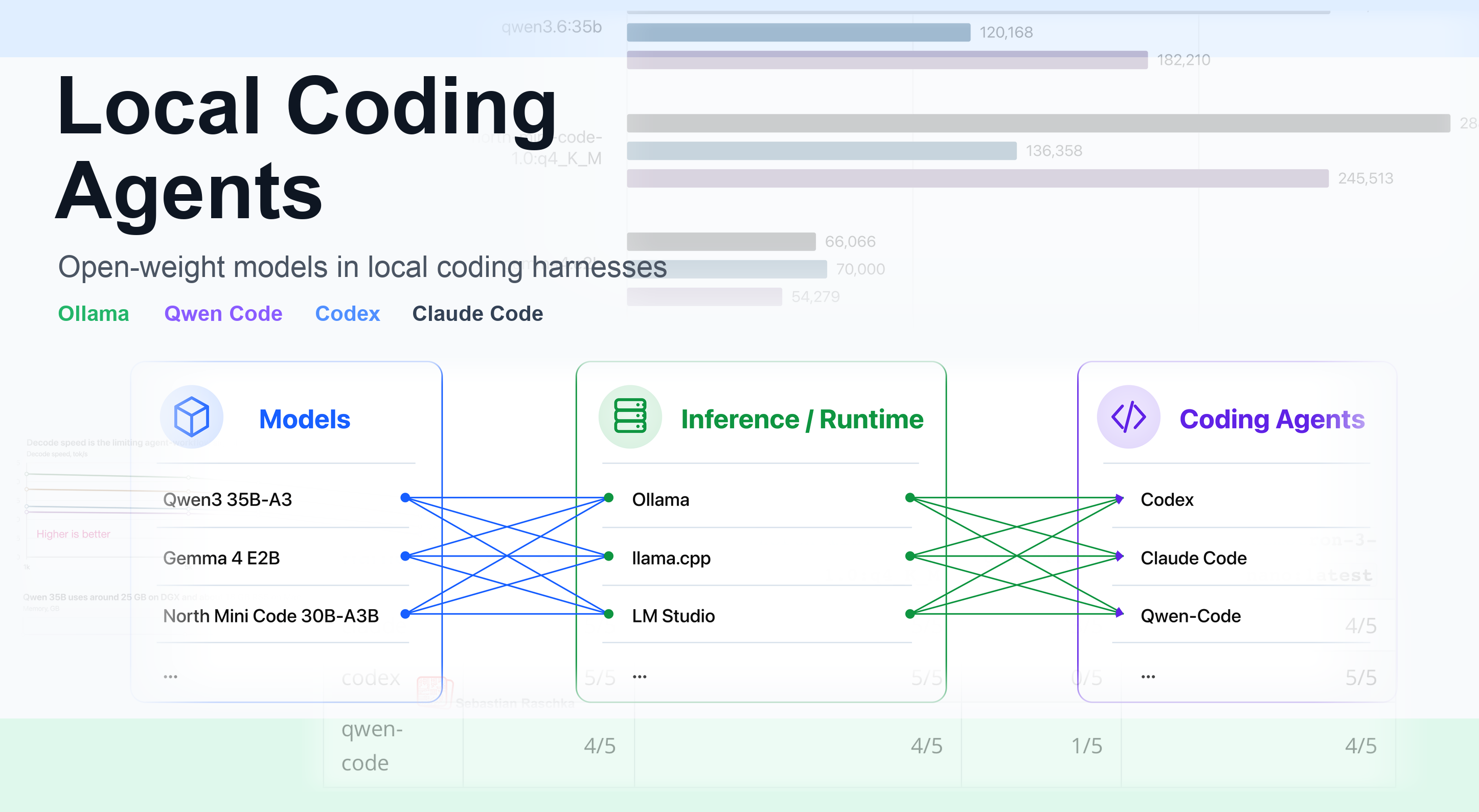
Using Open-Weight Models in Local Coding Harnesses as an Alternative to Claude Code and Codex Subscriptions
By Sebastian Raschka, PhD
Using Gemma 4, Ollama, OpenAI Agents SDK, and Tavily MCP to build a lightweight research agent The post From Local LLM to Tool-Using Agent appeared first on Towards Data Science .
By Shuai Guo
arXiv:2508. 08005v4 Announce Type: replace-cross Abstract: The Maximum Clique Problem (MCP) is an NP-hard problem with wide-ranging applications in fields such as bioinformatics, network science, and social computing, yet no single algorithm consistently outperforms all others across diverse graph instances.
By Xiang Li, Shanshan Wang, Chenglong Xiao
arXiv:2606. 26424v1 Announce Type: new Abstract: Trajectory forecasting for autonomous driving has advanced rapidly, yet representative models often produce uninformative posteriors over forecast modes, causing problems for mode pruning.
By Qiyuan Wu, Katie Z Luo, Bharath Hariharan, Wei-Lun Chao, Mark Campbell
arXiv:2606. 26793v1 Announce Type: cross Abstract: Multimodal agentic retrieval-augmented generation (RAG) systems expand the attack surface beyond prompt injection to include text poisoning, image injection, direct-query attacks, and orchestrator-level tool manipulation.
By Inderjeet Singh, Andr\'es Murillo, Motoyoshi Sekiya, Yuki Unno, Junichi Suga
arXiv:2606. 26574v1 Announce Type: new Abstract: Many real-world control problems involve hybrid discrete-continuous action spaces.
By Timothy Flavin, Sandip Sen
arXiv:2606. 27032v1 Announce Type: cross Abstract: Energy trading decisions depend not only on current market prices, but also on expected future market conditions, and operational constraints.
By Jesper Klicks, Sander Vr\v{z}ina, Vincent Fran\c{c}ois-Lavet
arXiv:2606. 26578v1 Announce Type: new Abstract: Automating optimization modeling from natural language with large language models (LLMs) faces two key challenges.
By Qingcan Kang, Mingyang Liu, Xiaojin Fu, Shixiong Kai, Tao Zhong, Mingxuan Yuan
arXiv:2606. 26904v1 Announce Type: cross Abstract: Video reasoning language models implicitly assume that every input frame is equally reliable.
By Yangfan He, Yujin Choi, Jaehong Yoon
arXiv:2606. 26836v1 Announce Type: new Abstract: Existing benchmarks typically report accuracy for a single model on a single run.
By Bradley Fowler, Ryan Smith, Daniel Thi Graviet, William Myers, Joshua Greaves, Narmeen Fatimah Oozeer, Ant\'ia Garc\'ia, Philip Quirke, Amirali Abdullah, Fazl Barez, Shriyash Kaustubh Upadhyay
arXiv:2606. 26123v1 Announce Type: cross Abstract: Ultra-low latency and high throughput are required for Virtual Reality (VR) services in 6G networks, which presents critical challenges for Software-Defined Radio Access Networks (SD-RANs) dynamic resource management.
By Khaled M. Naguib, Soumaya Cherkaoui, Mahmoud M. Elmesalawy, Ahmed M. Abd El-Haleem, Ibrahim I. Ibrahim
arXiv:2606. 27154v1 Announce Type: new Abstract: Root cause analysis (RCA) poses a holistic test of LLM agentic capabilities, such as long-context understanding, multi-step reasoning, and tool use.
By Aoyang Fang, Yifan Yang, Jin'ao Shang, Qisheng Lu, Junjielung Xu, Rui Wang, Songhan Zhang, Yuzhong Zhang, Boxi Yu, Pinjia He
arXiv:2606. 26406v1 Announce Type: cross Abstract: We propose a complete architectural blueprint for safe artificial general intelligence based on a closed reentry loop (D I cycle).
By A. S. Ushakov, Yu. N. Berdinsk
arXiv:2606. 26173v1 Announce Type: new Abstract: Recent work shows that Large Language Models (LLMs) can act as semantic mutation operators for the evolutionary discovery of programs and proofs.
By Dhruv Sharma, Gautam Shroff
arXiv:2606. 26397v1 Announce Type: cross Abstract: Real-world decision-making often requires balancing multiple conflicting objectives, a challenge that standard Reinforcement Learning (RL) frequently addresses by aggregating rewards into a single scalar signal.
By Aniruddha Joshi, Niklas Lauffer, Sanjit Seshia
arXiv:2606. 26300v1 Announce Type: new Abstract: A classical intuition holds that verifying a solution is easier than producing one.
By Binghai Wang, Chenlong Zhang, Dayiheng Liu, Jiajun Zhang, Jiawei Chen, Mouxiang Chen, Rongyao Fang, Siyuan Zhang, Xuwu Wang, Yuheng Jing, Zeyao Ma, Zeyu Cui