Modern LLM deployments routinely compress models and raise sampling temperature to reduce cost, latency, or repetition, yet safety evaluations usually treat these choices as fixed implementation details. This leaves a practical uncertainty: does a model that is safe at FP16 and greedy decoding remain safe after it is quantized and sampled stochastically, or do the two deployment knobs amplify one another?
The standard way to compare two text embeddings is cosine similarity. Scattered studies report that a different metric does better, but never pin down the geometric condition that decides when, or why.
We propose Persona-Trained Monte Carlo (PTMC), a method for estimating distributions of market-outcome statistics by repeatedly simulating limit-order-book interaction among swarms of persona-conditioned neural-policy trading bots. Each run instantiates many bots sharing one trained policy network but conditioned on heterogeneous, individually sampled persona parameters drawn from a learned trader-heterogeneity distribution; the bots interact in a continuous double auction, and the resulting price path is one Monte Carlo sample.
The verbose context problem occurs when structured concepts have token-inefficient textual representations. This bottleneck is acute in population health: cohort-level analysis of longitudinal patient records requires reasoning over thousands of medically-coded events, often exceeding 400K tokens in total.
Social influence dialogue changes user behavior by altering internal cognitive states. The central evaluation question is whether the user's beliefs, desires, intentions, and emotions measurably change over the course of conversation, a process-oriented criterion that neither surface-level text metrics (BLEU/ROUGE) nor single-score LLM judgments can capture.
Inference-time safety methods for large language models have proliferated, yet no systematic comparison exists. We evaluate five defense paradigms (no defense, static steering, CAST, AlphaSteer, probe-gated) across seven instruction-tuned models (7-31B) and five attack types (GCG, AutoDAN, DeepInception, prefilling, intent laundering).
Balance-oriented multi-warehouse inventory allocation is a recurring decision problem in large-scale e-commerce supply chains, in which a fixed replenishment quantity is distributed across warehouses to balance post-allocation inventory coverage while accounting for demand forecasts and heterogeneous allocation constraints. In practice, allocation requirements are often scenario-dependent and expressed in semi-structured or natural-language form rather than as ready-to-solve operations research (OR) formulations.
Reliable event detection underpins induced-seismicity monitoring for Carbon dioxide Capture and Storage (CCS) and geothermal operations, distributed acoustic sensing (DAS), and industrial condition monitoring. In each setting a detector must stay reliable both when sensors fail and when the signal is buried in noise.
Pose histories provide the core kinematic evidence for 3D human motion prediction, but they lack explicit high-level semantic guidance. This paper introduces ZGL, a lightweight language-conditioned predictor that uses captions of the observed motion as a semantic prior while preserving a strong motion backbone as the main source of dynamics.
A deep network's loss is invariant to continuous symmetries of its parameters: the logit shift, the ReLU rescaling, the LayerNorm scale, the per-head attention rotation. Adam's per-coordinate preconditioner drifts along each symmetry orbit, which pulls the trajectory off the symmetry quotient where the optimization lives and blurs the singular-learning rate the quotient makes readable.
Retrieval-Augmented Generation (RAG) has become the standard way to ground large language models in external knowledge, yet most systems retrieve a fixed number of passages for every question regardless of its difficulty. This wastes computation on easy questions, starves hard ones, and gives no signal for when a generated answer can be trusted.
Use coding agents to power your knowledge base The post How to Build a Powerful LLM Knowledge Base appeared first on Towards Data Science .
By Eivind Kjosbakken
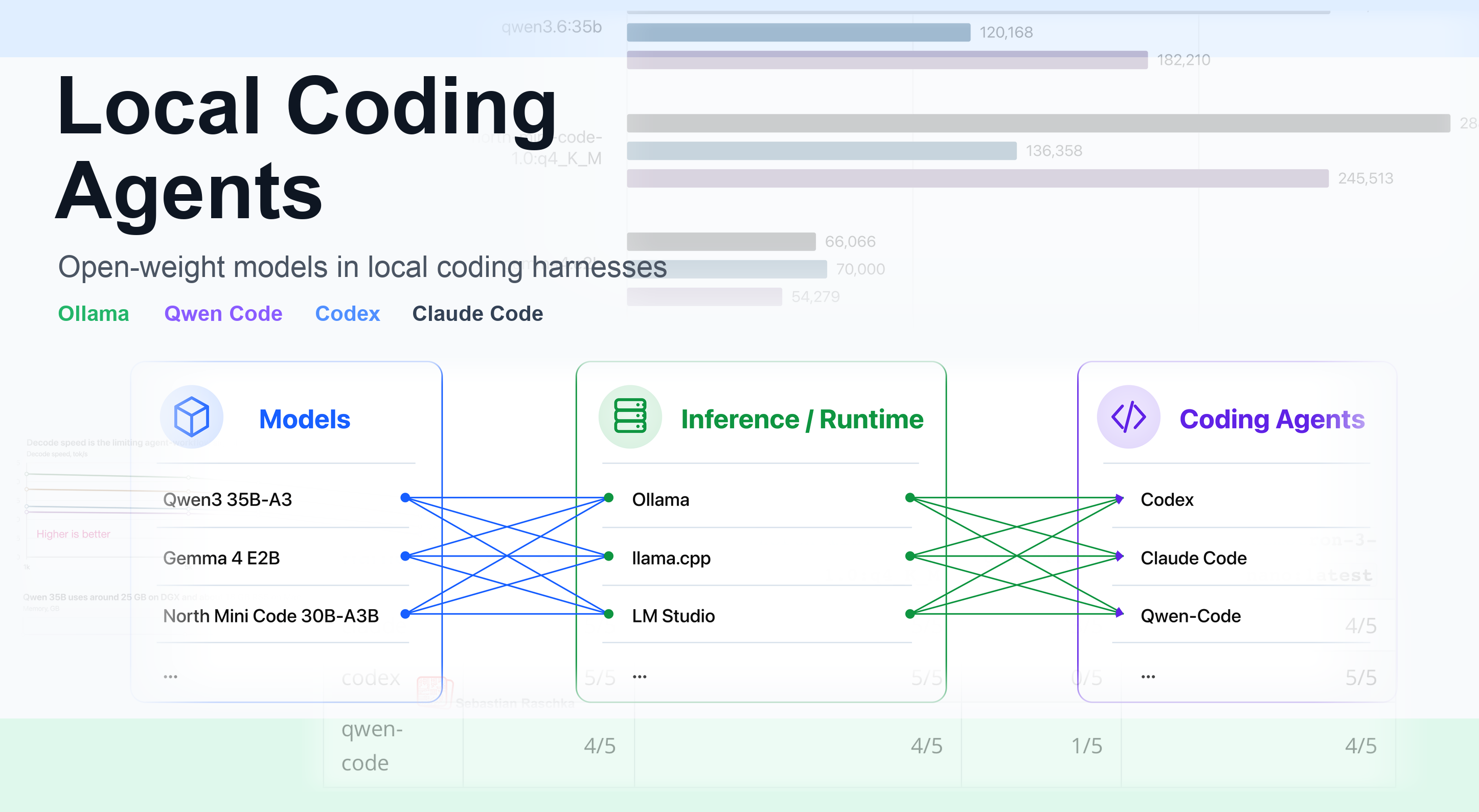
Using Open-Weight Models in Local Coding Harnesses as an Alternative to Claude Code and Codex Subscriptions
By Sebastian Raschka, PhD
Using Gemma 4, Ollama, OpenAI Agents SDK, and Tavily MCP to build a lightweight research agent The post From Local LLM to Tool-Using Agent appeared first on Towards Data Science .
By Shuai Guo
The AI community has framed the relationship between large language models (LLMs) and world models as a dichotomy: LLMs predict tokens; world models simulate reality. Yann LeCun argues in 2022 that reaching general intelligence requires abandoning autoregressive token prediction in favour of latent-space architectures.
To help robots do chores in places like homes and factories, a new approach from MIT uses one language model to clarify users’ instructions, then another to ignore irrelevant info.
By Alex Shipps | MIT CSAIL
OpenAI previews GPT-5. 6 Sol, a next-generation model with stronger capabilities in coding, science, and cybersecurity, paired with its most advanced safety stack.
arXiv:2606. 26356v1 Announce Type: new Abstract: Practitioners of prompt-composed agentic systems report a recurring failure mode: editing one prompt module silently shifts the behavior of others despite no shared variable or executable dependency.
By Ching-Yu Lin, Yifan Liu
arXiv:2606. 26986v1 Announce Type: cross Abstract: Open Relation Extraction (OpenRE) requires a model to extract unseen relations between head and tail entities from unstructured text for real-world applications.
By Xin Lin, Liang Zhang, Guoqi Ma, Hongyao Tu, Jinsong Su
arXiv:2606. 26422v1 Announce Type: new Abstract: Researchers increasingly use text classification--supervised models or large language models--to measure constructs from natural language, providing metrics such as recall and precision as evidence of their validity.
By Kylie Anglin