Hugging Face Blog
Feb 14, 2020
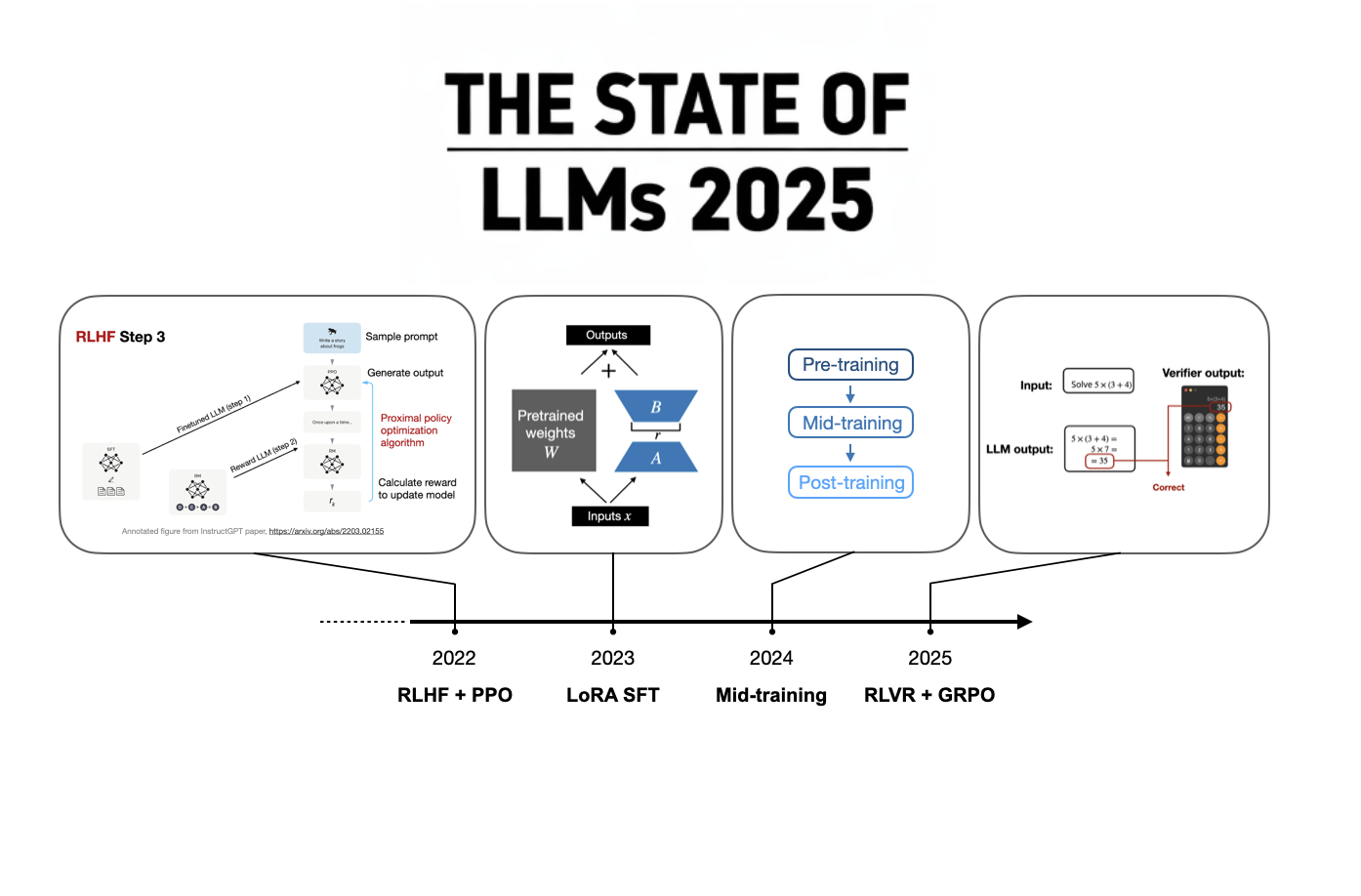
A 2025 review of large language models, from DeepSeek R1 and RLVR to inference-time scaling, benchmarks, architectures, and predictions for 2026.
The article explains how to transform a small open‑source Qwen LLM into a fast, single‑pass text classifier by replacing its language‑modeling head with a JEV model. It provides a step‑by‑step guide to swapping the head, enabling the LLM to perform classification tasks efficiently. The process leverages the flexibility of open‑source models to create a lightweight, high‑performance classifier.
The paper presents Qwenfant, a Qwen3-based model trained on concise parallel text for the 2026 BabyLM Challenge’s Multilingual track. By leveraging LLM-summarized and translated data, a larger model size, and a character-level vocabulary—both fine-tuned with LoRA—the authors achieve a top ranking in the competition.
The article discusses the rise of large language models (LLMs) and their growing influence on our decisions and actions. It explores the concept of agentic LLMs—LLMs that can act directly in the real world and interact with one another. The book aims to explain how these agentic LLMs function, their capabilities, and the implications for users.
arXiv:2610.19331v1 Announce Type: new Abstract: This paper presents LLM-jp-4, a family of Japanese sovereign large language models (LLMs) developed with an emphasis on transparency, reproducibility,...
The article introduces the concept of Agentic Large Language Models, which extend traditional LLMs by enabling them to act directly in the real world and interact with one another. It outlines how these agentic LLMs function, their mechanisms for action, and the implications of their capabilities for users. The discussion highlights the growing influence of LLMs on decision-making and explores the potential shifts in how we engage with AI tools.