The article discusses the rise of large language models (LLMs) and their growing influence on our decisions and actions. It explores the concept of agentic LLMs—LLMs that can act directly in the real world and interact with one another. The book aims to explain how these agentic LLMs function, their capabilities, and the implications for users.
arXiv:2608. 11215v1 Announce Type: new Abstract: Simulating societies of many large language model (LLM) agents is expensive, yet the questions asked of such simulations are usually macroscopic: phase behaviour, stylised facts, and scaling with the number of agents $N$, not the cognition of any single agent.
By Igor Itkin
The chapter discusses how large language models (LLMs) simplify the transformation of cultural material into analyzable variables and how LLM-driven agentic systems broaden machine assistance across research workflows. It examines key aspects of this emerging paradigm and its broader implications, arguing that LLMs increase scale, methodological diversity, and delegation while largely preserving the fundamental logic that underpins cultural measurement and claim formation.
By Andres Karjus
arXiv:2404. 02039v5 Announce Type: replace Abstract: Game environments provide rich, controllable settings that stimulate many aspects of real-world complexity.
By Sihao Hu, Tiansheng Huang, Gaowen Liu, Ramana Rao Kompella, Fatih Ilhan, Selim Furkan Tekin, Yichang Xu, Zachary Yahn, Ling Liu
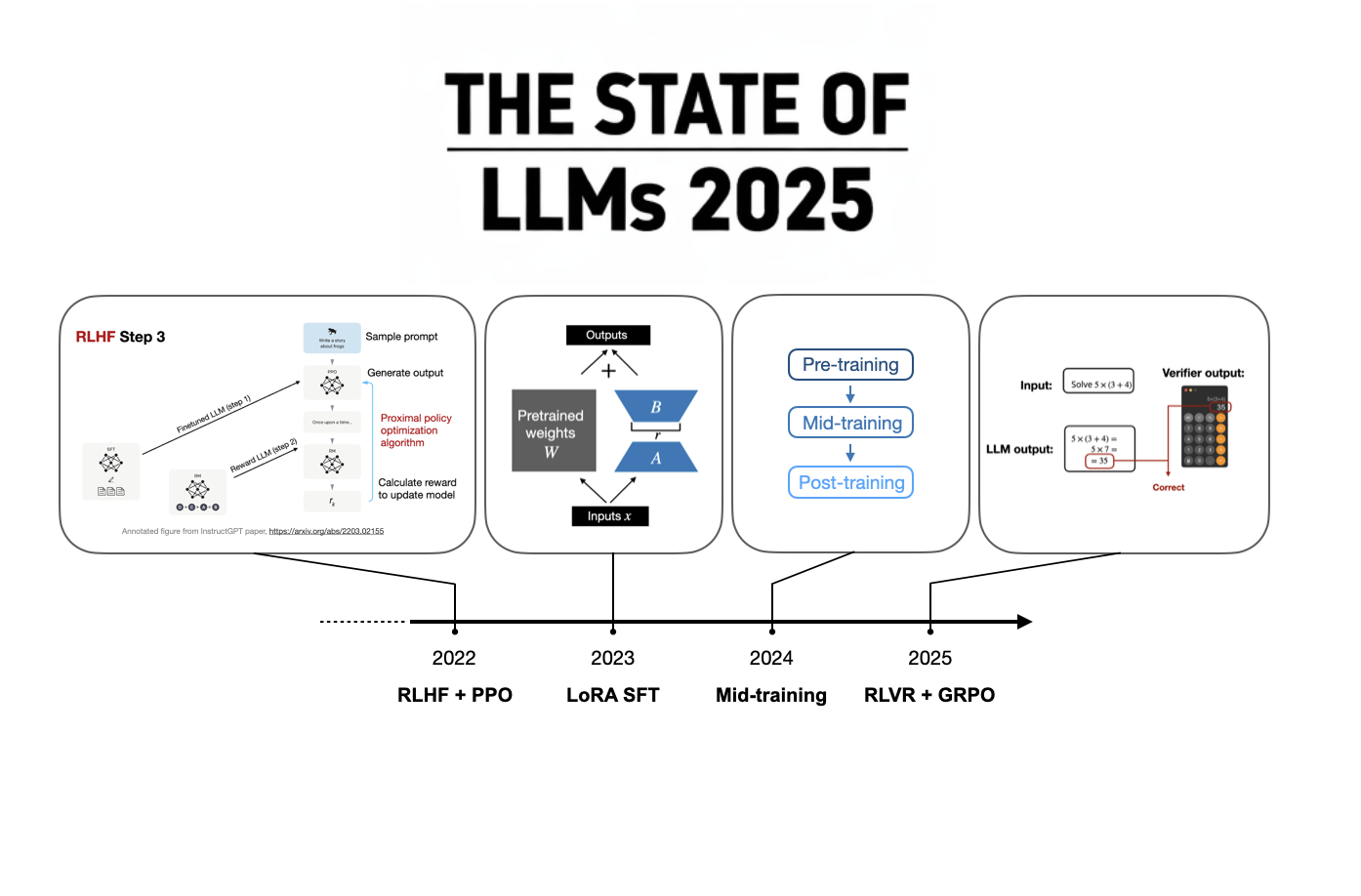
A 2025 review of large language models, from DeepSeek R1 and RLVR to inference-time scaling, benchmarks, architectures, and predictions for 2026.
By Sebastian Raschka, PhD