The article discusses the rise of large language models (LLMs) and their growing influence on our decisions and actions. It explores the concept of agentic LLMs—LLMs that can act directly in the real world and interact with one another. The book aims to explain how these agentic LLMs function, their capabilities, and the implications for users.
arXiv:2608. 11215v1 Announce Type: new Abstract: Simulating societies of many large language model (LLM) agents is expensive, yet the questions asked of such simulations are usually macroscopic: phase behaviour, stylised facts, and scaling with the number of agents $N$, not the cognition of any single agent.
By Igor Itkin
The chapter discusses how large language models (LLMs) simplify the transformation of cultural material into analyzable variables and how LLM-driven agentic systems broaden machine assistance across research workflows. It examines key aspects of this emerging paradigm and its broader implications, arguing that LLMs increase scale, methodological diversity, and delegation while largely preserving the fundamental logic that underpins cultural measurement and claim formation.
By Andres Karjus
arXiv:2404. 02039v5 Announce Type: replace Abstract: Game environments provide rich, controllable settings that stimulate many aspects of real-world complexity.
By Sihao Hu, Tiansheng Huang, Gaowen Liu, Ramana Rao Kompella, Fatih Ilhan, Selim Furkan Tekin, Yichang Xu, Zachary Yahn, Ling Liu
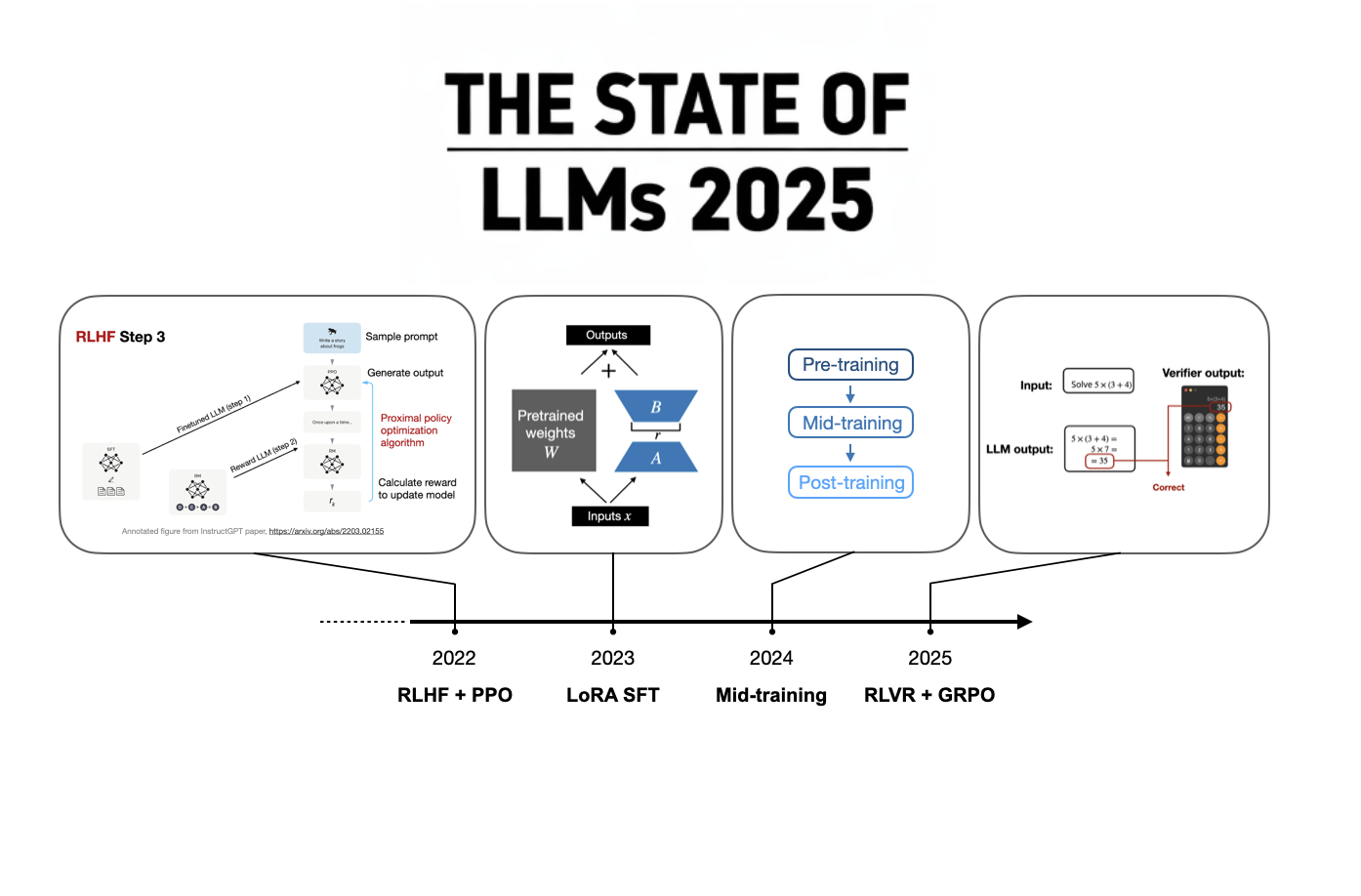
A 2025 review of large language models, from DeepSeek R1 and RLVR to inference-time scaling, benchmarks, architectures, and predictions for 2026.
By Sebastian Raschka, PhD
arXiv:2506. 12078v2 Announce Type: replace-cross Abstract: Understanding the dynamic evolution of complex social phenomena requires both high-fidelity modeling of human behavior and large-scale simulations.
By Haoxiang Guan, Jiyan He, Liyang Fan, Zhenzhen Ren, Shaobin He, Xin Yu, Yuan Chen, Xueyin Xu, Shuxin Zheng, Yan Gao, Enhong Chen, Tie-Yan Liu, Zhen Liu
arXiv:2607. 06757v1 Announce Type: new Abstract: Agent-based modeling (ABM) has the capability to model millions of individuals and their interactions, which is useful for policy making.
By Sifat Afroj Moon, Dakotah Maguire, Adam Spannaus, Joe Tuccillo, Maksudul Alam, Sudip K. Seal, John Gounley, Heidi Hanson
arXiv:2609.01491v1 Announce Type: cross
Abstract: The growing rate at which LLM agents interact with one another raises key questions about language evolution in multi-LLM-agent settings, with implic...
By Elias Stengel-Eskin, Newton Sander, Carlos Bonetti, Sasha Boguraev, James Bowler, Hale Sirin, Simon Kirby
arXiv:2610.03033v1 Announce Type: new
Abstract: Large language model (LLM)-based agents increasingly operate in multi-agent systems (MAS) characterised by strategic interaction. However, little is kn...
By Alessio Buscemi, Daniele Proverbio, Alessandro Di Stefano, The Anh Han, German Castignani, Pietro Li\`o
The paper introduces SILICA, an open instrument designed to evaluate whether large language model (LLM) agent societies replicate human behavioural distributions. Using five environments with human‑anchored data and perturbations, the study finds that most LLMs only match human behaviour at initial stages, failing to reproduce end‑state cooperation or correct acceptance thresholds. The results suggest that current LLM societies can support exploratory claims but do not yet reliably emulate human social dynamics.
By Raad Bin Tareaf