Towards Data Science
Jul 4
Setting Up Your Own Large Language Model
Still a long way to go, but the future is promising The post Setting Up Your Own Large Language Model appeared first on Towards Data Science .
The article explains how to transform a small open‑source Qwen LLM into a fast, single‑pass text classifier by replacing its language‑modeling head with a JEV model. It provides a step‑by‑step guide to swapping the head, enabling the LLM to perform classification tasks efficiently. The process leverages the flexibility of open‑source models to create a lightweight, high‑performance classifier.
Still a long way to go, but the future is promising The post Setting Up Your Own Large Language Model appeared first on Towards Data Science .
TypeSafe AI’s new model, Jev, is a ‘System One’ or decision model that takes text or semi‑structured data as input and outputs floating‑point probabilities for yes/no, choice, or score questions, rather than text. It charges only for input tokens ($0.042/million) and offers free output, making it cheaper and faster than typical LLMs. The API lets users build a state object (string, array, or key‑value pairs) and query it with multiple questions, receiving confidence scores and probability distributions for each answer.
The article "How to Fine-Tune an LLM: An End-to-End Guide" offers a practical, hands‑on walkthrough for fine‑tuning large language models in real‑world scenarios. It covers the entire process from data preparation to deployment, providing readers with actionable steps to adapt LLMs to specific tasks. The guide is aimed at practitioners looking to implement fine‑tuning in a structured, end‑to‑end manner.
The paper introduces SinLlama, the first decoder‑based open‑source large language model with explicit support for Sinhala. By extending Llama‑3‑8B, adding Sinhala‑specific tokenizer vocabulary, and performing continual pre‑training on a cleaned 10‑million‑token Sinhala corpus, the authors created a model that surpasses both the base and instruction‑fine‑tuned variants of Llama‑3‑8B on three text classification tasks. This work addresses the underrepresentation of low‑resource languages in open‑source LLMs.
How to stop parsing JSON by hand and start trusting your model's output The post Pydantic + OpenAI: The Cleanest Way to Get Structured Outputs from LLMs appeared first on Towards Data Science .
If you have ever wanted to actually build an LLM inference runtime yourself — pack your own weights, own every barrier, capture your own CUDA graphs — this is what that journey looks like on an H100. A step-by-step tour of a small runtime called annotated-llm-runtime, and the three bugs that produced most of the annotations.
Why use it? How to implement it?
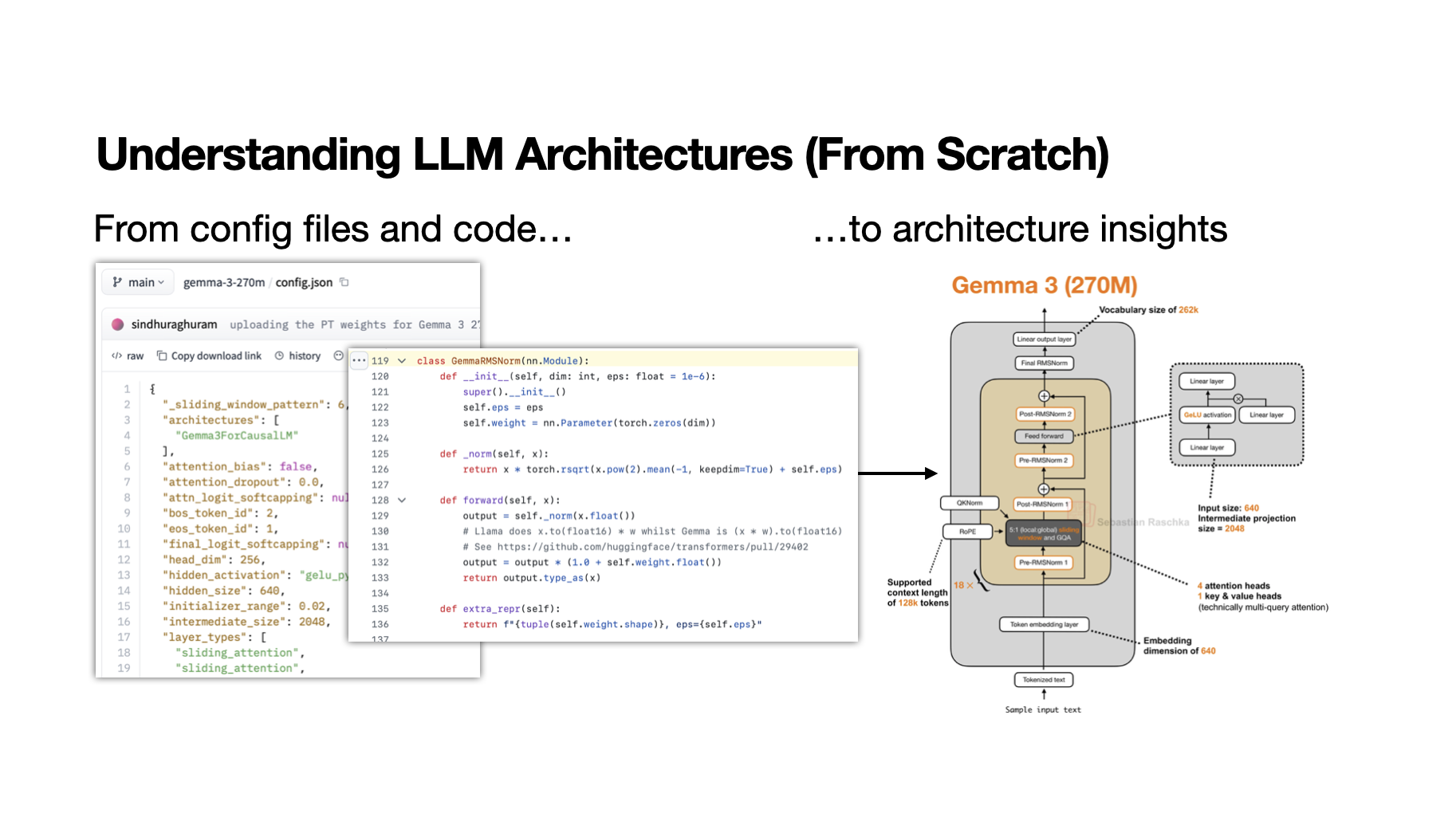
A learning-oriented workflow for understanding new open-weight model releases
Getting reliable, readable responses out of your LLM, and knowing which tool to reach for The post Structured Outputs with LLMs: JSON Mode, Function Calling, and When to Use Each appeared first on Towards Data Science .
arXiv:2604. 01206v2 Announce Type: replace-cross Abstract: We present RELISH (REgression with a Latent Iterative State Head), a novel, lightweight architecture designed for text regression with large language models.