The paper introduces “Persuasio”, a multi‑agent dialogue platform that uses a formal argumentation theory to adjudicate winners in free‑text debates. Using this system, the authors generated 192 debates on a UK political topic involving humans and large language models (LLMs), and evaluated 22 interlocutors through automated adjudication and 9,702 crowdsourced pairwise judgments across 1,386 annotation instances. The results show a consistent decoupling between subjective persuasiveness—where LLMs dominate—and formal argumentative strength—where humans remain competitive, with multi‑agent and retrieval‑augmented variants widening this gap.
By Jordan Robinson, Angus R. Williams, Katie Atkinson, Anthony G. Cohn
arXiv:2607. 02235v1 Announce Type: cross Abstract: LLM-as-a-Judge has become the dominant evaluation paradigm for many natural language generation tasks, due to shortcomings of conventional metrics and high correlations with human judgment, albeit mostly in English.
By A. Seza Do\u{g}ru\"oz, Xixian Liao, Verena Blaschke, Jakob Prange, Senyu Li, David Ifeoluwa Adelani
arXiv:2607.02235v2 Announce Type: replace-cross
Abstract: LLM-as-a-Judge has become the dominant evaluation paradigm for many natural language generation tasks (albeit mostly in English) due to short...
By A. Seza Do\u{g}ru\"oz, Xixian Liao, Verena Blaschke, Jakob Prange, Senyu Li, David Ifeoluwa Adelani
The paper investigates why large language models sometimes hallucinate when asked about facts in a language different from the one in which the facts were learned. By training small Transformer models on synthetic multilingual datasets, the authors show that the degree of correlation between facts and their learning language (informativeness) and the ease of language identification (extractability) determine whether models develop unified or separate representations across languages. Unified representations enable cross‑lingual fact transfer, while separate representations do not. The study proposes a unifying perspective on cross‑lingual transfer and suggests training methods to promote representational unification.
By Carter Blum, Katja Filippova, Ann Yuan, Asma Ghandeharioun, Julian Zimmert, Fred Zhang, Jessica Hoffmann, Tal Linzen, Martin Wattenberg, Lucas Dixon, Mor Geva
arXiv:2608. 09925v1 Announce Type: cross Abstract: Large language models are increasingly being deployed in governmental settings, yet few existing evaluation frameworks jointly reflect the values of public administration and the linguistic requirements of non-English contexts.
By Laurens Samson, Iva Gornishka, Gossa L\^o, Yuki M. Asano, Sennay Ghebreab
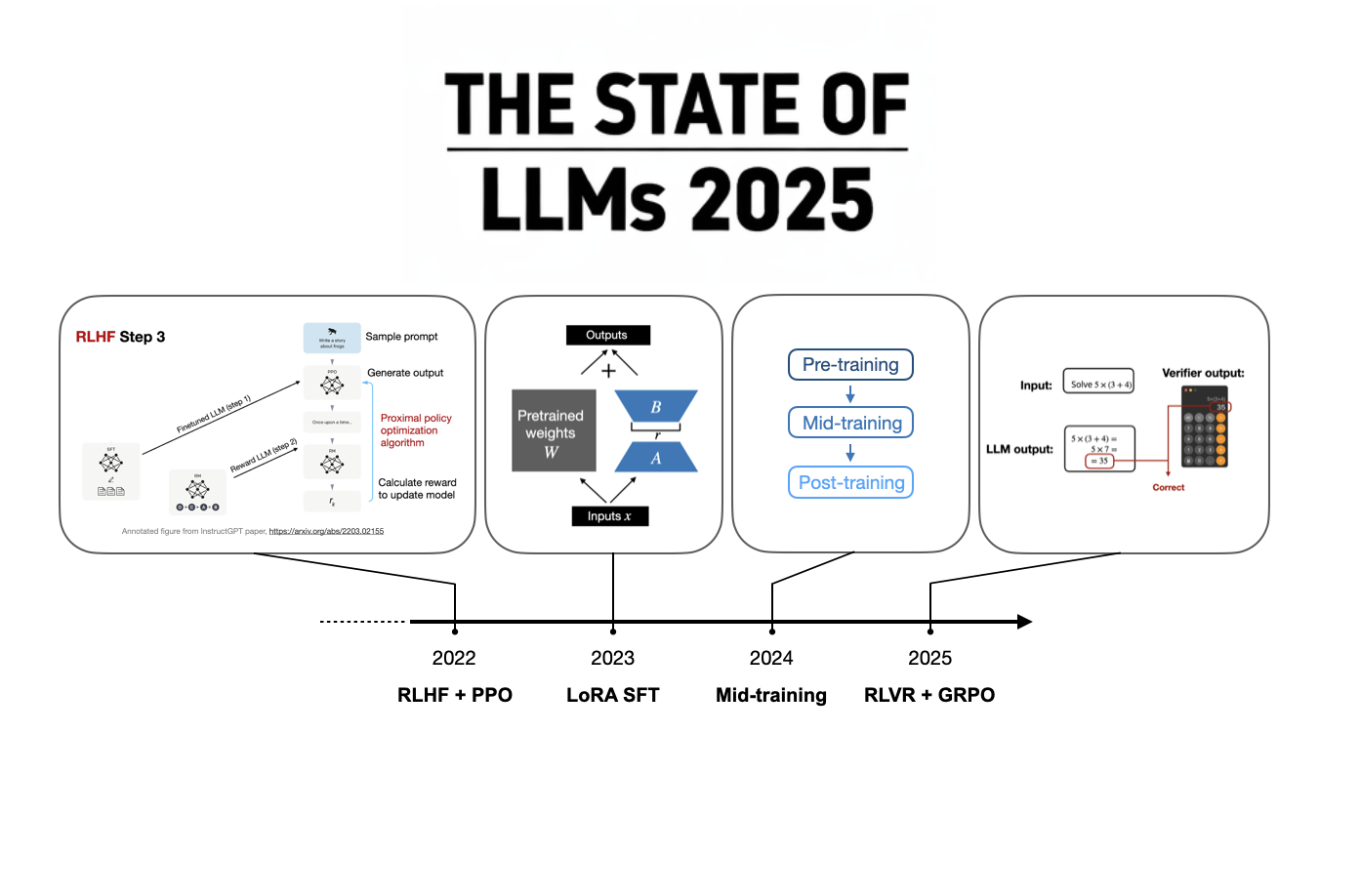
A 2025 review of large language models, from DeepSeek R1 and RLVR to inference-time scaling, benchmarks, architectures, and predictions for 2026.
By Sebastian Raschka, PhD
arXiv:2601. 04387v2 Announce Type: replace Abstract: Negotiation is a core component of social intelligence, requiring agents to balance strategic reasoning, cooperation, and social norms.
By Stuti Sinha, Himanshu Kumar, Aryan Raju Mandapati, Rakshit Sakhuja, Dhruv Kumar
arXiv:2606. 01736v1 Announce Type: cross Abstract: As LLMs are increasingly used to draft public-facing arguments, they may flatten public debate by repeatedly introducing the same polished, plausible arguments.
By Yekyung Kim, Yapei Chang, Chau Minh Pham, Mohit Iyyer
We evaluate large language models (LLMs) as language agents playing goal-directed dialogue games in self-play across 30 languages: the 24 official EU languages plus six others. Unlike static or preference-based evaluation, this paradigm is multi-turn, reference-free and programmatically scored, and because the game mechanics are language-agnostic it extends to a new language by localising a fixed set of prompt and word-list files.
arXiv:2606. 01800v1 Announce Type: cross Abstract: Large language models (LLMs) have excelled in processing multiple languages through pre- and post-training on multilingual data, even though English dominates the training data.
By Haruki Sakajo, Yusuke Sakai, Hidetaka Kamigaito, Taro Watanabe