arXiv:2409. 06067v3 Announce Type: replace Abstract: Previous studies on federated learning (FL) often encounter performance degradation due to data heterogeneity among different clients.
By Jianyi Zhang, Hao Frank Yang, Ang Li, Xin Guo, Pu Wang, Haiming Wang, Yiran Chen, Hai Li
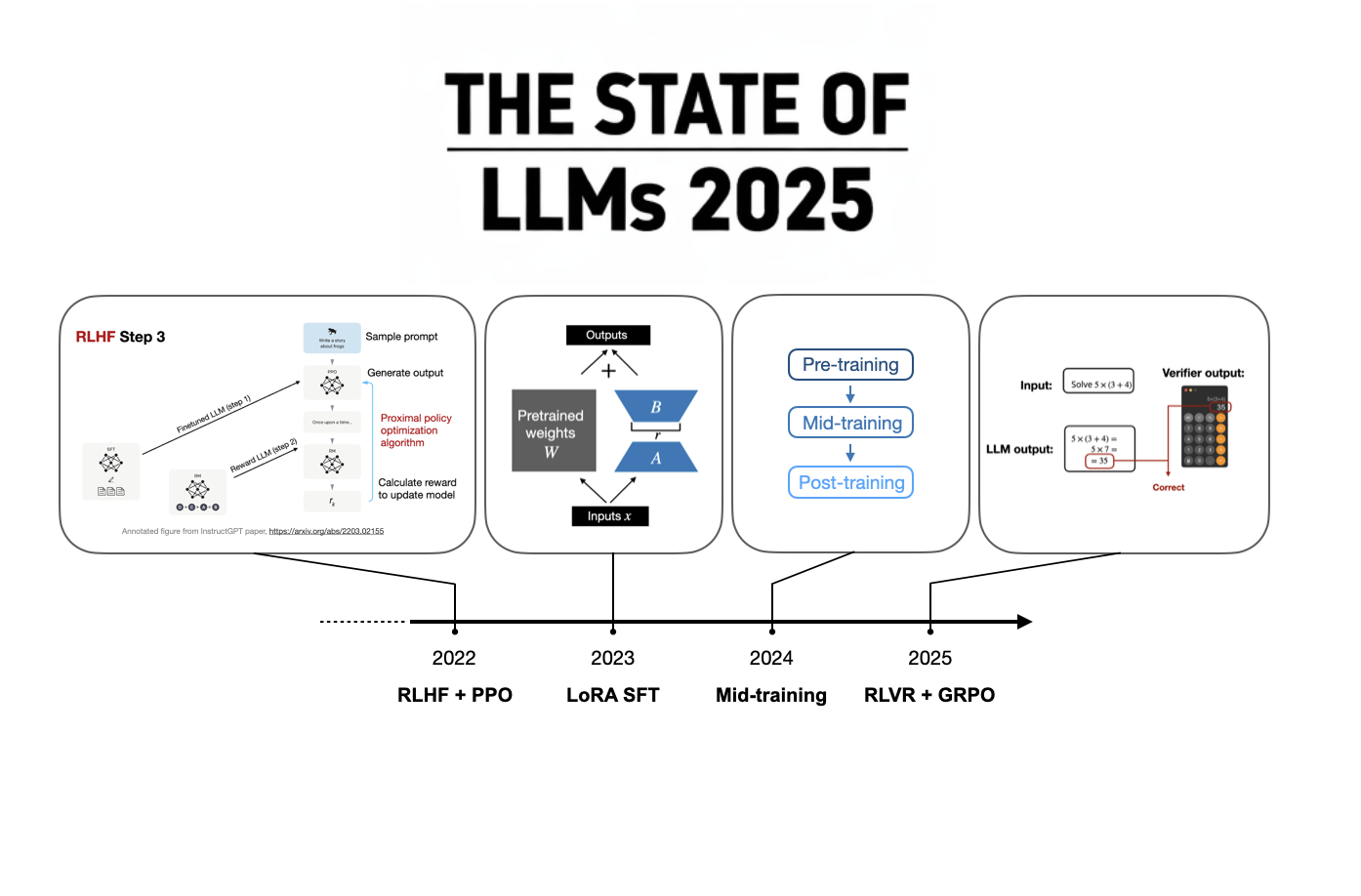
A 2025 review of large language models, from DeepSeek R1 and RLVR to inference-time scaling, benchmarks, architectures, and predictions for 2026.
By Sebastian Raschka, PhD
arXiv:2608. 19726v1 Announce Type: cross Abstract: The typical training process of a multimodal large language model (MLLM) involves adapting both the language model backbone and the projector between the backbone and a modality-specific encoder.
By Nyx Iskandar, Saathvik Selvan, Slater Victoroff
arXiv:2505. 12741v3 Announce Type: replace Abstract: Language models are increasingly used not only as standalone predictors but also as components in larger inference systems, from test-time scaling to multi-agent collaboration.
By Shiguang Wu, Yaqing Wang, Quanming Yao
arXiv:2610.19247v1 Announce Type: new
Abstract: Transformers are intuitively considered to be efficient at copying from their inputs. We actually show that the ability of LLMs to copy in context can...
By Nathan Godey, Yoav Artzi
arXiv:2406. 19892v5 Announce Type: replace Abstract: This article presents multilingual deep learning models for identifying web registers -- text varieties such as news reports and discussion forums -- across 16 languages.
By Erik Henriksson, Amanda Myntti, Saara Hellstr\"om, Anni Eskelinen, Selcen Erten-Johansson, Veronika Laippala
SharedSAE demonstrates that a single sparse autoencoder can replace multiple model‑specific SAEs by using a shared dictionary with model‑specific encoder‑decoder pairs. It preserves activation magnitudes, normalizes only selection scores, and supports single‑model inference via model dropout. Trained on four 1B‑scale language models, SharedSAE retains 96.6% of the mean explained variance of dedicated SAEs, shows higher cross‑model latent correlations, and allows efficient adaptation of new models to the shared latent space.
By Daniil Ognev, C\'elian Vasson, Lijie Hu, Kentaro Inui, Benjamin Heinzerling
arXiv:2610.33005v1 Announce Type: new
Abstract: Energy-based models have shown promising properties for domain-specific tasks but remain challenging in modeling general-purpose scenarios. To bridge t...
By Yuan Pu, Yudong Lu, Ting Wang, Zhicong Hong, Qinuo Li, Xuansheng Wu, Na Zou, Xia Hu, Guanchu Wang
arXiv:2608. 09521v1 Announce Type: new Abstract: Activation-based tools are usually tied to one model's native hidden space, requiring probes, sparse autoencoders, and natural-language interpreters to be rebuilt or rediscovered for each new language model.
By Su-Hyeon Kim, Jiwan Mun, Yo-Sub Han