Sebastian Raschka
Apr 4
Components of A Coding Agent
How coding agents use tools, memory, and repo context to make LLMs work better in practice
Code agents increasingly work on evolving real repositories, and memory systems aim to help them reuse earlier experience. However, such experience is diverse and evolving, so it remains unclear how m...
Simon Willison reflects on his experience with coding agents, noting that while they enable impressive feats, they also complicate software engineering. He emphasizes that fully harnessing their capabilities demands exceptional discipline and deep knowledge. The article highlights the dual nature of coding agents as both powerful tools and challenging additions to development workflows.
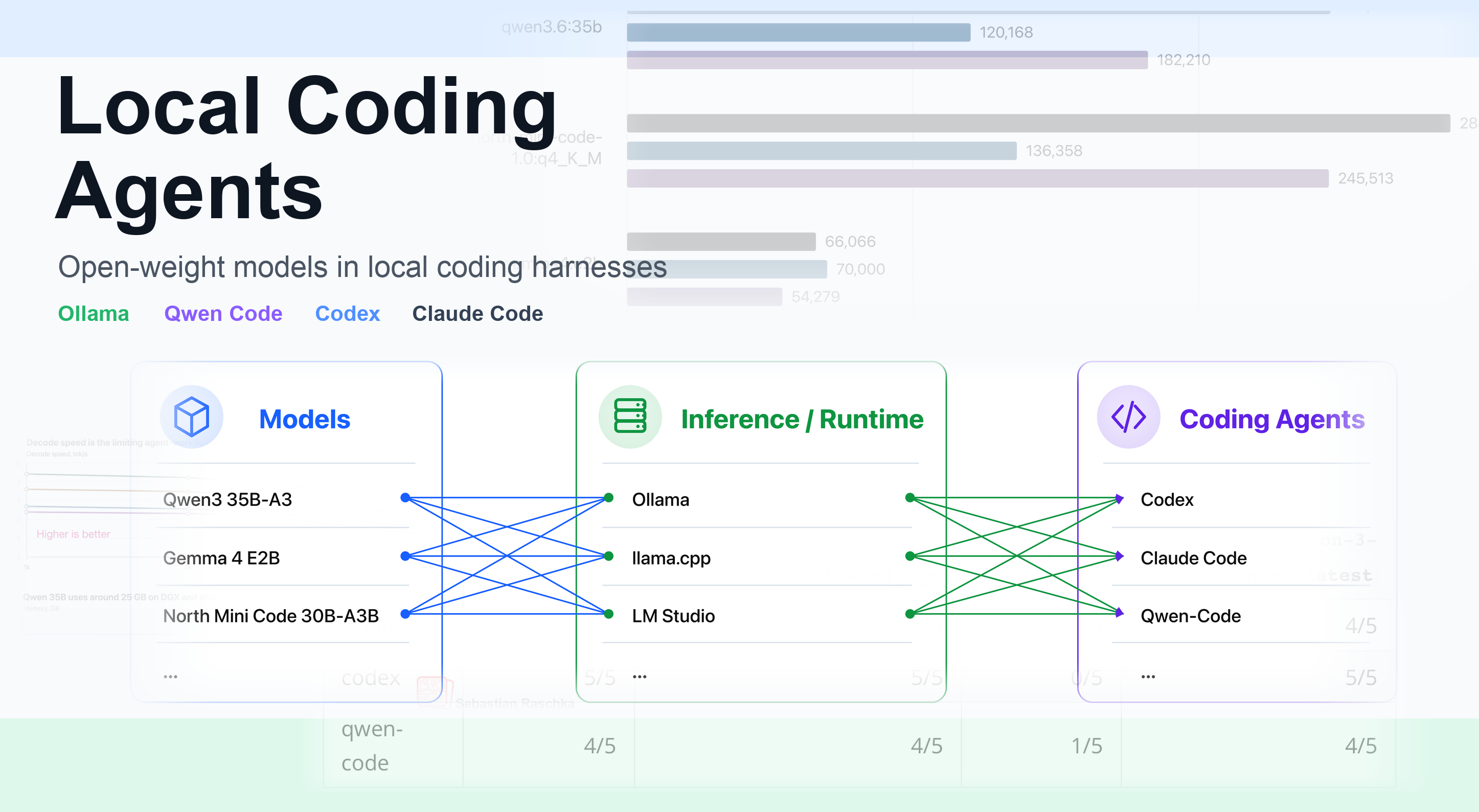
Using Open-Weight Models in Local Coding Harnesses as an Alternative to Claude Code and Codex Subscriptions
arXiv:2608.31057v1 Announce Type: new Abstract: Agent working memory is heterogeneous. Objects such as instructions, artifacts, tool outputs, and agent-generated state play different semantic roles a...
MemDev-Bench is a new benchmark that evaluates how memory systems influence code agents across diverse repository histories. It pairs each task with relevance‑annotated earlier tasks from the same repository, creating 4,869 historical tasks for 555 base tasks and an automated pipeline that ensures these tasks are executable and verifiable. The study finds that memory mainly improves fine‑grained localization and editing, but can also cause failures when agents reuse memory without reassessing its applicability, and that providing raw historical trajectories reduces steps more effectively than compressed memories.