Mistral AI
Upgrading agentic coding capabilities with the new Devstral models
Read the original on Mistral AI →The Flow has not summarised this story yet — read it at Mistral AI.
The Flow has not summarised this story yet — read it at Mistral AI.
arXiv:2606. 17799v1 Announce Type: cross Abstract: Coding agents have become a major mode of software engineering, but the benchmarks we use to compare them were designed in a pre-agent era: they collapse model, harness, and environment into a single end-to-end score, typically computed against one reference solution, with no component-level signal for iteration.
Simon Willison reflects on his experience with coding agents, noting that while they enable impressive feats, they also complicate software engineering. He emphasizes that fully harnessing their capabilities demands exceptional discipline and deep knowledge. The article highlights the dual nature of coding agents as both powerful tools and challenging additions to development workflows.
arXiv:2609.40303v1 Announce Type: new Abstract: Recent autonomous machine learning engineering (MLE) agents have made significant progress on public leaderboards. Often motivated by progress stagnati...
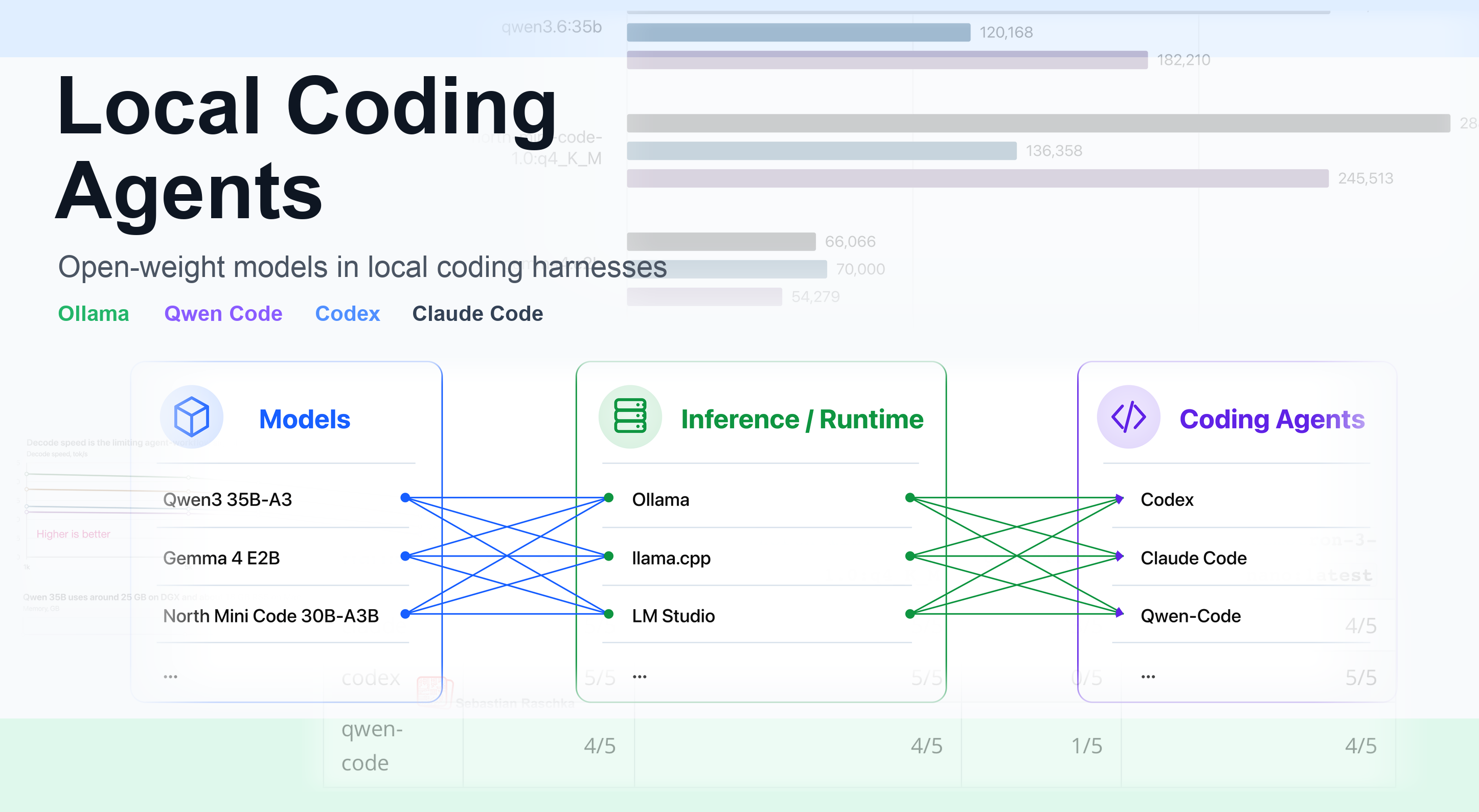
Using Open-Weight Models in Local Coding Harnesses as an Alternative to Claude Code and Codex Subscriptions
The paper introduces LibraryDesignBench, a benchmark that tests how well agents can design reusable libraries from specifications without prescribed designs. It evaluates libraries by measuring the correctness and simplicity of programs written by three different user agents across 242 programming problems in four languages. Findings show that while agents often replicate human-designed abstractions, downstream agents still tend to reimplement library features due to rigidity or usability issues, and that providing more prescriptive guidance improves reuse and program simplicity.