Hugging Face Blog
May 9, 2023
arXiv:2610.28160v1 Announce Type: cross Abstract: Programmable Logic Controller (PLC) coding remains a manual, IDE-centric task that demands constant context switching between documentation, project...
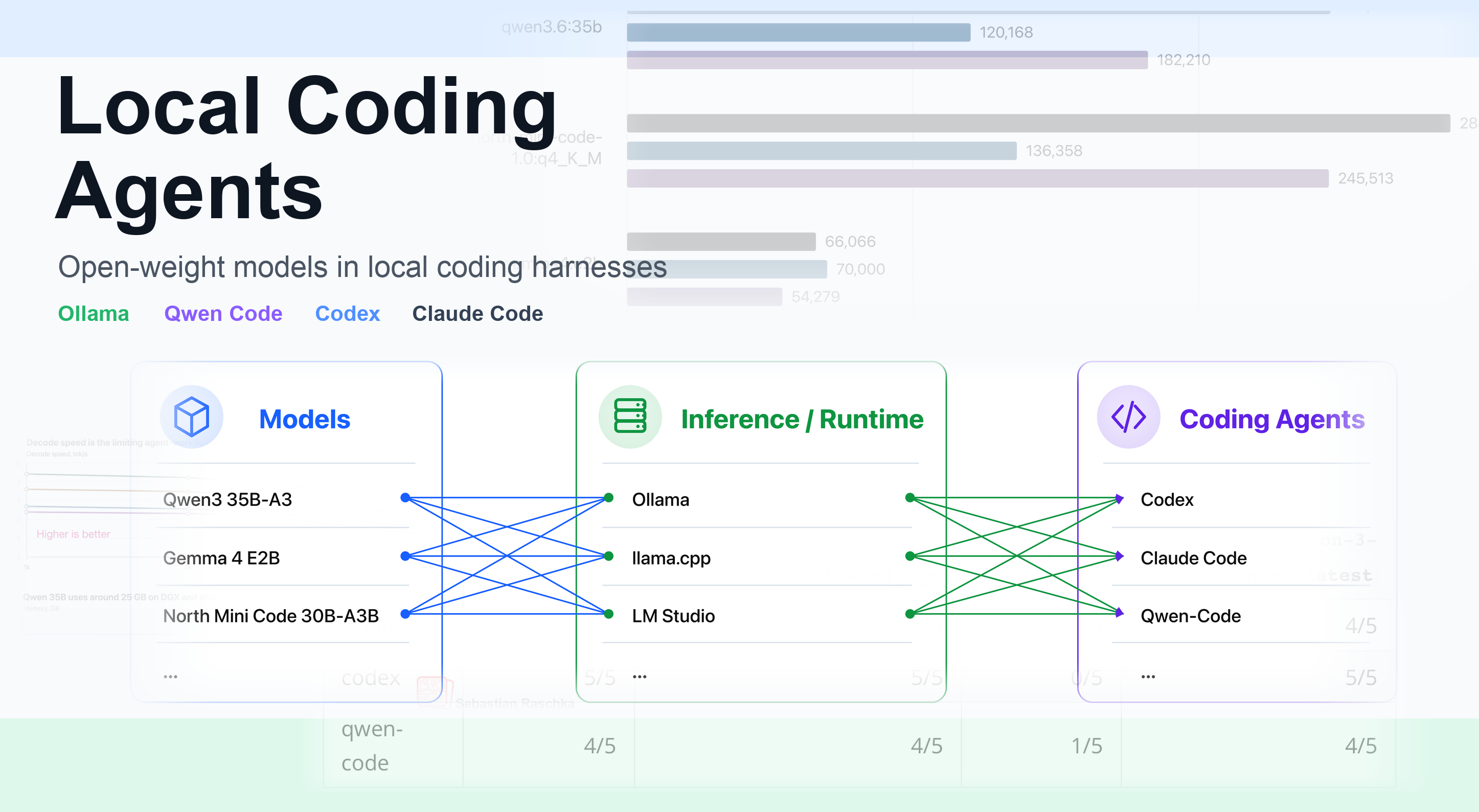
Using Open-Weight Models in Local Coding Harnesses as an Alternative to Claude Code and Codex Subscriptions
SWE-Journey is a new benchmark designed to evaluate coding assistants in more realistic settings, focusing on long-horizon tasks and multi-turn interactions. It introduces a weak-to-strong synthesis pipeline to create extended coding challenges and a user-simulation agent based on four real user personas to mimic authentic code-assistance dialogues. The benchmark reveals that while models succeed on over 75% of tests with software architects, they manage less than 25% with non-coders, highlighting a significant gap in current assistant capabilities.
Learn how to build and use custom GPTs to automate workflows, maintain consistent outputs, and create purpose-built AI assistants.
A USAF cadet and a Lincoln Laboratory researcher found AI chatbots can help nontechnical service members produce viable software applications for their unique problems.
The paper shows that a small transformer can learn to execute programs written in MicroPy, a simplified yet computationally universal language. By training on randomly generated MicroPy programs, the model learns to predict small‑step execution using PENCIL scaffolding, enabling efficient evaluation within a bounded context window. The transformer generalizes to unseen human‑written programs—including tasks such as bit copying, binary arithmetic, and SAT solving—and even to programs from a different distribution, demonstrating out‑of‑distribution performance.
arXiv:2606. 31980v1 Announce Type: cross Abstract: Agents are increasingly capable of automating software tasks, but can they teach humans how to use software themselves?
arXiv:2608.24644v1 Announce Type: cross Abstract: This paper introduces an environment for constructing literate programs in concert with language-aware machine agents. This environment includes a gr...