The paper demonstrates that Large Language Models, despite their non‑linear components, exhibit a fundamental linearity property: when inputs from two distinct text streams are linearly combined, the model outputs a superposition of the individual next‑token distributions. This "Superposition Linearity Hypothesis" appears to be an intrinsic feature of the Transformer architecture, tends to weaken during pretraining, but can be largely restored with lightweight fine‑tuning. The authors also present a guided decoding method that separates the superposed outputs, allowing two coherent continuations to be generated from a single forward pass.
By Pavel Tikhonov, Anton Korznikov, Matvey Mikhalchuk, Nikita Dragunov, Temurbek Rahmatullaev, Polina Druzhinina, Anton Razzhigaev, Ivan Oseledets, Elena Tutubalina
arXiv:2607. 11760v1 Announce Type: new Abstract: A theoretical understanding of Transformers is crucial to better understand the capacities and limitations of large language models (LLMs).
By Michael Rizvi-Martel, Satwik Bhattamishra, Guillaume Rabusseau, Michael Hahn
The paper introduces dQwen3.5, a family of diffusion language models derived from the hybrid-attention architecture of Qwen3.5 at 0.8B, 2B, 4B, and 9B parameters. It demonstrates that adapting a hybrid backbone—combining attention and RNN layers—can be more efficient than full-attention models, reaching a target training loss in roughly half the tokens. Across scales, dQwen3.5 exhibits full-attention-like behavior in any-order decoding and strong performance with parallel decoding.
By Anton Xue, Litu Rout, Aditya Akella, Adam Klivans, Sujay Sanghavi, Sanjay Shakkottai
The paper introduces TANGO, a Token‑Aggregated Nonlinear Gating Operator that blends cross‑token mixing and token‑wise transformation in transformer architectures. By computing a nonlinear gate per source token and averaging these gates for each destination, TANGO forms a source‑conditioned linear operator that improves predictive performance. Experiments on web text, formal mathematics, and code show that full‑prefix TANGO achieves the lowest test negative log‑likelihood across 16 settings, while a narrower variant offers substantial throughput gains with only a modest increase in loss.
By Joshua Nunley
The paper introduces dQwen3.5, a family of diffusion language models derived from the hybrid-attention architecture of Qwen3.5 at 0.8B, 2B, 4B, and 9B parameters. It demonstrates that adapting a hybrid AR backbone—combining attention and RNN layers—can be more efficient than full-attention models, reaching a target training loss in roughly half the tokens. Across scales, dQwen3.5 exhibits full-attention-like behavior in any‑order decoding and strong performance under parallel decoding.
The paper introduces LLM-Microscope, a toolkit for measuring how Large Language Models encode contextual information at the token level. It shows that seemingly minor tokens—such as determiners, stopwords, and punctuation—carry surprisingly high contextual weight, and removing them degrades performance on benchmarks like MMLU and BABILong-4k. The study also finds a strong link between contextualization and linearity, indicating that the transformation between layers can be approximated by a single linear mapping when tokens are well contextualized.
By Anton Razzhigaev, Matvey Mikhalchuk, Temurbek Rahmatullaev, Elizaveta Goncharova, Polina Druzhinina, Ivan Oseledets, Andrey Kuznetsov
arXiv:2607. 15893v1 Announce Type: cross Abstract: While the internal mechanisms of autoregressive (AR) transformers have been studied extensively, much less is known about diffusion language models (DLMs), an emerging alternative that generates text by iterative denoising.
By Andy Catruna, Emilian Radoi
arXiv:2511. 15927v4 Announce Type: replace-cross Abstract: Diffusion language models (DLMs) have emerged as a promising alternative to autoregressive (AR) generation, yet their reliance on Transformer backbones limits inference efficiency due to quadratic attention or KV-cache overhead.
By Vaibhav Singh, Oleksiy Ostapenko, Pierre-Andr\'e No\"el, Eugene Belilovsky, Torsten Scholak
arXiv:2608. 11249v1 Announce Type: cross Abstract: We study the problem of lossless text compression, motivated by the rapid growth in the collection and storage of digital textual data - including plain text, source code, and structured formats such as XML - and by recent advances in neural language model-based compression.
By Angelo Nardone, Paolo Ferragina
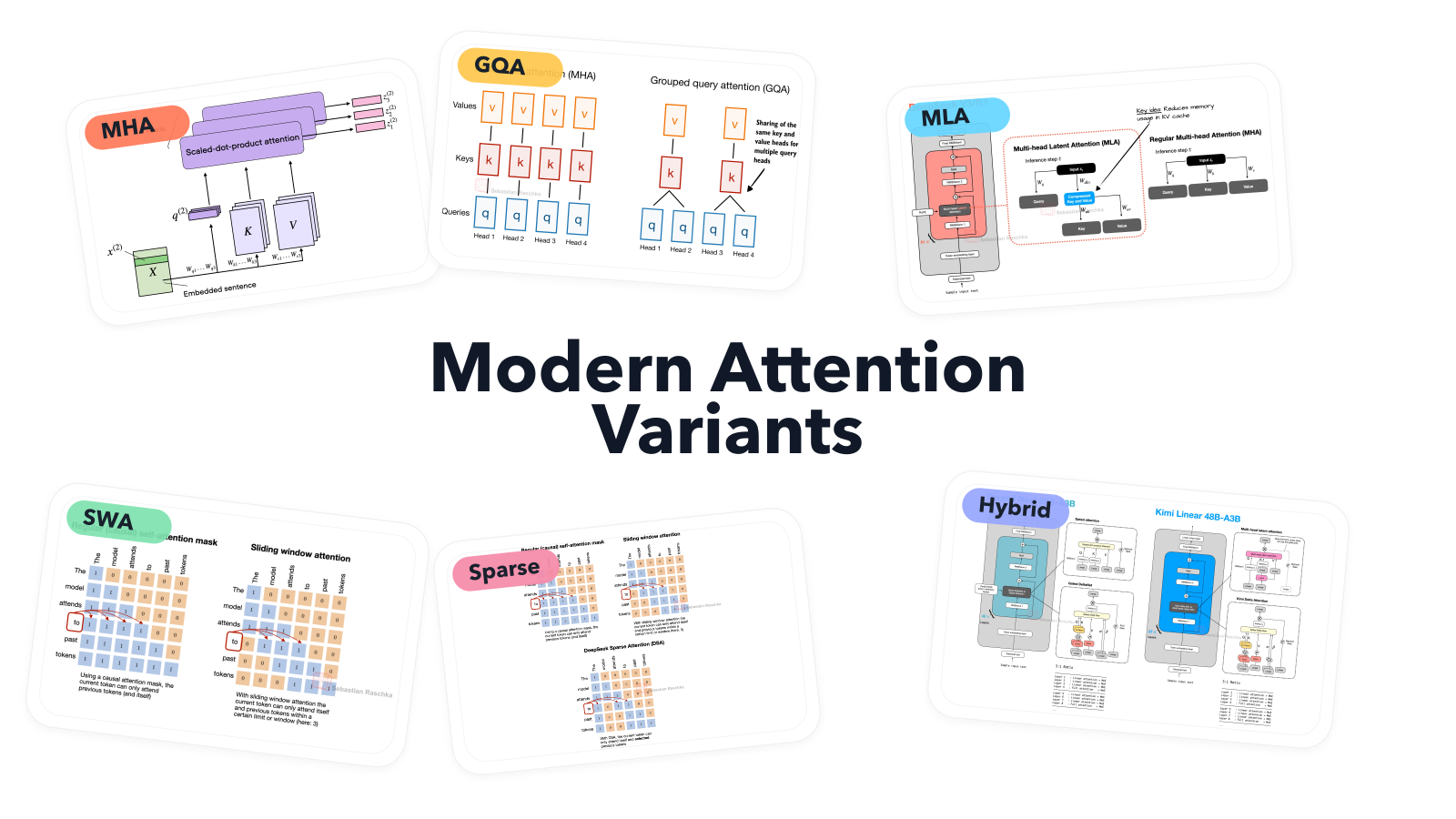
From MHA and GQA to MLA, sparse attention, and hybrid architectures
By Sebastian Raschka, PhD
arXiv:2604. 01206v2 Announce Type: replace-cross Abstract: We present RELISH (REgression with a Latent Iterative State Head), a novel, lightweight architecture designed for text regression with large language models.
By Yiheng Su, Matthew Lease