arXiv:2605. 28066v2 Announce Type: replace-cross Abstract: Large Language Models (LLMs) have demonstrated remarkable efficacy in text embedding, yet current adaptation methods like LoRA face significant bottlenecks in computational efficiency and cross-architecture transferability.
By Yu-Che Tsai, Kuan-Yu Chen, Yuan-Hao Chen, Yu-Han Chang, Ching-Yu Tsai, Yu-Hsiang Chuang, Shou-De Lin
The paper proposes replacing dense output projection in large language models with an HNSW-based vector index to perform maximum inner product search over token embeddings. This approach reduces memory bandwidth usage by retrieving only a small set of high-scoring tokens and can be integrated into existing decoding pipelines via sparse logits scattering. Experiments on Gemma 3, Llama 3.2, and Qwen 3 show up to 82% speed‑up in batch‑size‑one decoding while maintaining generation quality.
By Martin Loretz, Sepp Hochreiter
arXiv:2607. 13425v1 Announce Type: cross Abstract: Learning effectively from limited data is critical in domains like security where labeled examples are scarce.
By Tuomas Oikarinen, Zixiao Chen, Charlotte Siska, Tsui-Wei Weng, Chandan Singh, Jianfeng Gao
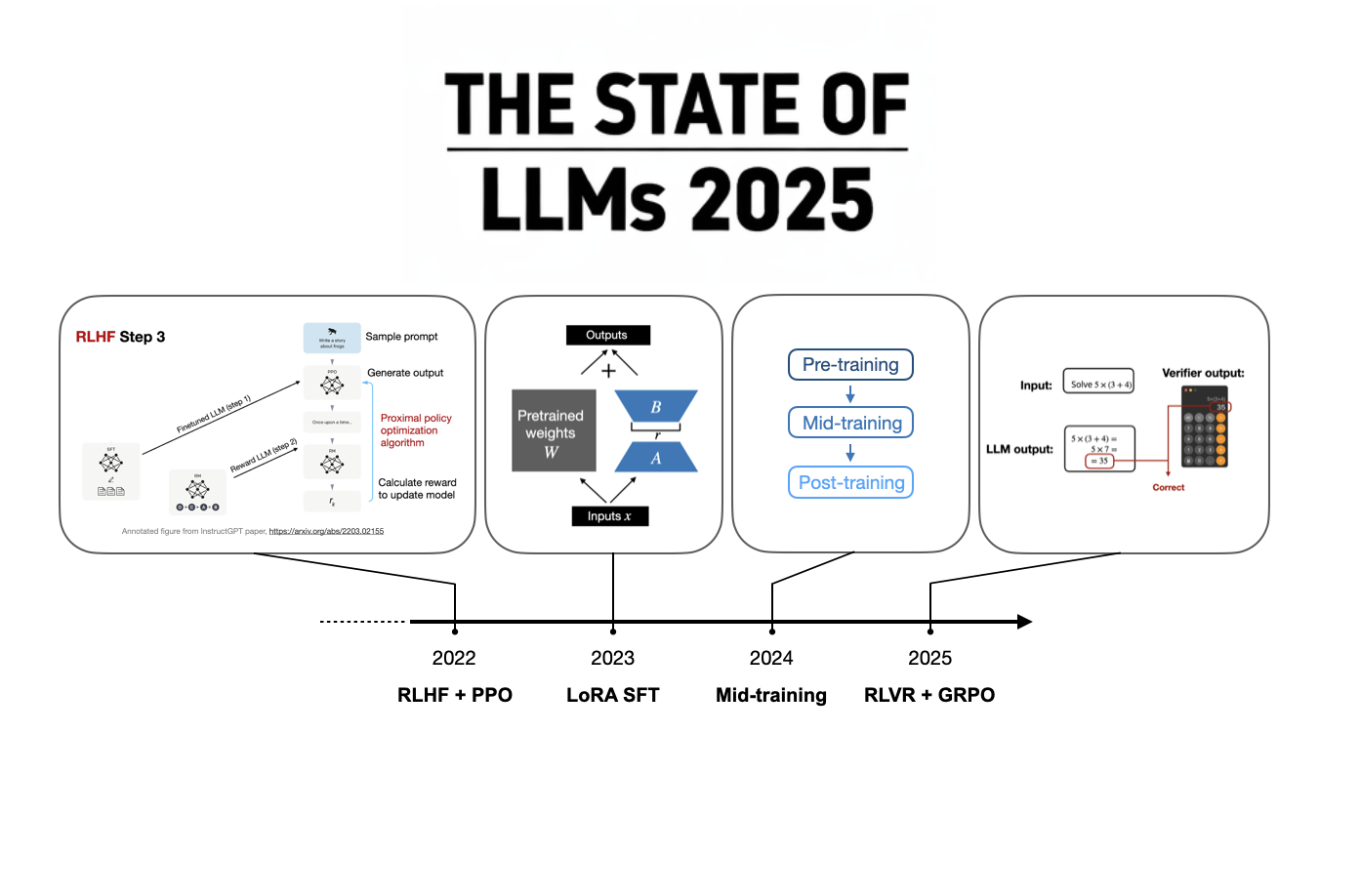
A 2025 review of large language models, from DeepSeek R1 and RLVR to inference-time scaling, benchmarks, architectures, and predictions for 2026.
By Sebastian Raschka, PhD
arXiv:2607. 18302v1 Announce Type: new Abstract: Autoregressive language models are least accurate at the beginning of a sequence, where little context forces reliance on a generic pretraining prior.
By Ye Qiao
The paper investigates whether adding Abstract Meaning Representation (AMR) data to large language models (LLMs) improves performance on downstream tasks. By reproducing recent studies and applying a consistent hyperparameter protocol, the authors find that text-only baselines match or surpass AMR-augmented models. A perplexity-based probe shows that AMR does not provide LLMs with additional relational knowledge, suggesting no clear benefit from AMR augmentation.
By Hoa Quynh Nhung Nguyen, Jacopo Staiano, Michael Sullivan
Osprey is a target‑agnostic pre‑training method that bootstraps draft models for speculative decoding from existing small language models. By pruning to a shallow backbone, restoring language‑modeling capability with next‑token pretraining, and adapting via vocabulary alignment and distillation, Osprey reduces per‑target work to a lightweight adaptation step. Experiments show that a single Osprey backbone improves mean acceptance length by up to 22.7% and increases tokens per second by 17.5% across several large target models, especially on out‑of‑domain and multilingual data.
By Fengxiang Bie, Yuqing Jian, Yifan Yu, Zhongzhu Zhou, Zelei Shao, Ben Athiwaratkun, Shuaiwen Leon Song, Chenfeng Xu, Xiaoxia Wu, Tianyi Zhang
arXiv:2609.06557v1 Announce Type: new
Abstract: Large language models (LLMs) are often considered fragile under aggressive sparsification, and maintaining reliable performance typically requires stic...
By Hyeondo Jang, Kwanhee Lee, Dongyeop Lee, Namhoon Lee
arXiv:2607. 05316v1 Announce Type: cross Abstract: Large language models generate one token at a time, yet their responses show remarkably consistent length structure: step-by-step solutions converge in predictable token counts, retrievals stop after a few sentences, retractions extend responses by measurable amounts.
By Mohamed Amine Merzouk, Dmitri Carpov, Mirko Bronzi, Damiano Fornasiere, Adam Oberman
arXiv:2511. 05963v4 Announce Type: replace Abstract: Transformers replace recurrence with a memory that grows with sequence length and self-attention that enables ad-hoc lookups over past tokens.
By Jayden Teoh, Manan Tomar, Kwangjun Ahn, Edward S. Hu, Tim Pearce, Pratyusha Sharma, Akshay Krishnamurthy, Riashat Islam, Alex Lamb, John Langford
arXiv:2605. 25475v2 Announce Type: replace-cross Abstract: Large Language Models (LLMs) are increasingly expected to operate over long contexts, yet standard softmax attention incurs a KV cache that grows linearly with sequence length, quickly becoming the bottleneck for long context inference.
By Xintong Yang, Hao Gu, Binxing Xu, Lujun Li, Bei Liu, Jiacheng Liu, Qiyuan Zhu, Yike Guo, Sirui Han
arXiv:2607. 11889v1 Announce Type: cross Abstract: Large language models trained on unrestricted internet corpora inevitably embed information from the future, introducing lookahead bias that compromises the validity of backtests and causal inference in finance and the social sciences.
By Bryan Kelly, Semyon Malamud, Johannes Schwab, Teng Andrea Xu