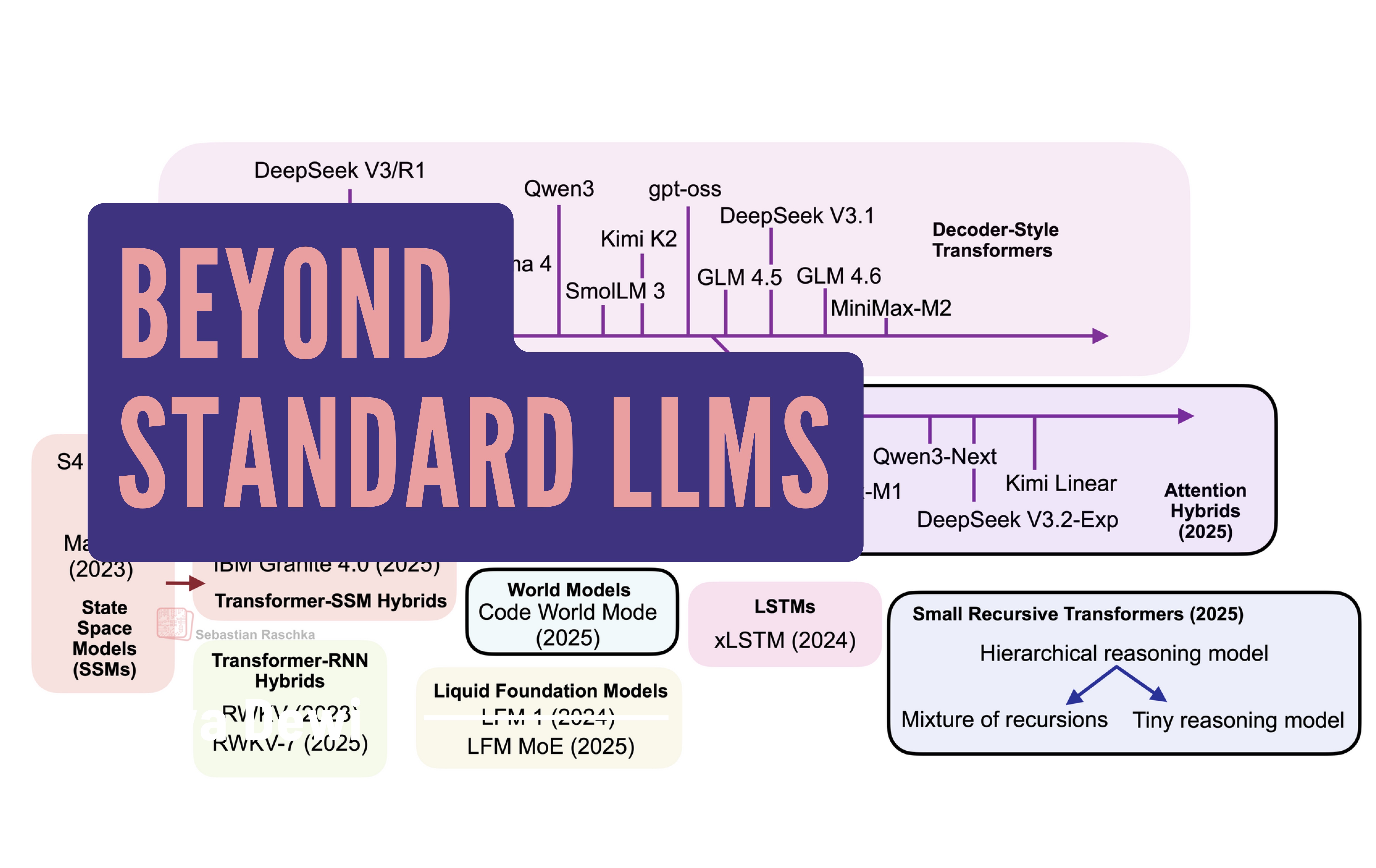
Linear Attention Hybrids, Text Diffusion, Code World Models, and Small Recursive Transformers
By Sebastian Raschka, PhD
arXiv:2606. 05843v1 Announce Type: cross Abstract: While Multimodal Large Language Models (MLLMs) demonstrate remarkable proficiency on complex vision-language tasks, the mechanisms by which they extract query-relevant visual features from complex, noisy contexts remain opaque.
By Ruoxi Sun, Quantong Qiu, Juntao Li, Zecheng Tang, Yihang Lou, Min Zhang
arXiv:2606. 15378v1 Announce Type: cross Abstract: Modern language models increasingly adopt hybrid architectures that combine full attention with efficient attention modules, such as sliding-window attention (SWA) and recurrent sequence mixers.
By Ziqing Qiao, Yinuo Xu, Chaojun Xiao, Zhou Su, Zihan Zhou, Yingfa Chen, Xiaoyue Xu, Xu Han, Zhiyuan Liu
arXiv:2508. 16771v3 Announce Type: replace-cross Abstract: Code Language Models (CodeLLMs) learn token importance from data correlations, whereas human developers attend selectively to semantically salient code.
By Yifan Zhang, Chen Huang, Yueke Zhang, Jiahao Zhang, Toby Jia-Jun Li, Collin McMillan, Kevin Leach, Yu Huang
The paper investigates how the topology of attention graphs can differentiate hallucinated from non-hallucinated responses in large language models. By analyzing Forman-Ricci curvature, the authors identify structural bottlenecks and develop a method that captures both semi-local and global information-flow characteristics of attention heads associated with hallucinations. Extensive evaluation across multiple LLMs and benchmarks shows that this single-pass approach consistently outperforms existing attention-based and multi-response baselines, while also revealing that impaired context sharing—such as over-reliance on self-attention and information over-squashing—correlates strongly with hallucination occurrences.
By Amir Jalilifard, Anderson Rocha, Eric Wong, Marcos Medeiros Raimundo
RAVE (Re-Allocating Visual Attention) is a lightweight pair‑gating mechanism that adds a learned query‑key bias to pre‑softmax attention scores over visual keys, derived from pre‑RoPE query and key features. It requires no architectural changes to the backbone and can be trained end‑to‑end with the rest of the model. Across multiple multimodal benchmarks, RAVE improves standard attention by an average of 3 points, especially on perception‑intensive tasks such as multilingual OCR, chart understanding, document VQA, and scene text VQA.
By Xi Leng, Xinhong Ma, Ziqiang Dong, Feng Zhang, Xiaoying Tang, Yang Yang, Guanjun Jiang