arXiv:2606. 06943v1 Announce Type: cross Abstract: Vision-language models (VLMs) such as CLIP achieve strong zero-shot recognition but remain highly fragile under adversarial perturbations.
By Sunoh Kim, Daeho Um
arXiv:2606. 07031v1 Announce Type: new Abstract: Self-supervised learning (SSL) for time-series representation learning is dominated by two paradigms: contrastive methods, which face challenges in constructing positive or negative pairs, and masking-based methods, which disrupt the temporal continuity of time-series signals.
By Jaehoon Lee, Sunghyun Sim
arXiv:2605. 17548v2 Announce Type: replace-cross Abstract: Code review has evolved for decades, from informal peer checking to today's pull request (PR) workflows, yet it remains a largely manual and cognitively demanding process.
By H\"useyin \"Ozg\"ur Kamal{\i}, Erdem Tuna, Vahid Haratian, Eray T\"uz\"un
arXiv:2606. 07141v1 Announce Type: cross Abstract: Language models trained for clinical disease inference are trained on patient data, which may include sensitive and private information, and data owners may request the removal of their data from a trained model due to privacy or copyright concerns.
By Anurag Sharma, Sai Teja Chunchu, Prasenjit Mitra, Sandipan Sikdar, Koustav Rudra
arXiv:2606. 07316v1 Announce Type: cross Abstract: Byzantine collaboration among large-language-model agents requires a finality-control primitive: given delivered stochastic, structured natural-language proposals, the protocol must decide whether the round supports a commit, what kind of commit, or a typed safe abort.
By Haoran Xu, Lei Zhang, Iadh Ounis, Xianbin Wang
arXiv:2606. 06735v1 Announce Type: new Abstract: Linear activation steering has gained popularity as a simple and empirically effective way to control language model behavior.
By Georgii Aparin, Tatiana Gaintseva
arXiv:2604. 08168v2 Announce Type: replace-cross Abstract: Vision-language-action (VLA) models have advanced robot manipulation through large-scale pretraining, but real-world deployment remains challenging due to partial observability and delayed feedback.
By Jindi Lv, Hao Li, Jie Li, Fankun Kong, Yang Wang, Pengfei Yi, Yifei Nie, Xiaofeng Wang, Zheng Zhu, Chaojun Ni, Qiuping Deng, Hengtao Li, Jiancheng Lv, Guan Huang
arXiv:2606. 07127v1 Announce Type: new Abstract: Interactive agents trained only against task return can achieve high scores while failing to represent the mechanisms that make their actions succeed.
By Hikaru Shindo, Yu Deng, Teng Cao, Quentin Delfosse, Christopher Tauchmann, Jannis Bl\"uml, Gopika Sudhakaran, Kristian Kersting
arXiv:2601. 18510v2 Announce Type: replace-cross Abstract: While Large Language Model (LLM) agents excel at general tasks, they inherently struggle with continual adaptation due to the frozen weights after deployment.
By Yibo Li, Zijie Lin, Ailin Deng, Xuan Zhang, Yufei He, Shuo Ji, Tri Cao, Bryan Hooi
arXiv:2606. 06833v1 Announce Type: cross Abstract: Automatic Speech Recognition (ASR) systems operating in real-time settings must process acoustic input under strict temporal constraints, where transcription decisions are inherently made on incomplete information.
By Jiani Xie, Andrew C. Cullen, Paul Montague, Benjamin I. P. Rubinstein
arXiv:2606. 07313v1 Announce Type: cross Abstract: Detecting machine-generated text is especially difficult under distribution shift, such as transfer across domains, source models, and editing attacks.
By Mikhail Vishnyakov, Tatiana Gaintseva
arXiv:2606. 06694v1 Announce Type: cross Abstract: Large language models (LLMs) are rapidly assuming an intermediary role in housing search through the integration of listing platforms within conversational interfaces, mediating access to information, search, and recommendations within urban settings.
By Hana Samad, Trung Lam, Christoph M\"ugge-Durum, Michael Akinwumi
We introduce ChinaHeritaQA, a multimodal benchmark dataset for evaluating the cultural reasoning abilities of vision-language models (VLMs) on UNESCO World Heritage sites in China. The dataset comprises 2,279 in-the-wild images paired with 14,133 bilingual (Chinese/English) multiple-choice QA pairs spanning seven cognitive dimensions, from basic identity recognition to historical periodization and architectural analysis.
We investigate whether information about time-to-event risk estimated by a Cox proportional hazards model can be transferred into a generative large language model. We propose a text-based survival modelling pipeline in which structured clinical covariates are converted into text prompts and a Qwen-based large language model is fine-tuned to generate patient-specific survival risk using Cox model predictions as a training target.
Macro placement is a fundamental step in modern chip physical design, playing a crucial role in determining the solution quality of high-dimensional combinatorial optimization problems. Despite recent advancements in machine learning for spatial coordinate determination, the temporal dimension of placement sequencing remains largely governed by static heuristics.
A small transformer encoder is trained to map Terminal-Wrench trajectories onto a unit sphere where embedding distance approximates the $L_1$ distance between reward and metadata signals. A linear probe on top of that embedding detects reward hacking on the cleaned test split with AUC $0.
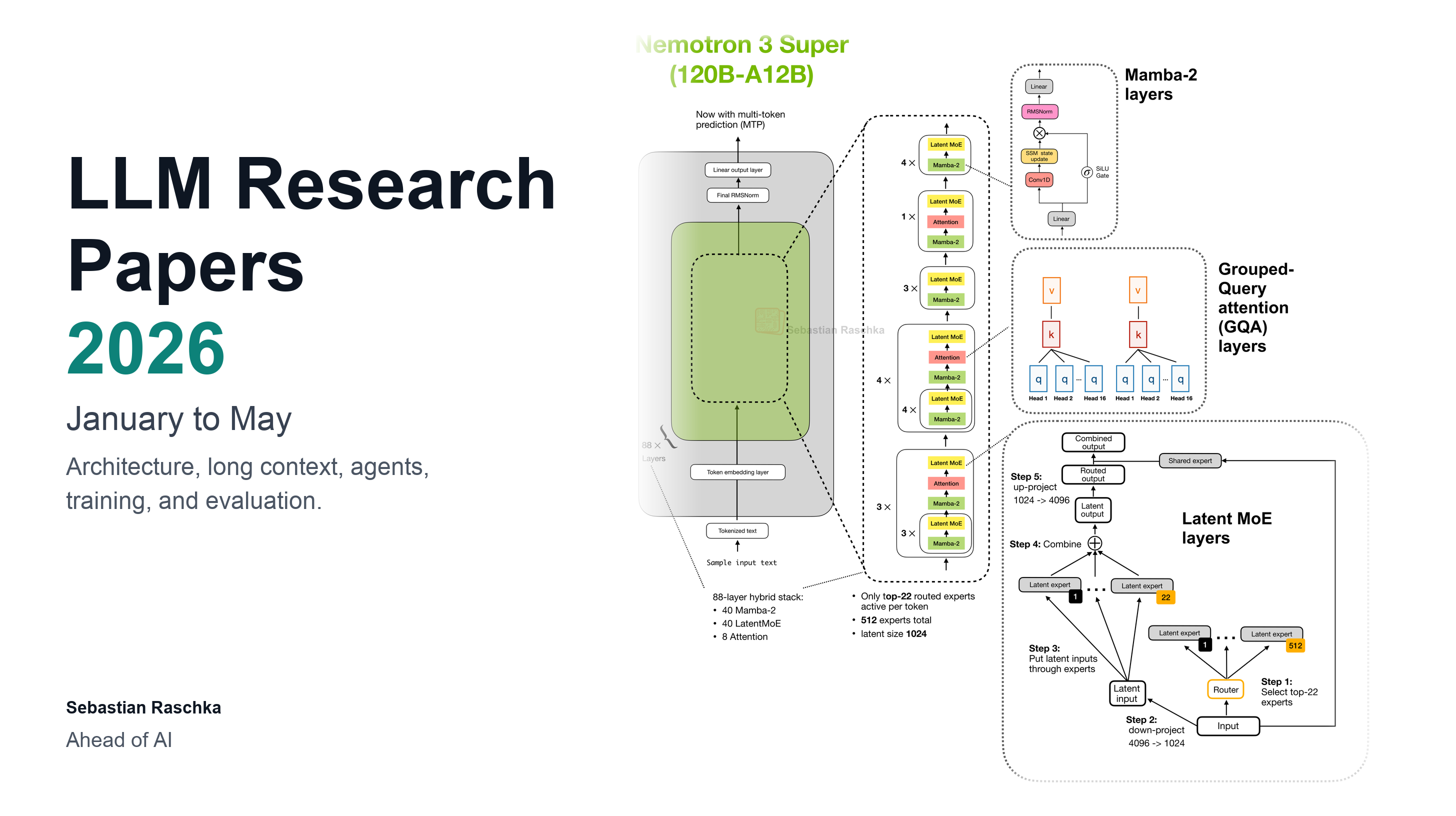
A curated roundup of notable LLM research papers that came out this year
By Sebastian Raschka, PhD
arXiv:2606. 05174v1 Announce Type: cross Abstract: Large Language Models (LLMs) have shown strong promise in healthcare applications.
By Arash Ahmadi, Parisa Masnadi, Sarah Sharif, Charles Nicholson, David Ebert, Mike Banad
arXiv:2407. 10486v3 Announce Type: replace Abstract: Query-focused summarization (QFS) aims to produce summaries that answer particular questions of interest, enabling greater user control and personalization.
By Jie Cao, Dian Jiao, Yang Dai, Rolan Yan, Wenqiao Zhang, Siliang Tang
arXiv:2606. 05176v1 Announce Type: cross Abstract: While large language models (LLMs) show strong performance in natural language understanding and generation, their evaluation and adaptation to domain-specific constraints in telecommunications customer support remain limited.
By Lucas Tamic, Ilan Jaffeux-Cheniout, Xavier Marjou