arXiv:2603. 04982v3 Announce Type: replace-cross Abstract: Can targeted user training unlock the productive potential of generative artificial intelligence in professional settings?
By Benjamin M. Chen, Hong Bao
arXiv:2606. 06534v1 Announce Type: cross Abstract: Longitudinal medical visual question answering (VQA) requires reasoning about anatomical differences between an image of a current time point and an image of a referred time point.
By Jialin Wu, Qianru Zhang, Georges El Fakhri, Xiaofeng Liu
arXiv:2510. 07315v2 Announce Type: replace-cross Abstract: Large Language Models (LLMs) have catalyzed vibe coding, where users leverage LLMs to generate and iteratively refine code through natural language interactions until it passes their vibe check.
By Ming Zhong, Xiang Zhou, Ting-Yun Chang, Qingze Wang, Nan Xu, Xiance Si, Dan Garrette, Shyam Upadhyay, Jeremiah Liu, Jiawei Han, Benoit Schillings, Jiao Sun
arXiv:2605. 06890v3 Announce Type: replace Abstract: AI agents are promising for high-stakes enterprise workflows, but dependable deployment remains limited because tool-use failures are difficult to diagnose and control.
By Hariom Tatsat, Ariye Shater
arXiv:2606. 07479v1 Announce Type: cross Abstract: Turkish idiomatic light verb constructions (LVCs) are challenging for multiword expression processing because they often share the same surface form as fully literal verb-object combinations while functioning as a single, partially idiomatic predicate.
By Sercan Karaka\c{s}, Yusuf \c{S}im\c{s}ek
arXiv:2606. 07512v1 Announce Type: cross Abstract: Current Vision-Language Models struggle with hours-long videos because processing full-length visual sequences induces prohibitive token explosion and attention dilution.
By Cong Chen, Guo Gan, Kaixiang Ji, ChaoYang Zhang, Zhen Yang, Guangming Yao, Hao Chen, Jingdong Chen, Yi Yuan, Chunhua Shen
arXiv:2606. 06523v1 Announce Type: new Abstract: Equipping Large Language Models (LLMs) to execute reliable multi-step workflows has become a central challenge in artificial intelligence.
By Ruida Wang, Jerry Huang, Pengcheng Wang, Xuanqing Liu, Luyang Kong, Tong Zhang
arXiv:2606. 06892v1 Announce Type: new Abstract: Scalable data attribution methods typically assign isolated utility scores to individual training examples.
By Yue Min, Ruining Chen, Yujun Li
We introduce ChinaHeritaQA, a multimodal benchmark dataset for evaluating the cultural reasoning abilities of vision-language models (VLMs) on UNESCO World Heritage sites in China. The dataset comprises 2,279 in-the-wild images paired with 14,133 bilingual (Chinese/English) multiple-choice QA pairs spanning seven cognitive dimensions, from basic identity recognition to historical periodization and architectural analysis.
We investigate whether information about time-to-event risk estimated by a Cox proportional hazards model can be transferred into a generative large language model. We propose a text-based survival modelling pipeline in which structured clinical covariates are converted into text prompts and a Qwen-based large language model is fine-tuned to generate patient-specific survival risk using Cox model predictions as a training target.
Macro placement is a fundamental step in modern chip physical design, playing a crucial role in determining the solution quality of high-dimensional combinatorial optimization problems. Despite recent advancements in machine learning for spatial coordinate determination, the temporal dimension of placement sequencing remains largely governed by static heuristics.
A small transformer encoder is trained to map Terminal-Wrench trajectories onto a unit sphere where embedding distance approximates the $L_1$ distance between reward and metadata signals. A linear probe on top of that embedding detects reward hacking on the cleaned test split with AUC $0.
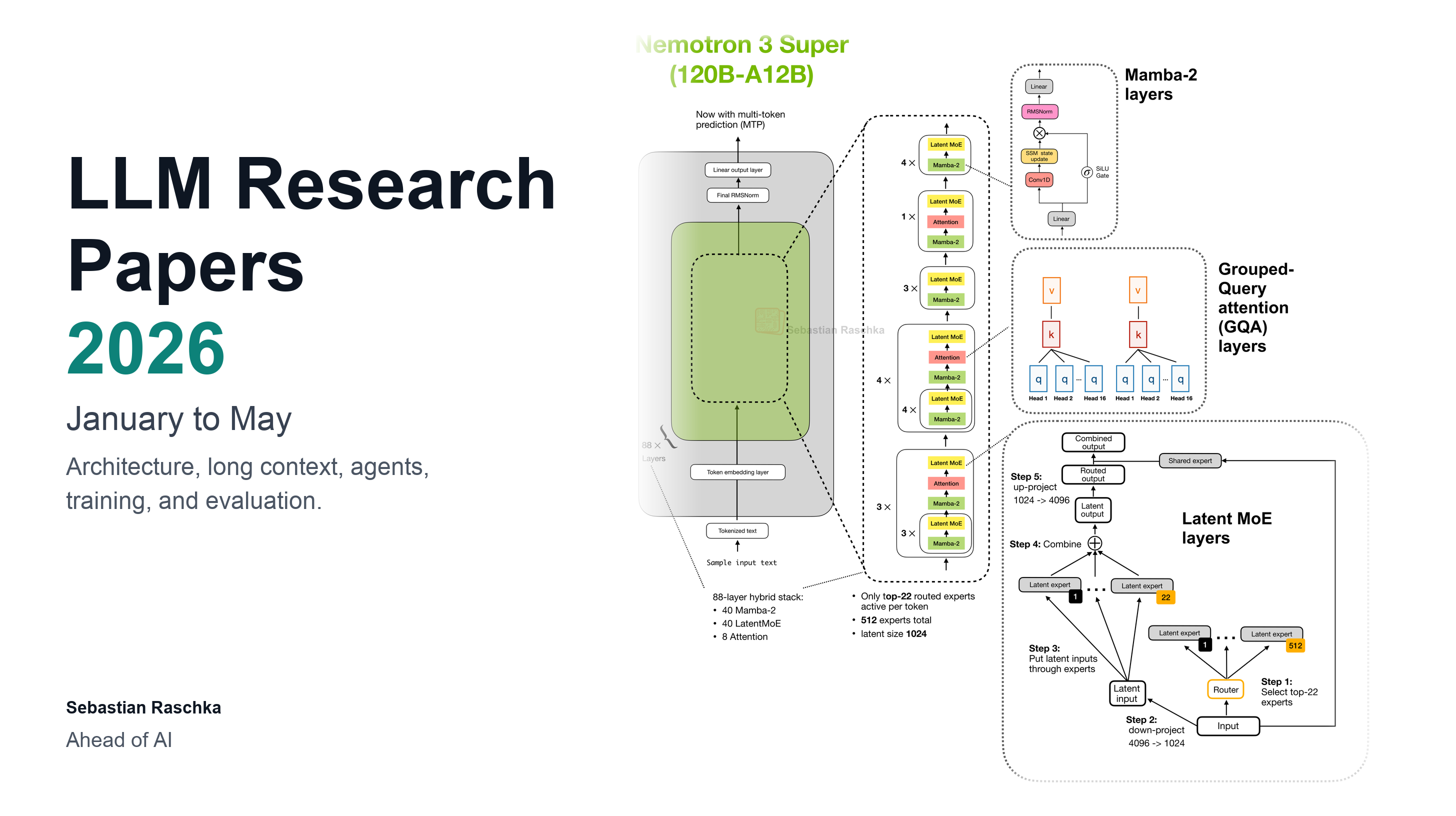
A curated roundup of notable LLM research papers that came out this year
By Sebastian Raschka, PhD
arXiv:2509. 04027v3 Announce Type: replace Abstract: Test-time scaling, primarily manifested through multi-step Chain-of-Thought (CoT) reasoning via Reinforcement Learning (RL), has emerged as a pivotal paradigm for enhancing the reasoning capabilities of Large Language Models (LLMs).
By Zeyu Gan, Hao Yi, Yong Liu
arXiv:2509. 20324v2 Announce Type: replace-cross Abstract: Retrieval-Augmented Generation (RAG) is an emerging approach in natural language processing that combines large language models (LLMs) with external document retrieval to produce more accurate and grounded responses.
By Atousa Arzanipour, Rouzbeh Behnia, Reza Ebrahimi, Kaushik Dutta
arXiv:2606. 06360v1 Announce Type: new Abstract: Modelling individual decision-making during infectious disease outbreaks is crucial for understanding behavioural dynamics and informing effective public health interventions.
By Yonchanok Khaokaew, Ruochen Kong, Andreas Zufle, Hao Xue, Taylor Anderson, Chandini Raina MacIntyre, Matthew Scotch, Flora D. Salim, David J Heslop
arXiv:2606. 06388v1 Announce Type: new Abstract: Recent advances in LLM agents have enabled complex cognitive capabilities, such as multi-step reasoning, planning, and tool use, that increasingly position these agents as human collaborators.
By Jiaju Chen, Yuxuan Lu, Jiayi Su, Chaoran Chen, Songlin Xiao, Zheng Zhang, Yun Wang, Yunyao Li, Jian Zhao, Tongshuang Wu, Toby Jia-Jun Li, Dakuo Wang, Bingsheng Yao
arXiv:2606. 05833v1 Announce Type: cross Abstract: Multimodal Large Language Models (MLLMs) excel at 2D semantic understanding but lack intrinsic 3D awareness, resulting in representations that fail to maintain geometric and spatial consistency across video frames.
By Haibo Wang, Lifu Huang
arXiv:2606. 06099v1 Announce Type: new Abstract: Whether Large Language Models (LLMs) exhibit covert psychological manipulation in complex human-AI interactions has garnered increasing safety concerns.
By Zeyang Yue, Chenfei Yan, Feifei Zhao, Haibo Tong, Mengwen Xu, Xiaozhen Wang, Erliang Lin, Yi Zeng
arXiv:2606. 06055v1 Announce Type: new Abstract: Long-term memory enables language model agents to support personalized interactions, but it remains unclear when available memories warrant integration into responses.
By Lingxiang Xu, Jiaoyun Yang, Min Hu, Hongtu Chen, Ning An