Professional translation is often a team-based process: translators, reviewers, and project managers must coordinate terminology, legal force, and accountability across documents. Yet many LLM-based translation tools treat human corrections as isolated edits.
As AI systems become more capable, training procedures that optimize for downstream outcomes risk introducing implicit agency: goal-directed behavior that designers never specified. We present a formal safety argument for the Scientist AI (SAI) Predictor, trained to approximate the Bayesian posterior conditioned on a dataset of "epistemically contextualized" natural-language statements.
A central premise of autonomous scientific imaging is that smarter navigation, whether Bayesian, RL-based, or otherwise adaptive, is the principal lever for sample-efficient acquisition. We present evidence to the contrary in scanning transmission electron microscopy (STEM), an atomic-resolution imaging modality whose every measurement deposits damaging electron dose.
We propose Persona-Trained Monte Carlo (PTMC), a method for estimating distributions of market-outcome statistics by repeatedly simulating limit-order-book interaction among swarms of persona-conditioned neural-policy trading bots. Each run instantiates many bots sharing one trained policy network but conditioned on heterogeneous, individually sampled persona parameters drawn from a learned trader-heterogeneity distribution; the bots interact in a continuous double auction, and the resulting price path is one Monte Carlo sample.
Role-semantic assignments provide priors over how heterogeneous agents may coordinate, but cooperative MARL systems instead settle on conventions through decentralized, non-stationary learning, with no guarantee that the resulting structure matches those priors. We study this translation gap between theory-informed role expectations and learned coordination structure through a diagnostic combining a role-routing matrix, formation sensitivity ($Δ_{\max}$), and gradient/occlusion attribution across three-role MiniGrid and SMACv2 (Terran) environments.
The verbose context problem occurs when structured concepts have token-inefficient textual representations. This bottleneck is acute in population health: cohort-level analysis of longitudinal patient records requires reasoning over thousands of medically-coded events, often exceeding 400K tokens in total.
Social influence dialogue changes user behavior by altering internal cognitive states. The central evaluation question is whether the user's beliefs, desires, intentions, and emotions measurably change over the course of conversation, a process-oriented criterion that neither surface-level text metrics (BLEU/ROUGE) nor single-score LLM judgments can capture.
Behind a customer's API, a high-quality answer isn't enough. It has to be usable, which means on time.
By Frank Wittkampf
Use coding agents to power your knowledge base The post How to Build a Powerful LLM Knowledge Base appeared first on Towards Data Science .
By Eivind Kjosbakken
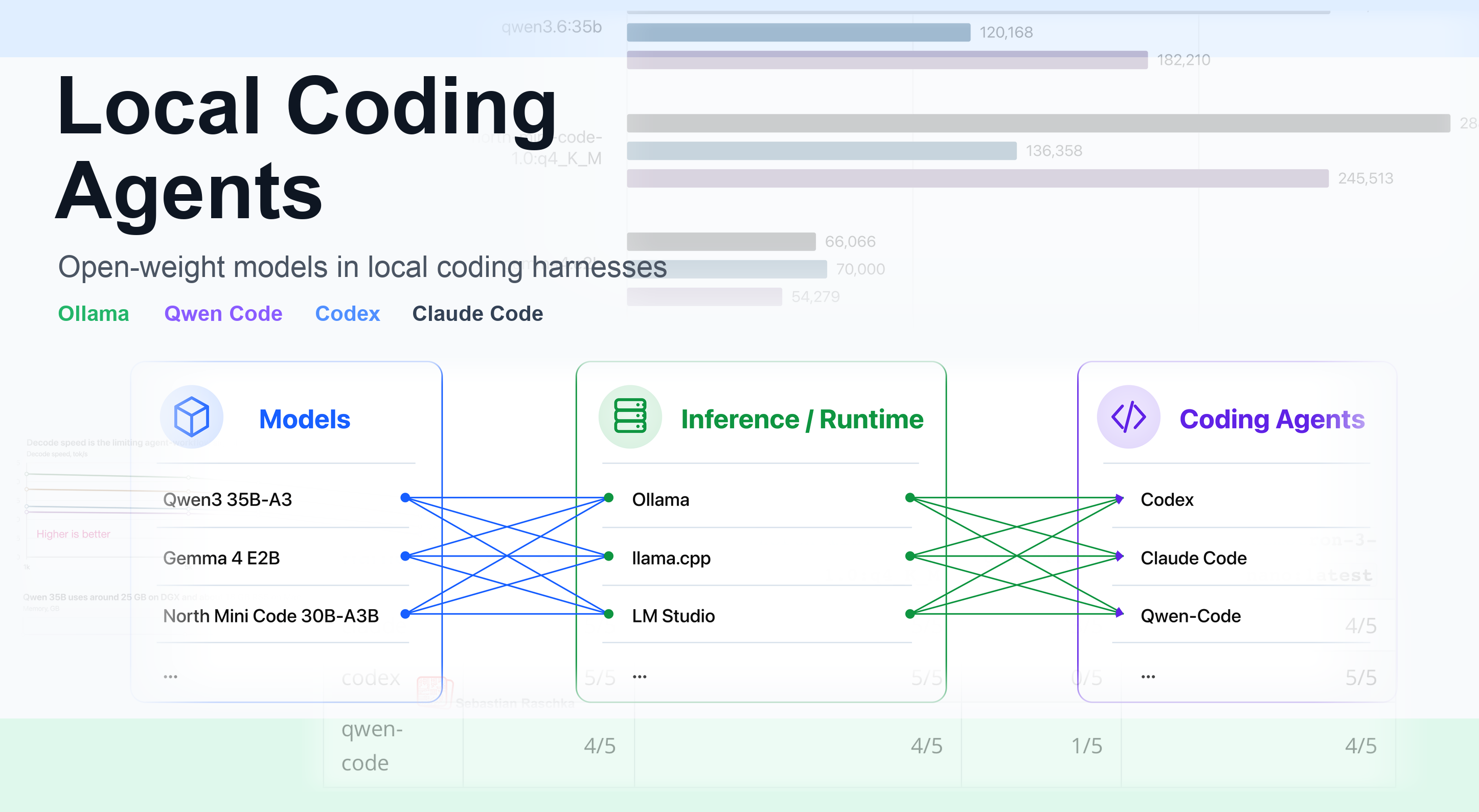
Using Open-Weight Models in Local Coding Harnesses as an Alternative to Claude Code and Codex Subscriptions
By Sebastian Raschka, PhD
Using Gemma 4, Ollama, OpenAI Agents SDK, and Tavily MCP to build a lightweight research agent The post From Local LLM to Tool-Using Agent appeared first on Towards Data Science .
By Shuai Guo
arXiv:2606. 07552v2 Announce Type: replace-cross Abstract: Large language models exhibit a risk-averse "turtle" bias as strategic agents.
By Augustin Chan
arXiv:2606. 26246v1 Announce Type: cross Abstract: Lacuna is a research map for machine learning that uses LLMs to turn papers and scholarly metadata into markdown summaries, concept elements, research directions, and research proposals.
By Martin Weiss, Miles Q. Li, Alejandro H. Artiles, Yacine Mkhinini, Chris Pal, Hugo Larochelle, Nasim Rahaman
arXiv:2606. 26552v1 Announce Type: cross Abstract: The rapid advancement of generative models presents a significant challenge to existing deepfake detection methods, particularly given the widespread dissemination of highly realistic AI-generated images.
By Yangjun Wu, Keyu Yan, Yu Liu, Jingren Zhou, Fei Huang, Rong Zhang, Zhou Zhao, Fei Wu
arXiv:2606. 26661v1 Announce Type: cross Abstract: Motion forecasting is essential for autonomous driving systems to enable safe decision-making and planning in complex driving scenarios.
By Sangjin Han, Hoseong Jung, Jeongtae Her, Changhyun Choi, H. Jin Kim
arXiv:2606. 26154v1 Announce Type: cross Abstract: Autonomous microrobots navigating biological vasculature could enable targeted drug delivery and thrombolysis, yet training control policies for realistic environments remains an open challenge.
By Jannik Drotleff, Samuel Tovey, Paul Hohenberger, Christoph Lohrmann, Julian Ho{\ss}bach, Konstantin Nikolaou, Christian Holm
arXiv:2606. 26924v1 Announce Type: cross Abstract: LLM coding harnesses grant agents broad file and shell access, yet the configuration layer that steers them -- rules files, agent definitions, IDE-specific markdown -- is largely unmanaged.
By Padmaraj Madatha
arXiv:2606. 26442v1 Announce Type: cross Abstract: We present AXLE (Axiom Lean Engine), a cloud service for Lean 4 proof manipulation, extraction, and verification.
By Jimmy Xin, Alex Schneidman, Chris Cummins, Karun Ram, Srihari Ganesh, Jannis Limperg
arXiv:2606. 26443v1 Announce Type: cross Abstract: A robot working alongside people must reason about what they have done, in what order, and with what intent.
By Baiqi Li, Ce Zhang, Yu Fang, Yue Yang, Shangzhe Li, Mingyu Ding, Gedas Bertasius
arXiv:2606. 26106v1 Announce Type: cross Abstract: Large language models (LLMs) are increasingly used in emotionally charged situations involving interpersonal conflict, frustration, and distress.
By Zhixing Sun, Shenghe Xu, Tao Li