Hugging Face Blog
Deep Learning over the Internet: Training Language Models Collaboratively
Read the original on Hugging Face Blog →The Flow has not summarised this story yet — read it at Hugging Face Blog.
The Flow has not summarised this story yet — read it at Hugging Face Blog.
arXiv:2409. 06067v3 Announce Type: replace Abstract: Previous studies on federated learning (FL) often encounter performance degradation due to data heterogeneity among different clients.
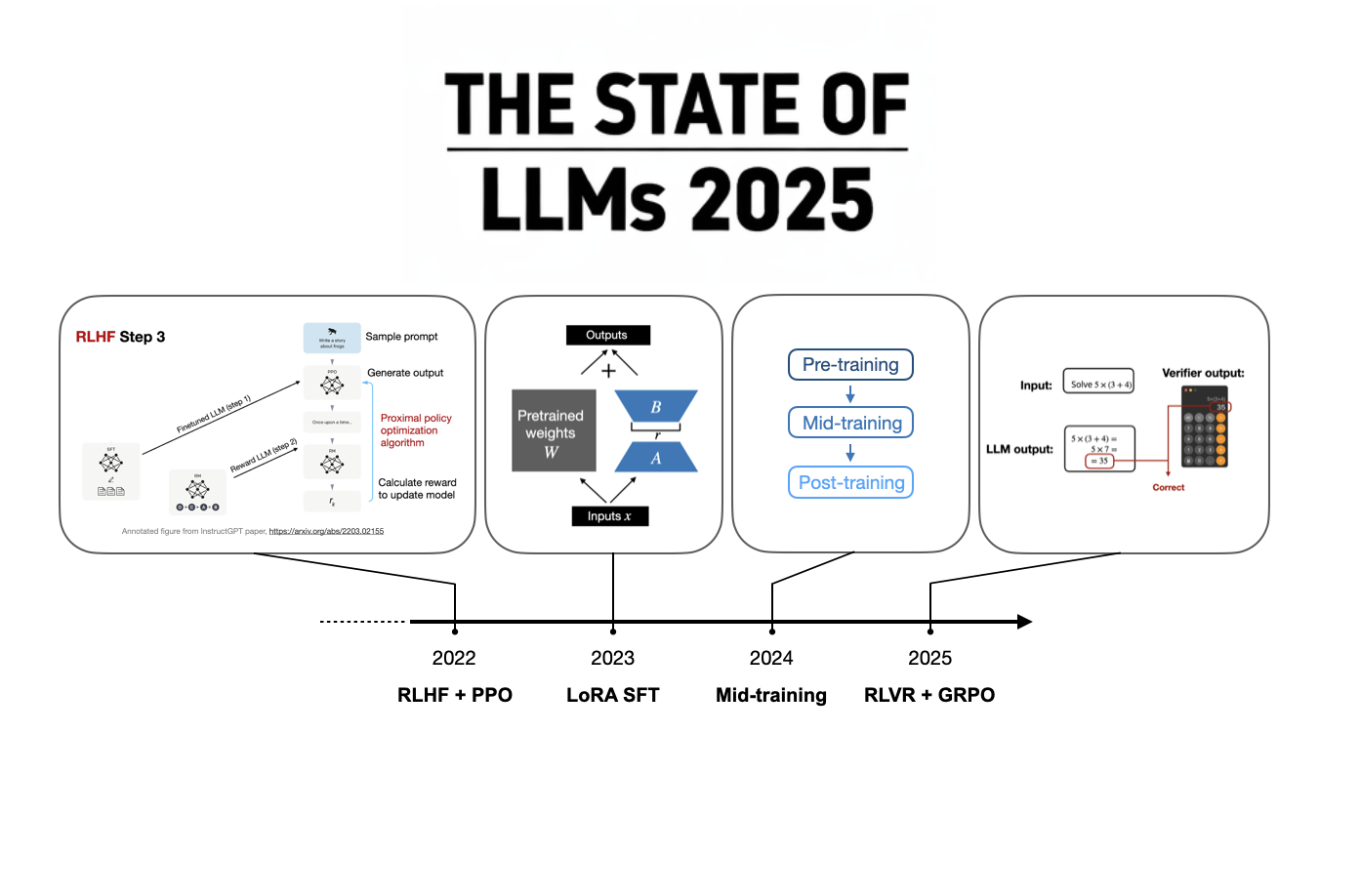
A 2025 review of large language models, from DeepSeek R1 and RLVR to inference-time scaling, benchmarks, architectures, and predictions for 2026.
arXiv:2608. 19726v1 Announce Type: cross Abstract: The typical training process of a multimodal large language model (MLLM) involves adapting both the language model backbone and the projector between the backbone and a modality-specific encoder.
arXiv:2505. 12741v3 Announce Type: replace Abstract: Language models are increasingly used not only as standalone predictors but also as components in larger inference systems, from test-time scaling to multi-agent collaboration.
SharedSAE demonstrates that a single sparse autoencoder can replace multiple model‑specific SAEs by using a shared dictionary with model‑specific encoder‑decoder pairs. It preserves activation magnitudes, normalizes only selection scores, and supports single‑model inference via model dropout. Trained on four 1B‑scale language models, SharedSAE retains 96.6% of the mean explained variance of dedicated SAEs, shows higher cross‑model latent correlations, and allows efficient adaptation of new models to the shared latent space.