Hugging Face Blog
Jan 24, 2024
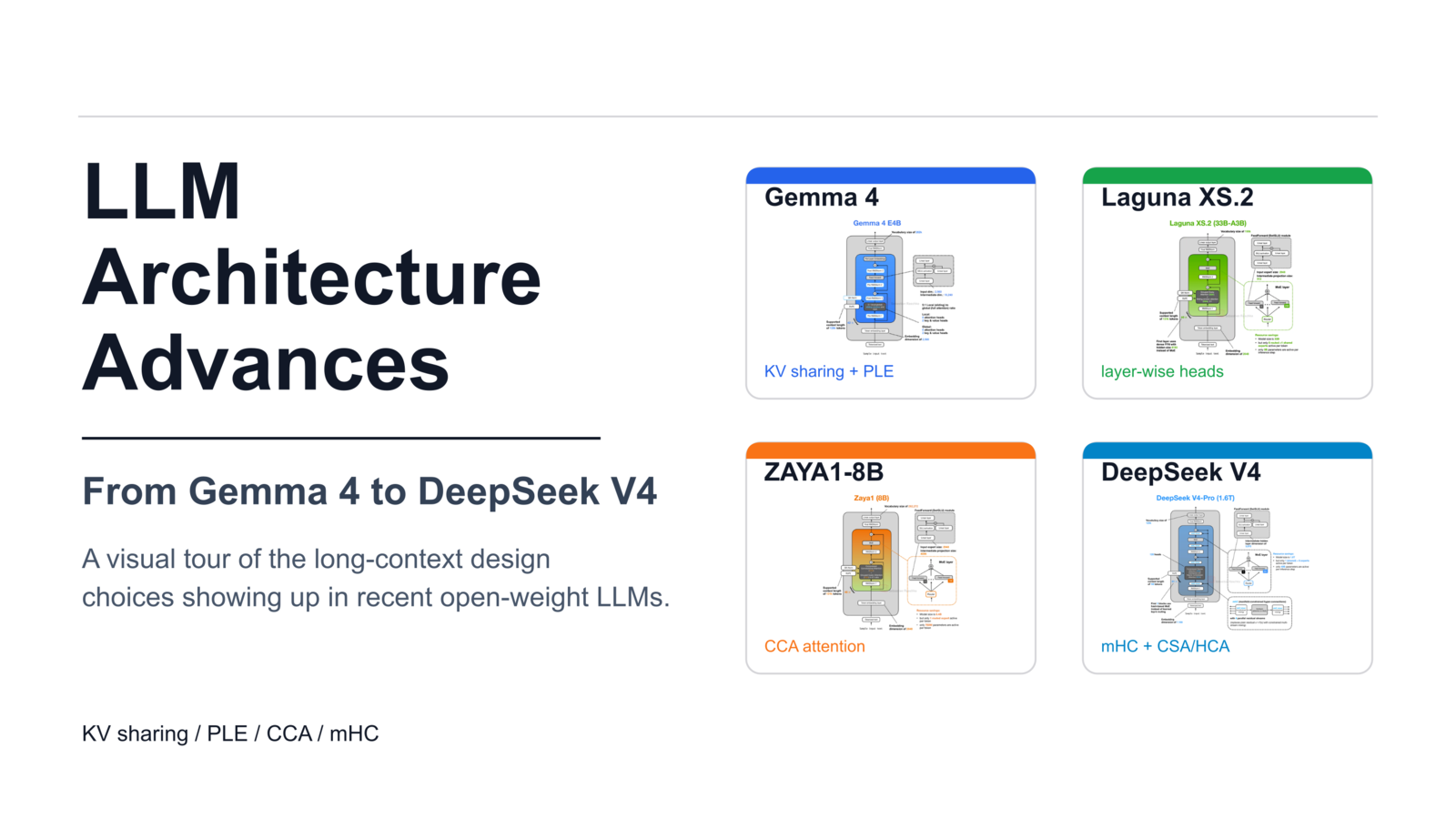
From Gemma 4 to DeepSeek V4, How New Open-Weight LLMs Are Reducing Long-Context Costs
The paper introduces a two-stage competence-aware framework for orchestrating large language model (LLM)-based multi-agent systems (MAS). It first estimates the LLM backbone’s task-conditioned competence for a given query, then uses this estimate to adjust which roles are activated and how agents communicate. Across six benchmarks, the method improves average performance to 93.81% and, depending on backbone competence, can boost accuracy while reducing token costs.
The paper compares three decentralized coordination strategies for large language model (LLM) agents in a perimeter‑defense simulation: a central commander, an auction‑based consensus team, and independent agents. Across five network conditions, the consensus team achieved the lowest breach rate (15%) while the commander and independent agents had higher rates (32% and 29%). The study also explores how network range, LLM authority, and prompt wording affect performance, finding that a dedicated conflict‑resolution protocol yields the fewest breaches.
arXiv:2607. 24759v1 Announce Type: new Abstract: Research projects, educational efforts, and adjacent knowledge work accumulate findings, decisions, and reasoning that future collaborators rarely recover.
arXiv:2607. 25446v1 Announce Type: new Abstract: Multi-agent frameworks built on large language models (LLMs) routinely entangle three logically distinct concerns: who is on the team (organization), how members align (coordination), and which algorithm fuses their work (collaboration protocol).
arXiv:2602. 00911v2 Announce Type: replace Abstract: The unit of collaboration in federated learning determines what guarantees are even expressible.
arXiv:2605. 15207v2 Announce Type: replace Abstract: Multi-agent LLM systems have shown promise for complex reasoning, yet recent evaluations reveal they often underperform single-model baselines.