Sebastian Raschka
May 16
Recent Developments in LLM Architectures: KV Sharing, mHC, and Compressed Attention
From Gemma 4 to DeepSeek V4, How New Open-Weight LLMs Are Reducing Long-Context Costs
From Gemma 4 to DeepSeek V4, How New Open-Weight LLMs Are Reducing Long-Context Costs
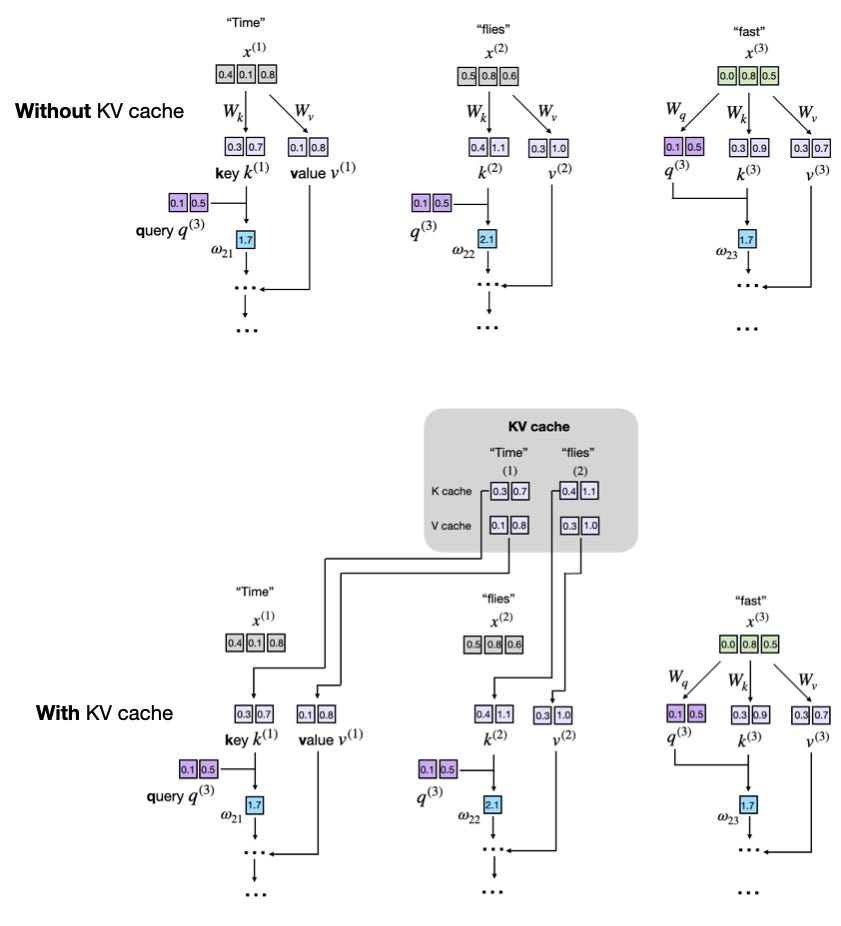
KV caches are one of the most critical techniques for efficient inference in LLMs in production.
KVMem is a KV-context virtualization system that allows large language model agents to maintain workspaces exceeding both GPU key‑value capacity and the model’s native context window. It stores overflowed history as paged KV state across GPU memory, host memory, and NVMe, using lightweight, model‑native attention‑space indexes to retrieve relevant historical blocks. Evaluations on long‑context agent benchmarks show that KVMem improves task utility and inference efficiency, enabling up to one million‑token workspaces on consumer GPUs and achieving interactive responsiveness in local deployments.
arXiv:2606. 07878v1 Announce Type: new Abstract: The KV cache is the memory bottleneck of long-horizon language model deployment.
arXiv:2505. 19293v2 Announce Type: replace-cross Abstract: Long-context capability is considered one of the most important abilities of LLMs, as a truly long context-capable LLM enables users to effortlessly process many originally exhausting tasks -- e.
arXiv:2608.30963v1 Announce Type: cross Abstract: Modern large language model (LLM) serving systems increasingly operate over repeated or shared context, yet each model typically performs its own pre...
LLMs don’t fail because they forget—they fail because they remember too much. As conversations grow, prompts accumulate redundant and low-value tokens, driving up cost and latency while silently degrading output quality.
arXiv:2608.30295v1 Announce Type: cross Abstract: Large language models (LLMs) have demonstrated strong capabilities in handling long-context tasks, but processing such long contexts remains challeng...
arXiv:2606. 24467v1 Announce Type: new Abstract: Long-context large language model (LLM) inference is increasingly constrained by the memory footprint and decoding cost of key-value (KV) caches, limiting sustainable deployment on resource-constrained hardware.
arXiv:2606. 06203v1 Announce Type: cross Abstract: Input length and the position of relevant information are widely cited as the primary causes of degraded LLM long-context performance.
Long-context large language model (LLM) inference is increasingly constrained by the memory footprint and decoding cost of key-value (KV) caches, limiting sustainable deployment on resource-constrained hardware. Existing KV cache eviction methods typically apply heuristic token scoring over all heads in GQA-based LLMs.