We introduce Dango, a 1. 8B-parameter large language model designed for controlled studies of L1-to-L2 (Japanese-to-English) transfer in second language acquisition (SLA).
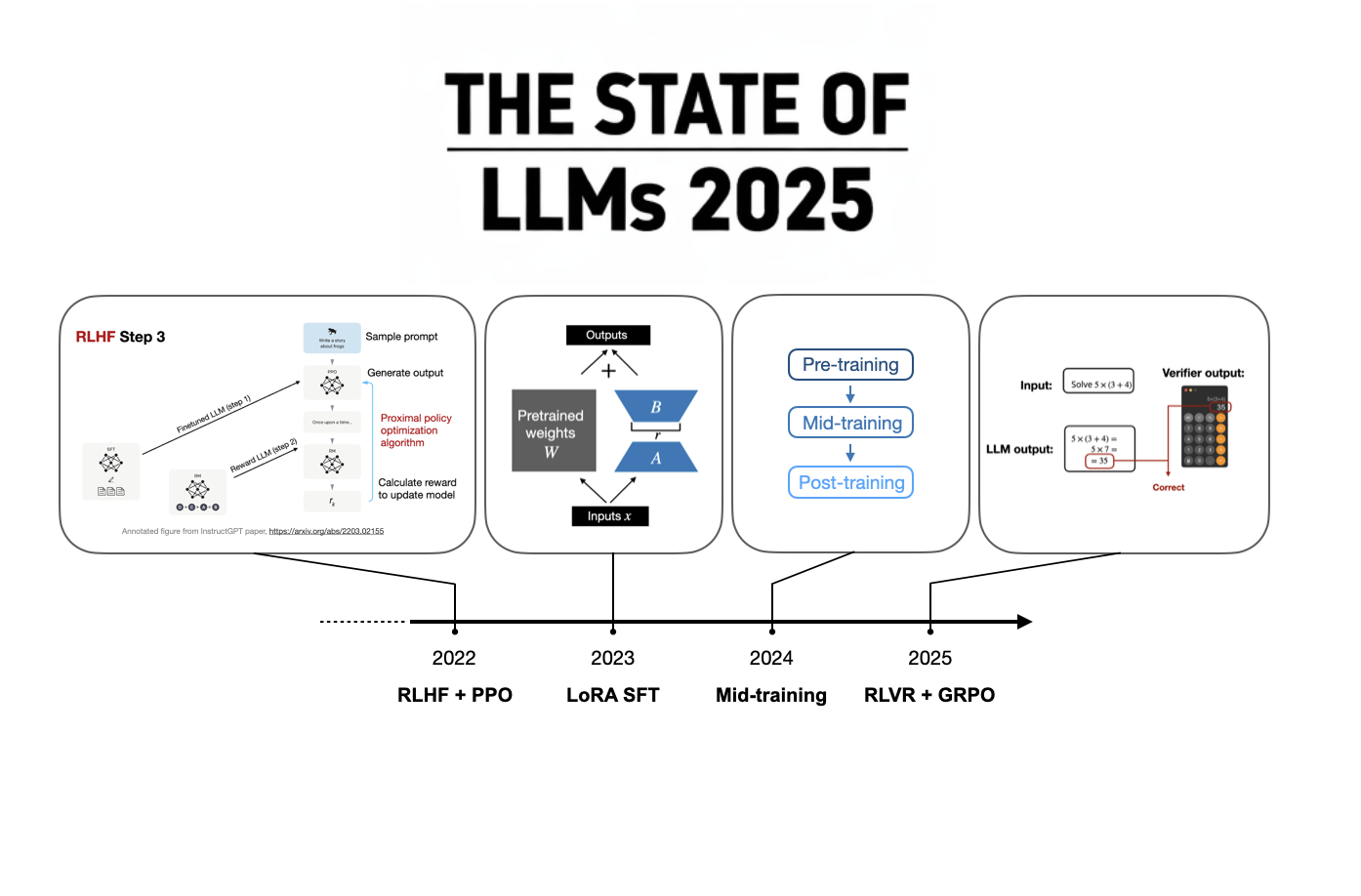
A 2025 review of large language models, from DeepSeek R1 and RLVR to inference-time scaling, benchmarks, architectures, and predictions for 2026.
By Sebastian Raschka, PhD
The paper presents Qwenfant, a Qwen3-based model trained on concise parallel text for the 2026 BabyLM Challenge’s Multilingual track. By leveraging LLM-summarized and translated data, a larger model size, and a character-level vocabulary—both fine-tuned with LoRA—the authors achieve a top ranking in the competition.
By Lukas Edman, Alexander Fraser
The paper compares generative and encoder-based neural models for multilingual Named Entity Recognition (NER) across the eleven languages of the Naamapadam benchmark. Five classic model families, four decoder-only large language models fine‑tuned with LoRA and 4‑bit NF4 quantisation, and nine generative models in zero‑to‑5‑shot inference were evaluated under strict CoNLL span‑level metrics. Encoder-based models (mBERT and XLM‑R) achieved substantially higher F1 scores—up to 0.675 on Hindi—than any generative architecture, with gaps of 7.5–40 percentage points; the best few‑shot result reached only 28% of the encoder baseline. The study identifies three language clusters (encoder‑dominant, partial‑coverage, and failure‑zone) and offers deployment guidelines based on transfer learning and low‑resource NLP principles.
By Jakkala Mahesh, Jatavath Shravan Kumar, Komalla Shivani, Sujoy Sarkar
arXiv:2604. 18347v2 Announce Type: replace-cross Abstract: Vision Language Models (VLMs) achieved rapid progress in the recent years.
By Daniela Baiamonte, Elena Fano, Matteo Gabburo, Stefano Simonazzi, Leonardo Rigutini, Andrea Zugarini
Large Language Models: A Plain-Language Overview for Engineers explains that LLMs are neural networks trained on vast text collections to predict subsequent words, and outlines key concepts such as Transformers, pre‑training, fine‑tuning, reinforcement learning from human feedback, retrieval‑augmented generation, chain‑of‑thought prompting, and tool‑using agents. It also discusses efficiency techniques like FlashAttention and QLoRA, provides a life‑cycle figure and comparative tables, and offers a checklist for evaluating LLM claims, including checks for data contamination, model‑based grading, long‑context handling, and hallucination. The article aims to give engineers a clear picture of how training changes and prompts affect generative AI tools like ChatGPT.
By Bahaeddin T\"urko\u{g}lu
The report introduces Nemotron-SEA-LION-v4.8, a family of Southeast Asian language models built on NVIDIA Nemotron 3, featuring 30B-A3B and 120B-A12B variants with both base and post‑trained checkpoints. The models are fine‑tuned on Southeast Asian, reasoning, code, and multilingual parallel datasets, then further refined with supervised fine‑tuning and online on‑policy distillation. On the SEA‑HELM benchmark, the 30B-A3B model raises the overall SEA score from 46.06 to 51.57, while the 120B-A12B model jumps from 49.30 to 63.44, with the largest improvements seen in instruction following, natural language reasoning, and understanding across seven Southeast Asian languages.
By Ahmed Mohammad Dabeer (David Wang Dawei), Ahn Jeongmi (David Wang Dawei), Anocha Sutaveephamochanon (David Wang Dawei), Antonyrex Sajeban (David Wang Dawei), Aulia Adila (David Wang Dawei), Chan Hok Teng (David Wang Dawei), Adwin (David Wang Dawei), Cheng Zi Yi (David Wang Dawei), Nicholas Zhuang Ziyi (David Wang Dawei), Choa Hsueh Mei Esther (David Wang Dawei), David Ong Tat-Wee (David Wang Dawei), Evelyn Tan Chor Phin (Li Chunren), Heng Cheng Peng (Li Chunren), Jonathan (Li Chunren), Lee Chwan Ren (Li Chunren), Leong Wai Yi (Huang Wenzong, Raymond), Leong Wei Qi (Huang Wenzong, Raymond), Leslie Teo Eng Sipp (Huang Wenzong, Raymond), Liew Rachel (Huang Wenzong, Raymond), Limkonchotiwat Peerat (Huang Wenzong, Raymond), Montalan Jann Railey Estrada (Huang Wenzong, Raymond), Muhammad Ridzuan Bin Mokhtar (Huang Wenzong, Raymond), Nagarajan Karthik (Huang Wenzong, Raymond), Ng Boon Cheong (Huang Wenzong, Raymond), Raymond (Huang Wenzong, Raymond), Ngui Jian Gang (Chen Xiaowei), Nguyen Thanh Ngan (Chen Xiaowei), Tasawong Panuthep (Chen Xiaowei), Pereira Mark Gregory (Chen Xiaowei), Phang Shi Wei Benjamin (Chen Xiaowei), Poon Yip Hung (Chen Xiaowei), Joseph (Chen Xiaowei), Rengarajan Hamsawardhini (Chen Xiaowei), Siow Wei Kang Bryan (Chen Xiaowei), Tai Ngee Chia (Chen Xiaowei), Tan Choon Meng (Chen Xiaowei), Tan Le Min (Chen Xiaowei), Sheryl (Chen Xiaowei), Tan Siao Wei (Chen Xiaowei), Tan Yi Xian, Tee Jun Yun, Teng Kok Wai, Tjhi William Chandra, Tuchinda Pume, Wu Donghang, Yong Xianbin, Yosephine, Zhang Zhou
The paper introduces a scalable, multi-step framework designed to improve the quality of Named Entity Recognition (NER) annotations, particularly in low-resource languages. It employs a frequency-based iterative approach that combines self‑training with a dual‑threshold mechanism to increase inference confidence. Experiments on various NER datasets show notable performance gains over the original data, and the study also investigates the use of generative Large Language Models for NER tasks.
By Toqeer Ehsan, Thamar Solorio
Group Relative Policy Optimisation (GRPO) is applied to a non‑LLM encoder‑decoder ASR model, Whisper‑large‑v3, to improve multilingual speech recognition across 51 African languages. The method mitigates exposure bias from teacher forcing, especially benefiting low‑resource and noisy audio scenarios. The resulting model, SunflowerASR, sets new macro‑averaged WER records on AfriVox‑v2 (0.227) and SimbaBench (0.372).
By Tim Wenjie Hu, Evelyn Nafula Ouma, Benjamin Akera, John A. Quinn
arXiv:2601.06347v3 Announce Type: replace
Abstract: Recent progress in universal multilingual named entity recognition (NER) has been driven by multilingual transformer models, task-specific architec...
By Jonas Golde, Patrick Haller, Alan Akbik
NEPSEE is a Nepali sentiment analysis benchmark created by having two annotators independently label 5,614 tweets from Nepali public figures on a five‑point scale. Only 3,189 sentences with identical polarity are kept for a three‑class version, while 766 sentences with adjacent labels are used in a five‑point task. Baseline results show NepBERTa achieving a macro‑F1 of 0.877 on the three‑class benchmark, with commercial LLMs performing similarly; on the five‑point task, Claude Opus 5.5 outperforms encoders by 0.10–0.12 macro‑F1, and a tokenizer audit reveals that restoring Devanagari vowel signs can significantly alter performance.
By Gaurab Baral, Mimansak Nepal, Grishma Basnet
arXiv:2606. 25331v1 Announce Type: cross Abstract: Modern large language models are predominantly trained with autoregressive factorization and causal attention.
By Shen Nie, Qiyang Min, Shaoxuan Xu, Zihao Huang, Yuxuan Song, Yong Shan, Yankai Lin, Wayne Xin Zhao, Chongxuan Li, Ji-Rong Wen