arXiv:2609.37379v1 Announce Type: new
Abstract: Looped Transformers provide a parameter-efficient approach to depth scaling by repeatedly applying shared Transformer blocks. Recent reasoning models h...
By Yulong Huang, Chen Jiang, Zhanpeng Zhou, Hongtao Zhang, Tianyu Li, Tianyu He, Xiangyu Zhang, Bojun Cheng
Rectified Looped Transformer (RLT) improves looped Transformers by redesigning feedback between loops with a linear interpolation schedule inspired by flow-based modeling. Each loop’s input is a blend of the current state and its prediction, which distributes state changes and keeps hidden-state norms bounded. Experiments show RLT achieves lower perplexity, greater robustness to perturbations, and more stable hidden-state trajectories without adding parameters or extra block evaluations.
By Musheng Li, Jiawei Zhang, Ziyuan Liu, Yuantao Gu
The paper introduces a fixed‑point framework to analyze looped transformer architectures, focusing on stability properties such as local attractivity, input‑dependence, and geometry. It shows theoretically that looped networks lacking recall have only countable fixed points and cannot achieve strong input‑dependence, whereas adding recall with outer normalization yields locally‑attractive, smoothly input‑dependent fixed points that support stable backpropagation. Empirical experiments on chess, sudoku, and prefix‑sums confirm that performance aligns with the framework’s predictions, and a new internal‑recall variant further validates the theory.
By Asher Labovich
The Recurrent Looped Transformer (RLT) divides its layers into a parallel causal encoder and a recurrent decoder, allowing the computation path to grow with sequence length while keeping a fixed per-token cost. Experiments on six algorithmic tasks show that RLT outperforms a standard eight‑layer Transformer, achieving perfect generalization on parity up to 256 bits and high accuracy on swap‑based permutation tracking and modular arithmetic beyond training lengths. Ablation studies confirm that the recurrent feedback is essential for these gains, with chunked updates preserving performance on parity but reducing accuracy on permutation tracking.
By Yifan Zhang, Jichen Feng, Shihan Qin
The paper investigates whether a global workspace—a set of verbalisable, causally potent representations—emerges in transformer models that use recurrence instead of a stack of distinct layers. Using a Jacobian lens extended with a virtual‑unrolling adapter, the authors analyze two recurrent transformer architectures, Ouro‑2.6B and Huginn‑0125, and compare them to a standard Qwen3.6‑27B baseline. They find that a workspace does form in the iterated parts of both models, but recurrence alters how it can be accessed: Ouro reconstructs workspace content in every loop and requires writes and ablations across all loops, whereas Huginn forwards content across all recurrences but limits reads, writes, and ablations to a sliding window of about two recurrences.
By Wenlong Wang, Fergal Reid
arXiv:2607. 13491v1 Announce Type: cross Abstract: Looped Transformers scale sequential computation by applying a compact stack of physical blocks for multiple rounds, increasing unrolled depth without increasing stored parameters.
By Shuzhen Li, Yifan Zhang, Jiacheng Guo, Quanquan Gu, Mengdi Wang
The paper introduces LoopCD, a training‑free contrastive decoding framework that improves token selection in Loop‑Transformer models by comparing the final prediction with earlier recurrent passes. LoopCD operates either in logit space (LoopCD‑Logits) with a single extra output pass or in hidden‑state space (LoopCD‑Hidden) with no output overhead. Across multiple looped Transformer families, LoopCD yields significant performance gains—raising pass@1 scores on tasks such as AIME 2024 and HumanEval—while enabling a reduction in the number of recurrent loops and a corresponding decrease in inference FLOPs.
By Weihao Liu, Huangjie Zheng, Tianrong Chen, Rohit Dilip, Richard He Bai, Yizhu Jiao, Yuyang Wang, Ruixiang Zhang
arXiv:2610.35544v1 Announce Type: new
Abstract: Looped Transformers offer a parameter-efficient approach to language modeling by repeatedly applying a shared backbone. Vanilla looped Transformers use...
By Feichen Song, Boyi Zeng, He Li, Shixiang Song, Yiqin Hao, Zitong Wang, Yizhou Yang, Yifan Liu, Ziwei He, Zhouhan Lin
arXiv:2610.35556v1 Announce Type: new
Abstract: Looped Transformers increase computation per token by repeatedly applying a shared backbone, offering a way to improve language modeling and downstream...
By Feichen Song, Boyi Zeng, Yiqin Hao, Shixiang Song, He Li, Yizhou Yang, Zitong Wang, Yifan Liu, Ziwei He, Zhouhan Lin
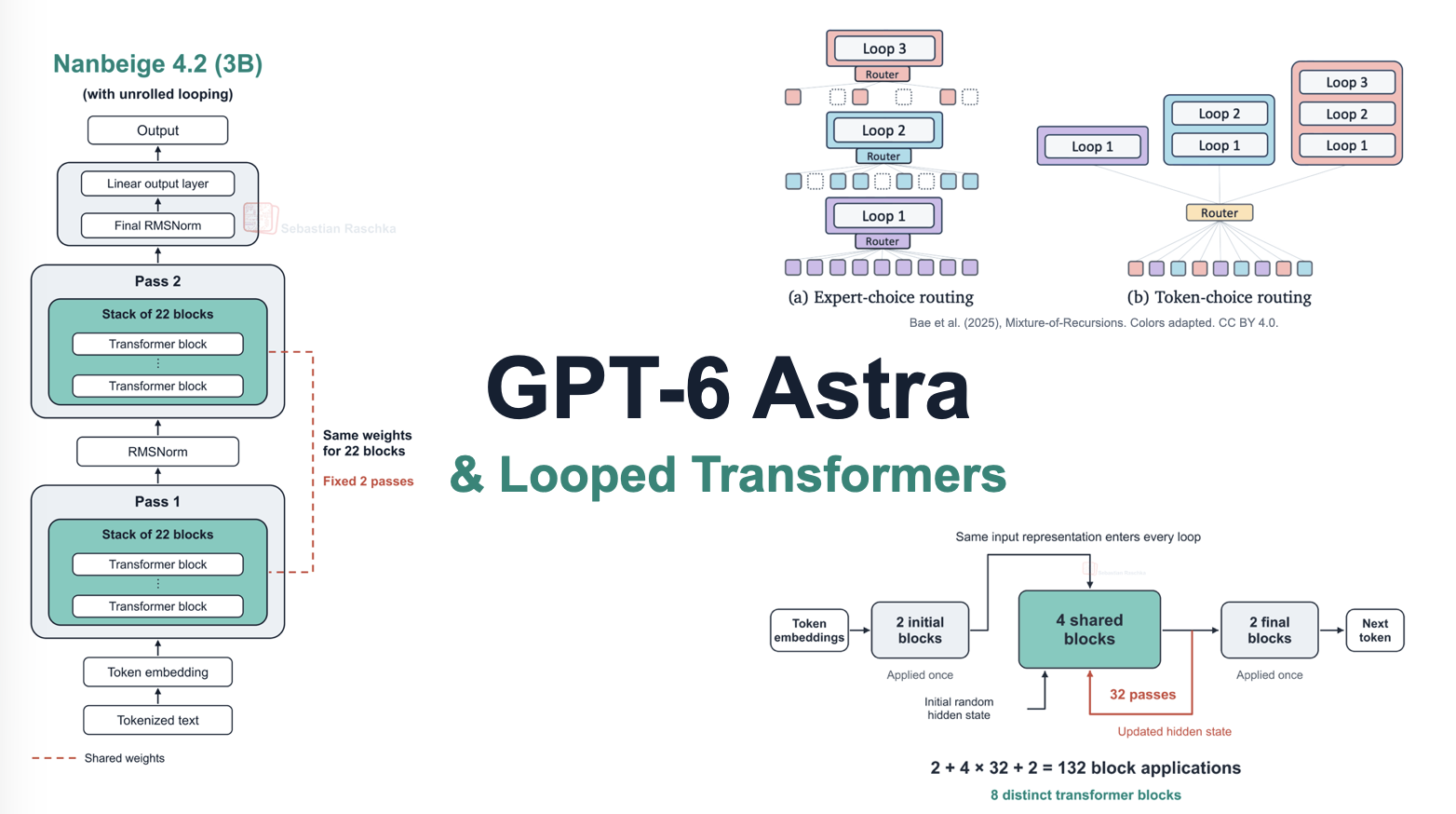
The article titled "GPT-6 Astra, Looped Transformers, and Hidden Reasoning" examines recent developments in transformer architecture, focusing on recurrent depth, hidden chains of thought, and the concept of looping transformer blocks. It discusses how these innovations aim to enhance the reasoning capabilities of language models by allowing deeper, more iterative processing of information. The piece highlights current research trends that explore the potential of these techniques to improve model performance and interpretability.
By Sebastian Raschka, PhD
The paper studies state space models (SSMs) and shows that diagonal real- or complex-valued SSMs can only track commutative groups because their transition matrices commute. By applying representation theory, the authors derive conditions for an SSM to track a group and introduce HyperSSM, which incorporates quaternion channels to satisfy these conditions while maintaining linear-time inference and parallel training. HyperSSM achieves exact solutions on recent state-tracking benchmarks, generalizes to much longer sequences, and allows direct interpretation of learned weights in real-world calibration tasks.
InfuseLoop introduces a cross‑trajectory latent injection mechanism for Parallel Looped Transformers (PLTs), allowing later prediction trajectories to inform earlier loops via lightweight attention residuals. This design keeps token‑parallel training and concurrent loop execution while adding only $O(Rd)$ hidden‑state storage. Experiments demonstrate that InfuseLoop removes training‑loss spikes, improves validation‑loss scaling up to eight loops, and yields significant perplexity and downstream accuracy gains with minimal decoding overhead.
By Zhaofeng Sun, Lanxiang Hu, Yu-Yang Qian, Jiaqi Leng, Yuanbo Yang, Chi Zhang, Youyou Lu, Peng Zhao, Hao Zhang