arXiv:2606. 13647v1 Announce Type: cross Abstract: We introduce SkMTEB, the first comprehensive MTEB-style text embedding benchmark for Slovak, a low-resource West Slavic language, comprising 31 datasets across 7 task types -- nearly 4$\times$ the depth of existing multilingual benchmark coverage for Slovak.
By Marek \v{S}uppa, Andrej Ridzik, Daniel Hl\'adek, Nat\'alia K\v{n}a\v{z}ekov\'a, Vikt\'oria Ondrejov\'a
arXiv:2608. 11249v1 Announce Type: cross Abstract: We study the problem of lossless text compression, motivated by the rapid growth in the collection and storage of digital textual data - including plain text, source code, and structured formats such as XML - and by recent advances in neural language model-based compression.
By Angelo Nardone, Paolo Ferragina
arXiv:2606. 28344v1 Announce Type: cross Abstract: Augmenting large language models (LLMs) with retrieved web text has become a dominant paradigm, yet the web is not natively textual: existing systems depend on complex parsing pipelines that linearize HTML and discard layout, visual structure, and formatting.
By Yichuan Wang, Zhifei Li, Zirui Wang, Paul Teiletche, Lesheng Jin, Matei Zaharia, Joseph E. Gonzalez, Sewon Min
Modern large language models are pretrained on massive datasets, making it difficult to prevent benchmark data from entering their training sets and undermining the reliability of evaluation results....
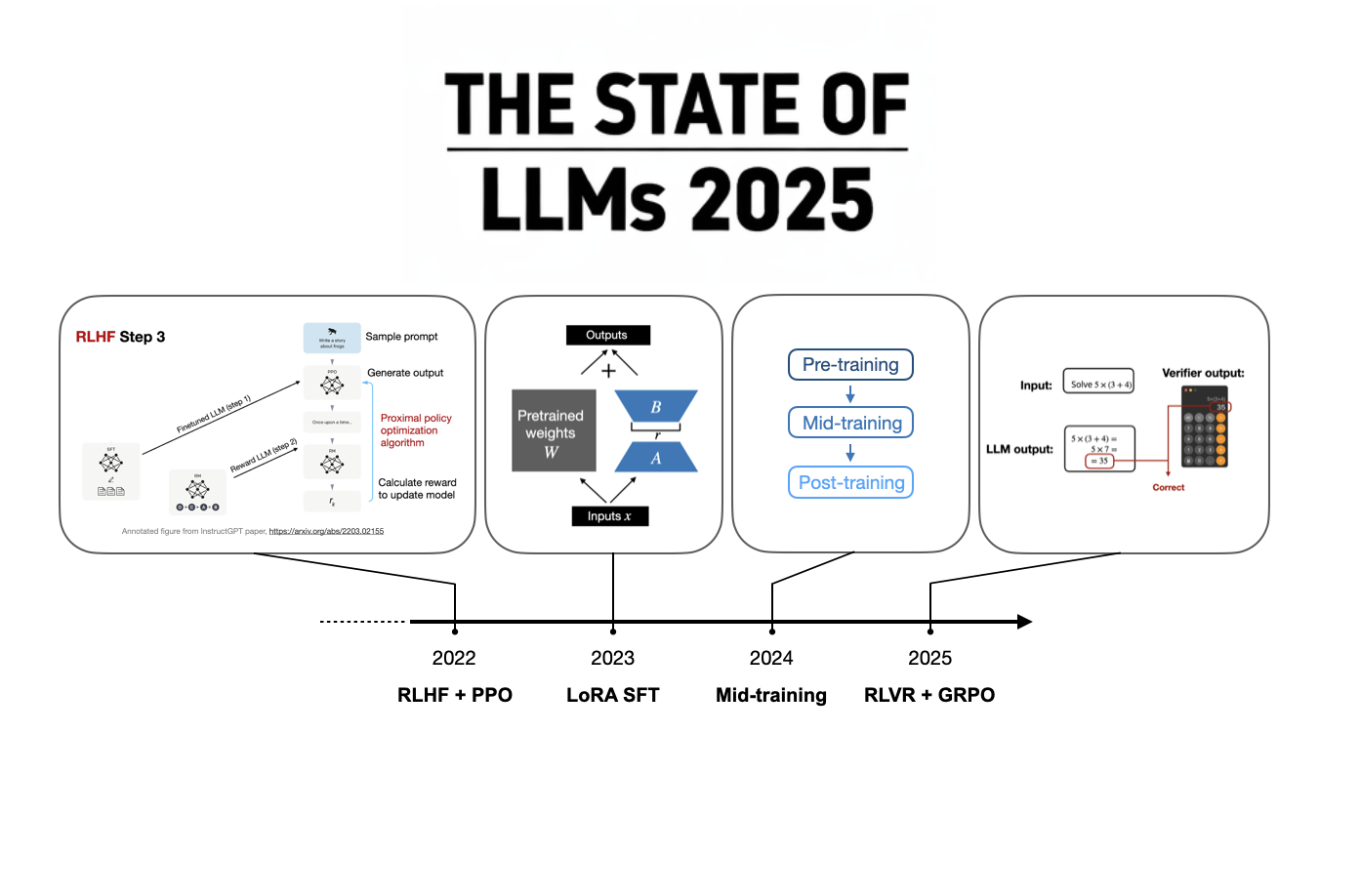
A 2025 review of large language models, from DeepSeek R1 and RLVR to inference-time scaling, benchmarks, architectures, and predictions for 2026.
By Sebastian Raschka, PhD
arXiv:2609.27510v1 Announce Type: cross
Abstract: Modern large language models are pretrained on massive datasets, making it difficult to prevent benchmark data from entering their training sets and...
By Kaifeng Tan, Yudong Li, Linlin Shen
Still a long way to go, but the future is promising The post Setting Up Your Own Large Language Model appeared first on Towards Data Science .
By Ivo Bernardo
The paper introduces a three‑stage training pipeline that builds compact, efficient dense retrievers without requiring ground‑truth relevance labels. Using cross‑lingual alignment, relational knowledge distillation, and contrastive fine‑tuning, the authors develop PolDense (six Polish models ranging from 17 M to 1 B parameters) and EuroDense (a 435 M‑parameter model covering nine European languages). Extensive evaluation on 41 Polish and 150 multilingual tasks shows that PolDense‑1B outperforms larger retrievers up to 9 B parameters, while EuroDense leads in task‑averaged and language‑averaged performance among models below 1 B parameters.
By S{\l}awomir Dadas, Rafa{\l} Po\'swiata, Ma{\l}gorzata Gr\k{e}bowiec, Micha{\l} Pere{\l}kiewicz
arXiv:2508. 10875v3 Announce Type: replace-cross Abstract: Diffusion Language Models (DLMs) are rapidly emerging as a powerful and promising alternative to the dominant autoregressive (AR) paradigm.
By Tianyi Li, Mingda Chen, Bowei Guo, Zhiqiang Shen
The paper investigates how to effectively pre‑train language models when the data budget is limited but compute is plentiful. It shows that increasing model size only improves performance up to an optimal point, after which overfitting degrades generalization, and that this optimal size varies with both the data budget and downstream tasks. To overcome the inefficiencies of standard Transformers in this regime, the authors propose recursive Transformers that reuse a shared block across depth and employ factorized embeddings, achieving better results than standard models on 10M–100M word pre‑training budgets and competitive performance with BabyLM Challenge 2025 winners.
By Serdar G\"ulbahar, Lukas Edman, Alexander Fraser