Sebastian Raschka
Apr 4
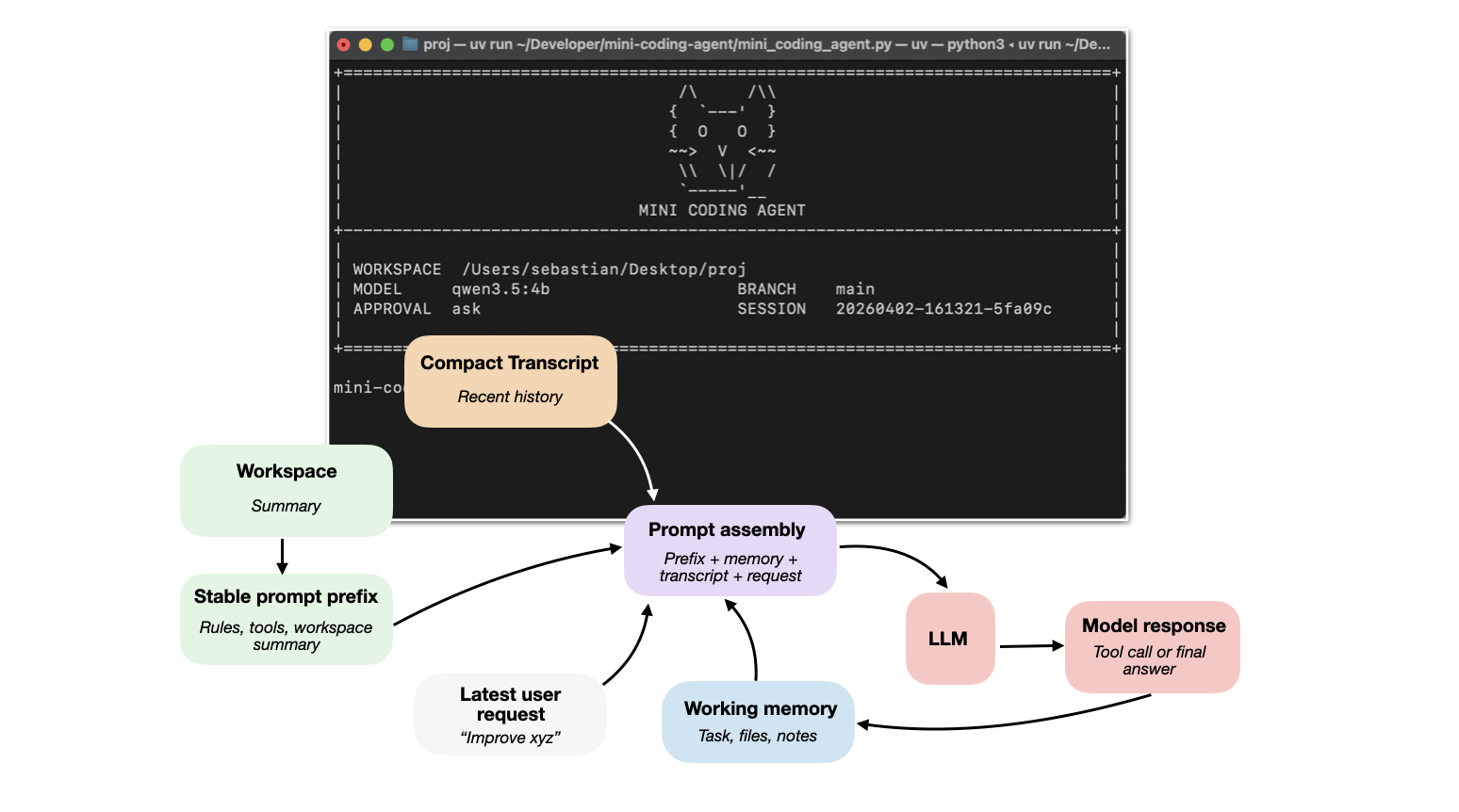
Components of A Coding Agent
How coding agents use tools, memory, and repo context to make LLMs work better in practice
The article explains how to package coding agent skills, rules, hooks, and MCP tool configurations as versioned plugins and distribute them via a marketplace. It demonstrates this approach using Claude Code and AWS as examples. The focus is on managing and governing these plugins across multiple repositories.
How coding agents use tools, memory, and repo context to make LLMs work better in practice
Simon Willison reflects on his experience with coding agents, noting that while they enable impressive feats, they also complicate software engineering. He emphasizes that fully harnessing their capabilities demands exceptional discipline and deep knowledge. The article highlights the dual nature of coding agents as both powerful tools and challenging additions to development workflows.
arXiv:2606. 03907v1 Announce Type: cross Abstract: Agentic AI coding tools write code with increasing autonomy and in doing so decide when to import a library and when to implement functionality from scratch.
The article explains three methods for comprehending a codebase when coding agents generate code. It covers using Claude Code to produce feature memos, reviewing pull requests, and creating visual HTML explainers. These techniques help developers grasp what the agents deliver.
arXiv:2607. 14037v1 Announce Type: cross Abstract: Agentic coding tools are increasingly capable of generating and submitting pull requests (PRs) to software projects, introducing new forms of human-agent collaboration in software development.
Learn how to optimize your CI/CD pipeline for coding agents The post How to Effectively Deploy Code With Claude Code appeared first on Towards Data Science .
Agentic coding tools are increasingly capable of generating and submitting pull requests (PRs) to software projects, introducing new forms of human-agent collaboration in software development. While prior studies have examined PR-level outcomes of agent-generated contributions, less is known about how agentic coding tools are adopted and managed at the project level.
Perform non-programming tasks with coding agents The post How to Apply Coding Agents to Non-Programming Tasks appeared first on Towards Data Science .
Building manager–specialist workflows with the OpenAI Agents SDK The post Using Agents as Tools appeared first on Towards Data Science .
The article "Where the Agent Development Lifecycle Fits" discusses how to coordinate the development of agent capabilities with the applications they power. It highlights the importance of aligning agent creation processes with the needs of the end‑use cases they support. The piece appears on Towards Data Science and focuses on integrating agent development into broader application workflows.
The article "Coding Agents Can Solve the Task — But How Much Work Did They Waste?" examines the performance of coding agents using real repositories and seeded agent decisions. It reports on 50,400 runs, highlighting metrics such as wasted turns, patch churn, and the effectiveness of different harness rules. The study provides insights into how these agents manage code modifications and the efficiency of their decision-making processes.