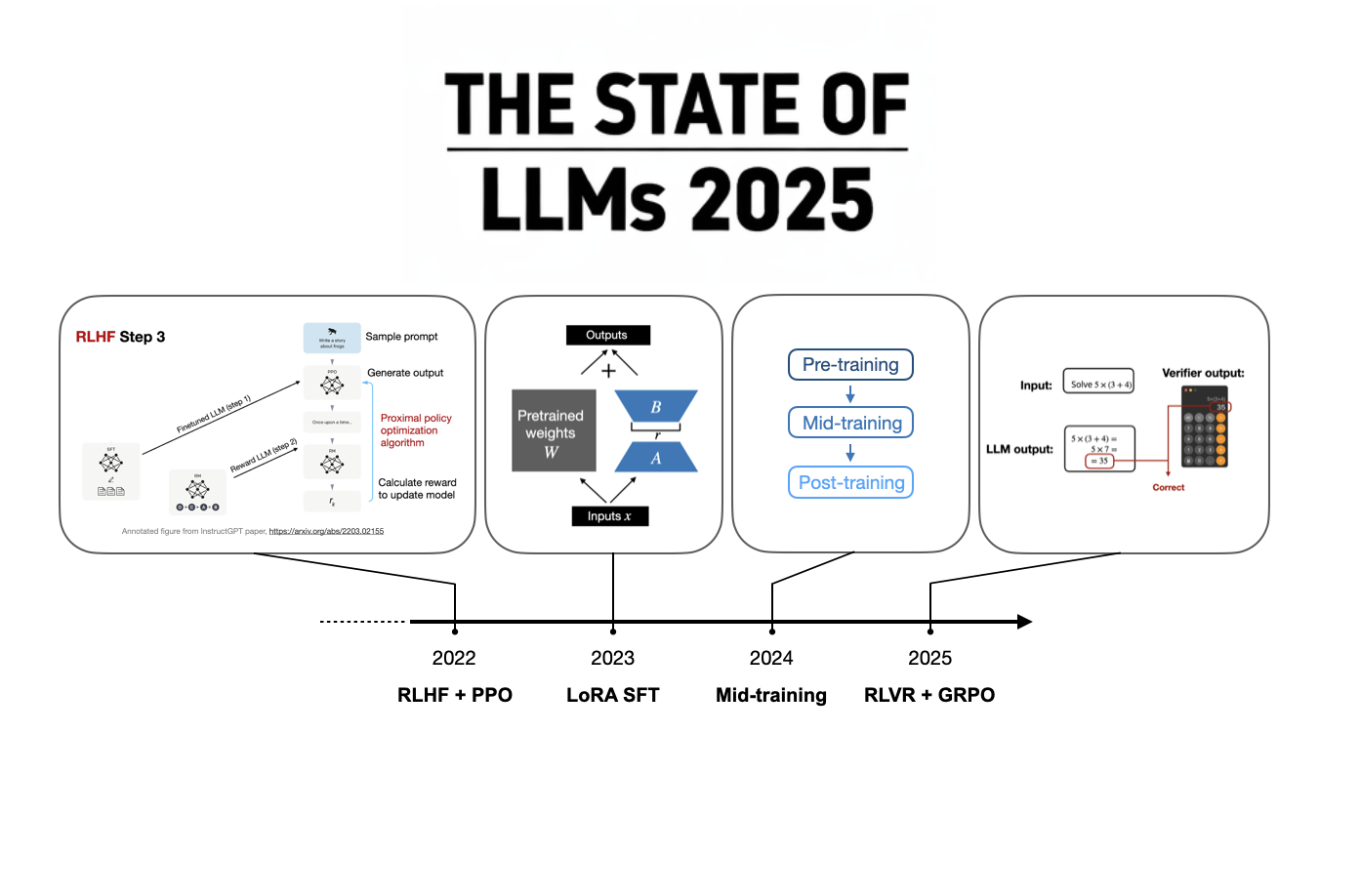
A 2025 review of large language models, from DeepSeek R1 and RLVR to inference-time scaling, benchmarks, architectures, and predictions for 2026.
By Sebastian Raschka, PhD
The paper demonstrates that deep limit order book forecasting models can be repurposed to quantify scenario-conditioned market impact without retraining. By injecting counterfactual order‑book messages into a trained Transformer forecaster, the authors compare predictive distributions before and after the injection, defining a short‑horizon model‑implied market impact. The approach achieves a Spearman correlation of 0.99 and 97.2% directional agreement with historical outcomes for non‑neutral scenarios, and captures incremental sequence‑dependent variation beyond scenario identity and pre‑event forecasts.
By Eljas Linna, Kestutis Baltakys, Derrick Manoharan, Alexandros Iosifidis, Juho Kanniainen
Deep Limit Order Book forecasting models capture nonlinear market dynamics, but their ability to quantify the effects of counterfactual order book messages has not been systematically validated. We in...
arXiv:2604. 06543v2 Announce Type: replace-cross Abstract: In this work, we demonstrate that reliable stochastic sampling is a fundamental yet unfulfilled requirement for Large Language Models (LLMs) operating as agents.
By Xiangming Gu, Soham De, Michalis Titsias, Larisa Markeeva, Petar Veli\v{c}kovi\'c, Razvan Pascanu
arXiv:2608. 11215v1 Announce Type: new Abstract: Simulating societies of many large language model (LLM) agents is expensive, yet the questions asked of such simulations are usually macroscopic: phase behaviour, stylised facts, and scaling with the number of agents $N$, not the cognition of any single agent.
By Igor Itkin
arXiv:2606. 07624v1 Announce Type: new Abstract: This discussion argues that sequential statistical inference can naturally contribute to LLM trustworthiness.
By Yao Xie