The article explains how transformers, which rely on self‑attention, can lose the natural order of time‑series data when fed scalar observations. It discusses the role of positional encoding in re‑introducing sequence order and provides a visual guide to illustrate this concept.
By Gurjinder Kaur
arXiv:2609.37921v1 Announce Type: new
Abstract: What are the inductive biases of a Transformer architecture? Existing theory on how the forward pass shapes representations either considers whether Tr...
By Erkan Turan, Gaspard Abel, Maks Ovsjanikov
arXiv:2602. 18948v2 Announce Type: replace Abstract: Transformer models contain substantial internal redundancy arising from coordinate-dependent representations and continuous symmetries, in model space and in head space, respectively.
By J. Fran\c{c}ois, L. Ravera
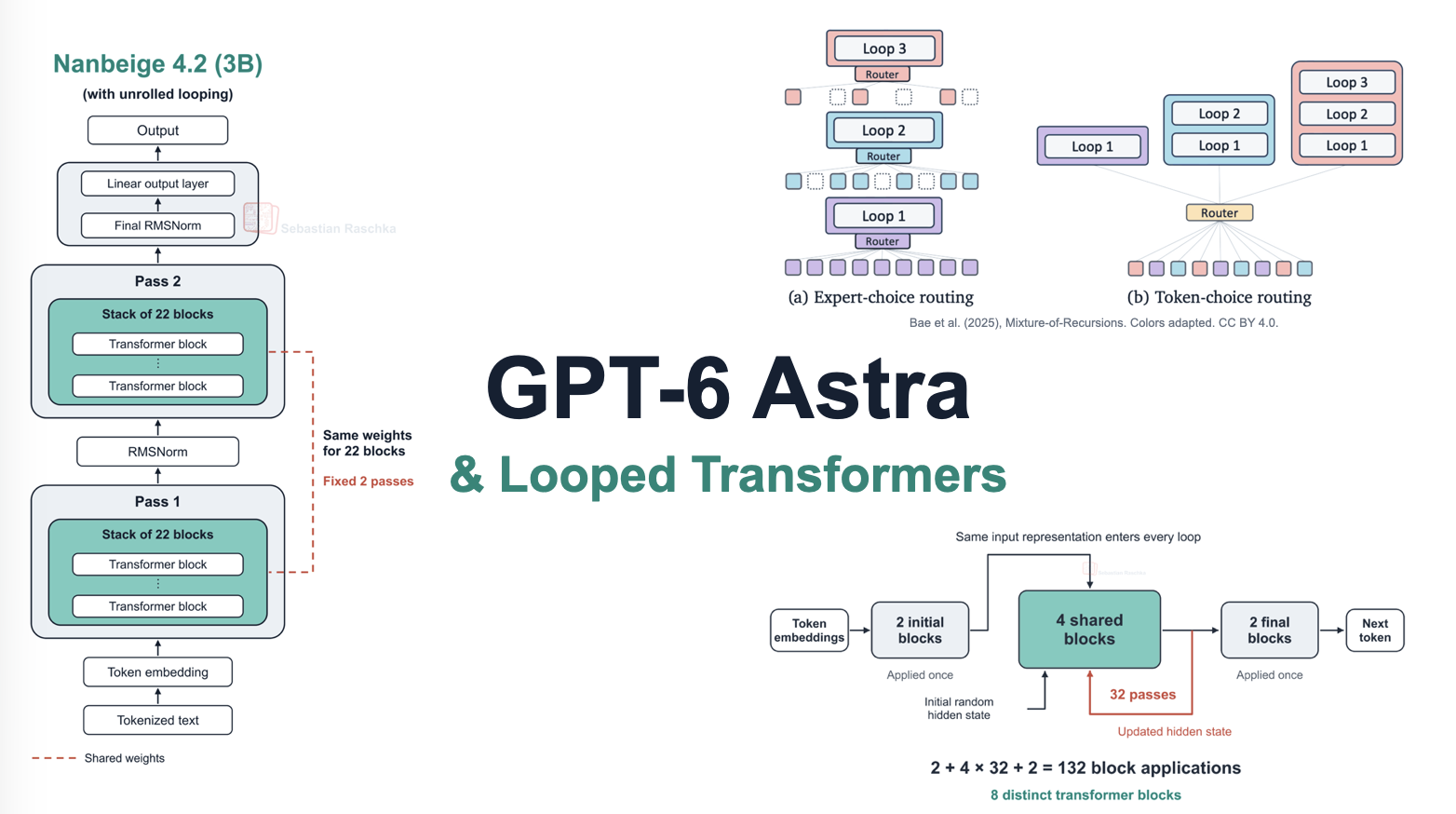
The article titled "GPT-6 Astra, Looped Transformers, and Hidden Reasoning" examines recent developments in transformer architecture, focusing on recurrent depth, hidden chains of thought, and the concept of looping transformer blocks. It discusses how these innovations aim to enhance the reasoning capabilities of language models by allowing deeper, more iterative processing of information. The piece highlights current research trends that explore the potential of these techniques to improve model performance and interpretability.
By Sebastian Raschka, PhD
arXiv:2606. 04032v1 Announce Type: cross Abstract: Transformers have become the standard solution for various AI tasks, with the query, key, and value (QKV) attention formulation playing a central role.
By Ali Kayyam, Anusha Madan Gopal, M Anthony Lewis