arXiv AI
Aug 14
On the Expressive Power of Transformers
arXiv:2608. 12671v1 Announce Type: new Abstract: Multi-layer transformers form the critical component of essentially all large language models (LLMs) in use today.
The paper "An Algebra of Transformers" proposes a formal algebraic framework for reasoning about transformer models, building on functional decomposition results. It introduces atomic actions based on these decompositions, along with sequential and parallel composition, recursion for feedback, and abstraction for hidden layers. This marks the first logical modeling attempt for transformers, enabling verification of transformer‑based applications.
arXiv:2608. 12671v1 Announce Type: new Abstract: Multi-layer transformers form the critical component of essentially all large language models (LLMs) in use today.
The paper introduces fixed universal transformers, which are transformers with immutable internal parameters that can emulate any transformer within a specified class by encoding the target model’s description into the input embedding. The authors provide explicit sparse constructions that achieve universality when the embedding dimension is large enough, and demonstrate that universality is generic—randomly initialized transformers are almost surely universal. Empirical tests on parenthesis balancing and multi‑hop reasoning tasks support the theory, suggesting that a transformer’s expressive power largely stems from its input representation rather than its learned weights.
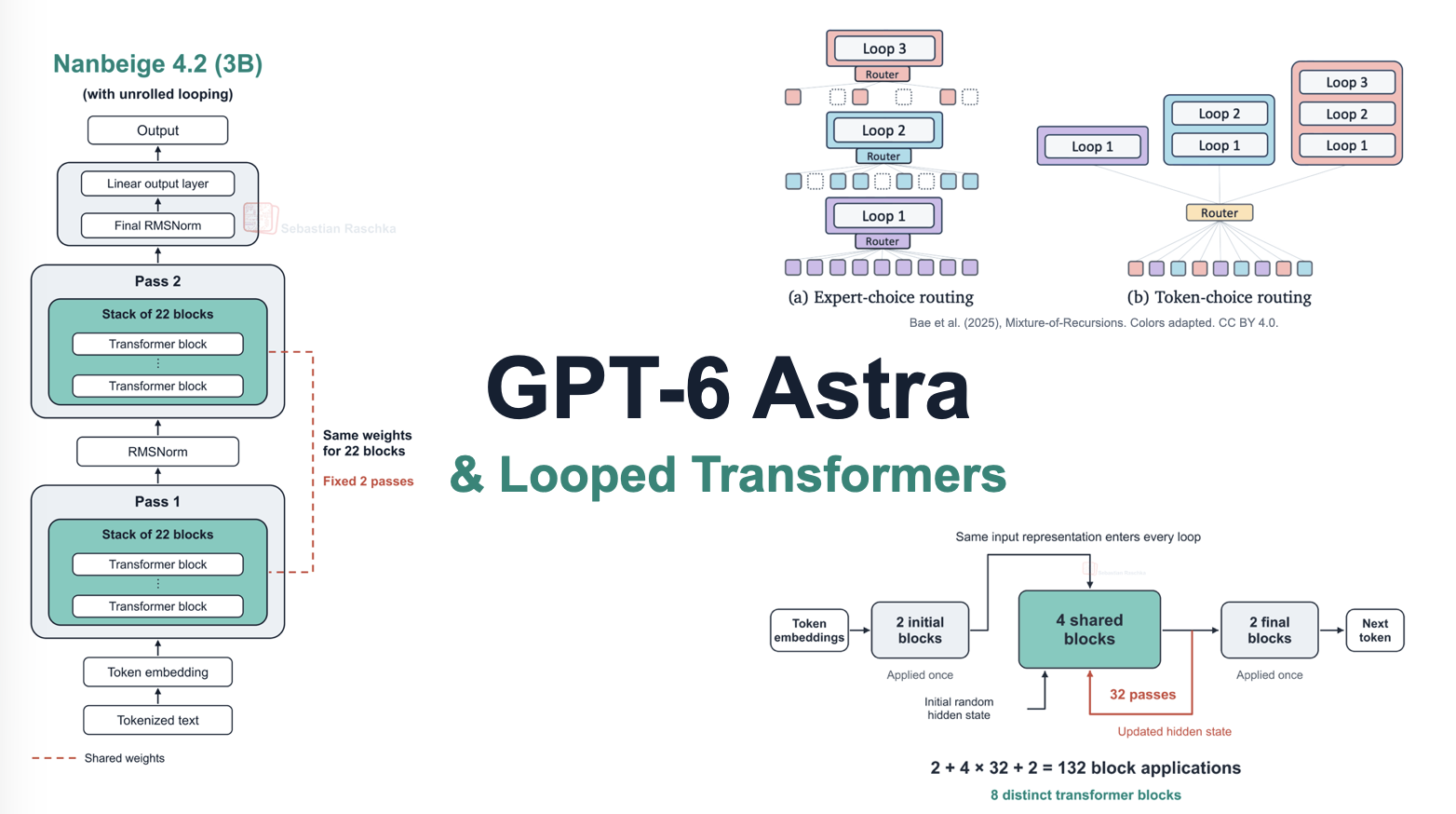
The article titled "GPT-6 Astra, Looped Transformers, and Hidden Reasoning" examines recent developments in transformer architecture, focusing on recurrent depth, hidden chains of thought, and the concept of looping transformer blocks. It discusses how these innovations aim to enhance the reasoning capabilities of language models by allowing deeper, more iterative processing of information. The piece highlights current research trends that explore the potential of these techniques to improve model performance and interpretability.
arXiv:2602. 18948v2 Announce Type: replace Abstract: Transformer models contain substantial internal redundancy arising from coordinate-dependent representations and continuous symmetries, in model space and in head space, respectively.
arXiv:2607. 07066v1 Announce Type: cross Abstract: Transformers have demonstrated a remarkable ability to learn algorithmic reasoning, yet mechanistic analyses have mostly focused on globally invertible operations such as cyclic addition and group composition.
arXiv:2608.31067v1 Announce Type: new Abstract: Learning generalizable algorithmic computations remains a challenge for neural networks, as reflected in persistent failures on compositional and lengt...
arXiv:2603. 02238v2 Announce Type: replace Abstract: Length generalization is a key property of a learning algorithm that enables it to make correct predictions on inputs of any length, given finite training data.
arXiv:2602. 08857v2 Announce Type: replace-cross Abstract: Recent work has shown that the computations of Transformers can be simulated in the RASP family of programming languages.
arXiv:2605. 22223v2 Announce Type: replace Abstract: We study how we can leverage only a handful of characteristics of a transformer's architecture to closely predict the number of different sequences it can output, both qualitatively and quantitatively.
arXiv:2511. 13663v2 Announce Type: replace-cross Abstract: How to construct globally sound abstract interpreters to safely approximate program behaviors remains a bottleneck in abstract interpretation.
arXiv:2603. 19954v2 Announce Type: replace Abstract: Transformers have shown inconsistent success in AI planning tasks, and theoretical understanding of when generalization should be expected has been limited.
The paper proposes LAMP, a look‑ahead mixed‑precision inference method for large language models. By analyzing rounding errors in composed functions, it adaptively selects a small subset of components to compute with higher precision while the rest use lower precision. Experiments on GPT‑2 show that even minimal recomputation can improve accuracy by up to two orders of magnitude.