arXiv:2608. 12671v1 Announce Type: new Abstract: Multi-layer transformers form the critical component of essentially all large language models (LLMs) in use today.
By Phokion Kolaitis, Rik Sengupta
The paper introduces fixed universal transformers, which are transformers with immutable internal parameters that can emulate any transformer within a specified class by encoding the target model’s description into the input embedding. The authors provide explicit sparse constructions that achieve universality when the embedding dimension is large enough, and demonstrate that universality is generic—randomly initialized transformers are almost surely universal. Empirical tests on parenthesis balancing and multi‑hop reasoning tasks support the theory, suggesting that a transformer’s expressive power largely stems from its input representation rather than its learned weights.
By Jingwen Liu, Alexandr Andoni, Daniel Hsu
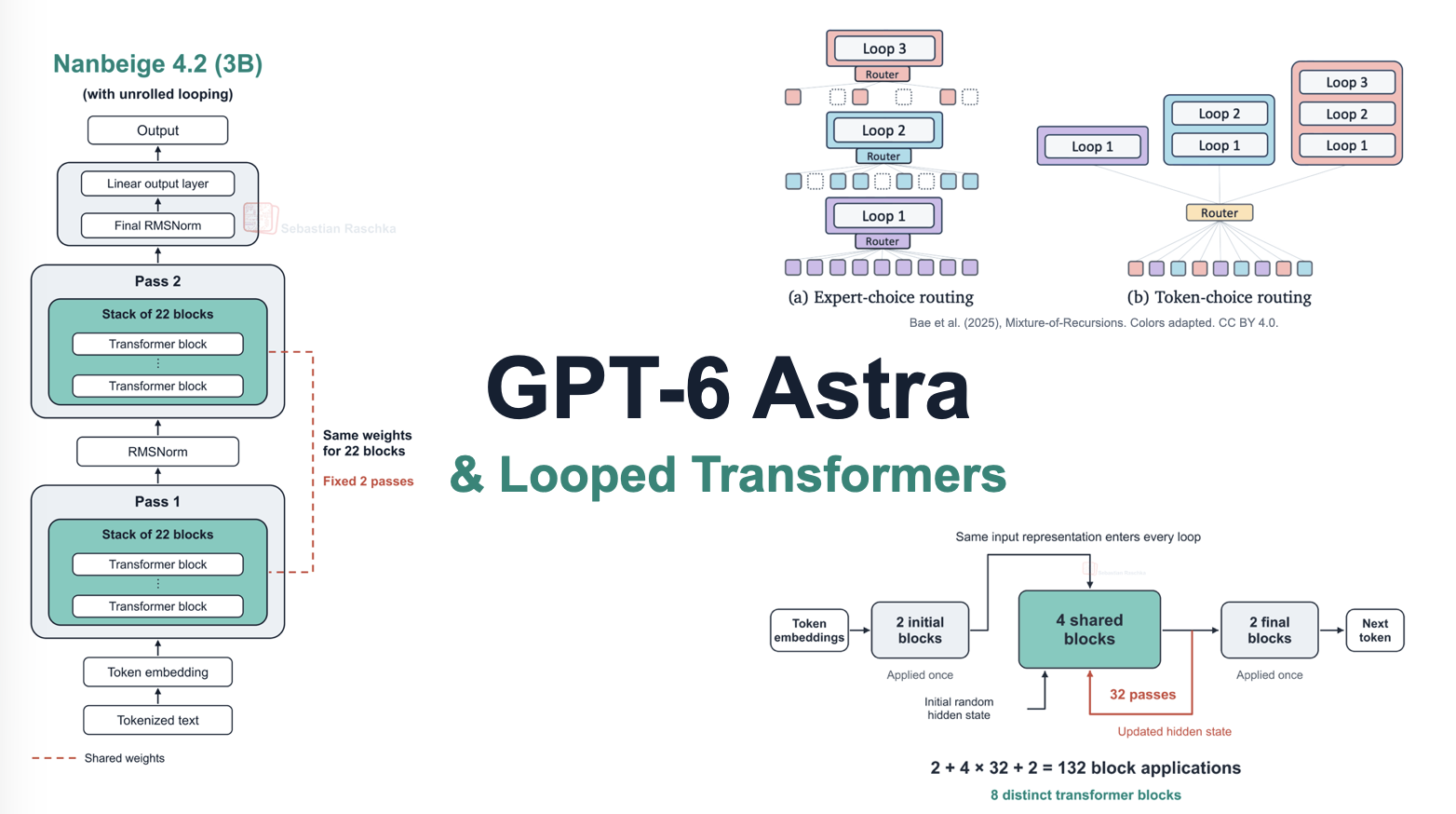
The article titled "GPT-6 Astra, Looped Transformers, and Hidden Reasoning" examines recent developments in transformer architecture, focusing on recurrent depth, hidden chains of thought, and the concept of looping transformer blocks. It discusses how these innovations aim to enhance the reasoning capabilities of language models by allowing deeper, more iterative processing of information. The piece highlights current research trends that explore the potential of these techniques to improve model performance and interpretability.
By Sebastian Raschka, PhD
arXiv:2602. 18948v2 Announce Type: replace Abstract: Transformer models contain substantial internal redundancy arising from coordinate-dependent representations and continuous symmetries, in model space and in head space, respectively.
By J. Fran\c{c}ois, L. Ravera
arXiv:2607. 07066v1 Announce Type: cross Abstract: Transformers have demonstrated a remarkable ability to learn algorithmic reasoning, yet mechanistic analyses have mostly focused on globally invertible operations such as cyclic addition and group composition.
By Zitong Andrew Chen, Junaid Hasan, Akhil Srinivasan, Hemkesh Bandi, Jarod Alper
arXiv:2608.31067v1 Announce Type: new
Abstract: Learning generalizable algorithmic computations remains a challenge for neural networks, as reflected in persistent failures on compositional and lengt...
By Takuya Ito, Ruchir Puri, Murray Campbell, Parikshit Ram