Hugging Face Blog
Announcing NeurIPS 2025 E2LM Competition: Early Training Evaluation of Language Models
Read the original on Hugging Face Blog →The Flow has not summarised this story yet — read it at Hugging Face Blog.
The Flow has not summarised this story yet — read it at Hugging Face Blog.
We introduce Dango, a 1. 8B-parameter large language model designed for controlled studies of L1-to-L2 (Japanese-to-English) transfer in second language acquisition (SLA).
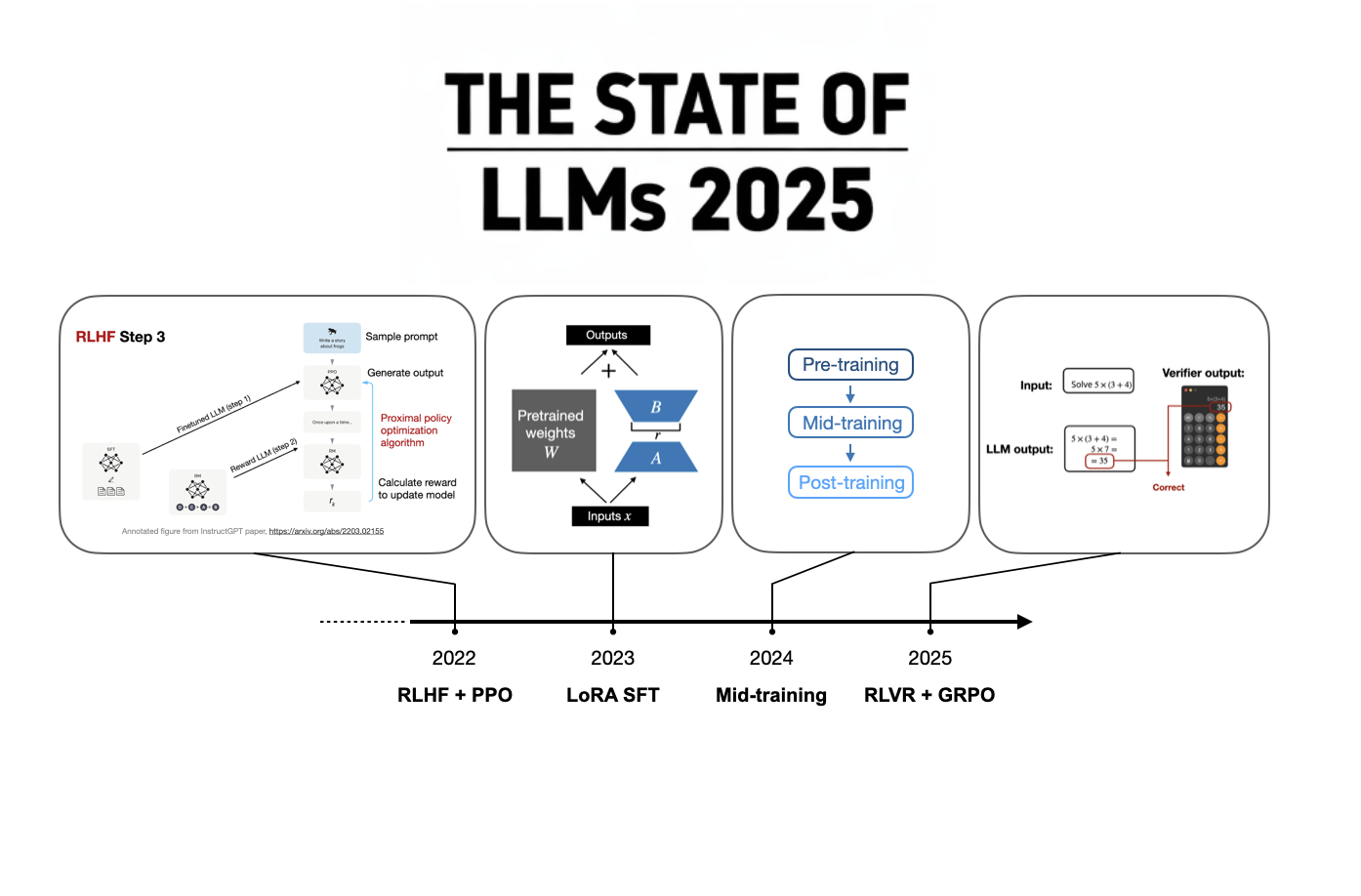
A 2025 review of large language models, from DeepSeek R1 and RLVR to inference-time scaling, benchmarks, architectures, and predictions for 2026.
The paper presents Qwenfant, a Qwen3-based model trained on concise parallel text for the 2026 BabyLM Challenge’s Multilingual track. By leveraging LLM-summarized and translated data, a larger model size, and a character-level vocabulary—both fine-tuned with LoRA—the authors achieve a top ranking in the competition.
The paper compares generative and encoder-based neural models for multilingual Named Entity Recognition (NER) across the eleven languages of the Naamapadam benchmark. Five classic model families, four decoder-only large language models fine‑tuned with LoRA and 4‑bit NF4 quantisation, and nine generative models in zero‑to‑5‑shot inference were evaluated under strict CoNLL span‑level metrics. Encoder-based models (mBERT and XLM‑R) achieved substantially higher F1 scores—up to 0.675 on Hindi—than any generative architecture, with gaps of 7.5–40 percentage points; the best few‑shot result reached only 28% of the encoder baseline. The study identifies three language clusters (encoder‑dominant, partial‑coverage, and failure‑zone) and offers deployment guidelines based on transfer learning and low‑resource NLP principles.
arXiv:2604. 18347v2 Announce Type: replace-cross Abstract: Vision Language Models (VLMs) achieved rapid progress in the recent years.
Large Language Models: A Plain-Language Overview for Engineers explains that LLMs are neural networks trained on vast text collections to predict subsequent words, and outlines key concepts such as Transformers, pre‑training, fine‑tuning, reinforcement learning from human feedback, retrieval‑augmented generation, chain‑of‑thought prompting, and tool‑using agents. It also discusses efficiency techniques like FlashAttention and QLoRA, provides a life‑cycle figure and comparative tables, and offers a checklist for evaluating LLM claims, including checks for data contamination, model‑based grading, long‑context handling, and hallucination. The article aims to give engineers a clear picture of how training changes and prompts affect generative AI tools like ChatGPT.