Hugging Face Blog
Dec 5, 2023
arXiv:2606. 17104v1 Announce Type: cross Abstract: As large language models (LLMs) are increasingly deployed in latency- and cost-sensitive settings, inference efficiency has become a central systems challenge.
arXiv:2607. 02521v1 Announce Type: cross Abstract: SwiGLU is the dominant MLP activation in modern large language models, yet its intermediate tensor materialization costs 9-37% of MLP execution time.
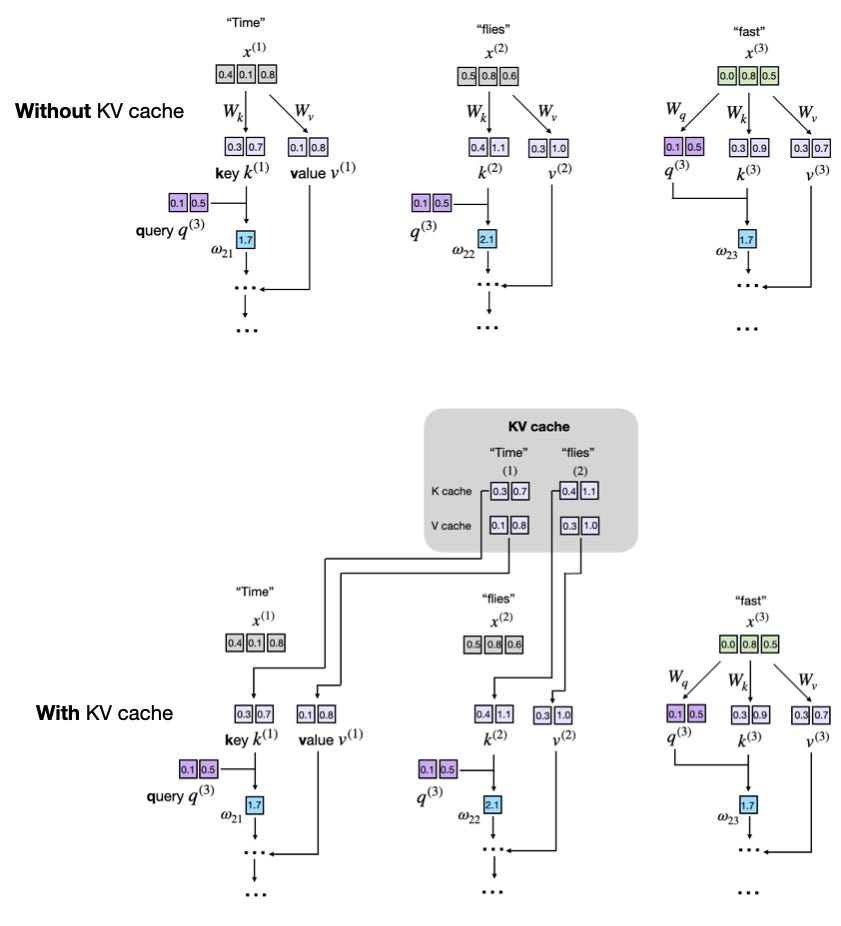
KV caches are one of the most critical techniques for efficient inference in LLMs in production.
arXiv:2607. 11211v1 Announce Type: new Abstract: The popularity of large language models (LLMs) escalates an ongoing demand for effective inference.
arXiv:2608.21836v1 Announce Type: new Abstract: Large language models have become increasingly capable agents for low-level code and kernel optimization, but isolated kernel benchmarks provide only a...
arXiv:2606. 16352v1 Announce Type: cross Abstract: Computation integrity of remote large language model (LLM) serving can be questionable.
The paper reports the development of 2‑bit microkernels for CPUs and mixed‑precision 2‑bit kernels for Intel Xe2 GPUs, achieving near‑roofline performance. Integrated into LLM inference pipelines, these kernels deliver up to 7× speedup over 16‑bit inference on CPUs and 6.7× on GPUs, surpassing the current state‑of‑the‑art bitnet.cpp runtime by 2.2×. The work demonstrates that ultra‑low‑bit LLM models can be deployed efficiently, offering significant gains in latency, memory, throughput, and energy consumption.
SpecQuant is a training‑free framework that merges speculative decoding with multi‑parent quantization to enable adaptive, efficient inference of large language models. It generates several quantized variants (INT4, FP8, FP16) from a single base model and routes queries to the appropriate variant based on predicted complexity, using lightweight models for simple tasks and full‑precision models for complex reasoning. Evaluations on Qwen2.5 models across MMLU, AlpacaEval, and GSM8K show 35‑43% speedups with less than 2% accuracy loss, facilitating practical on‑device LLM deployment without specialized infrastructure.