Hugging Face Blog
Nov 19, 2024
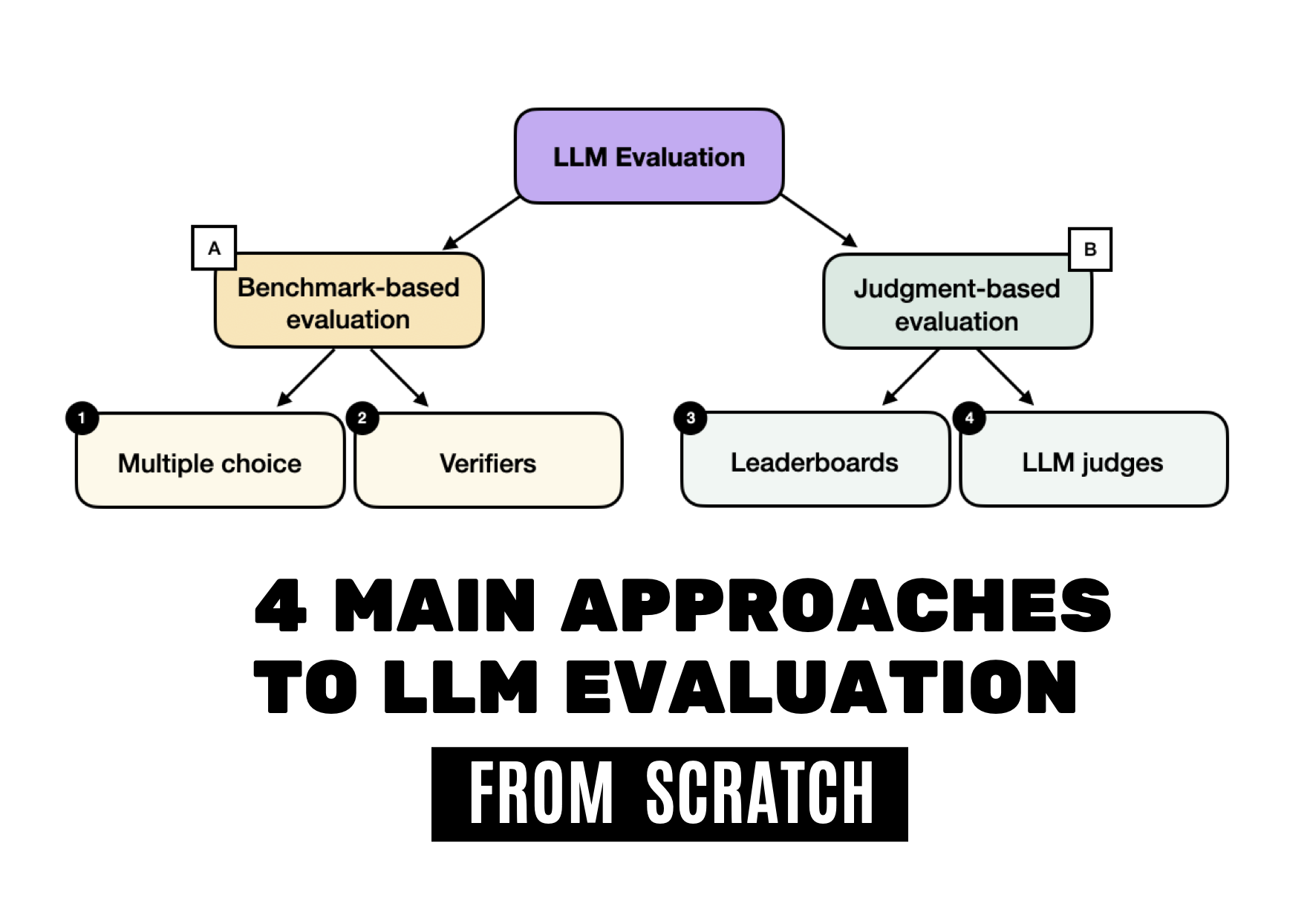
Multiple-Choice Benchmarks, Verifiers, Leaderboards, and LLM Judges with Code Examples
arXiv:2608. 04714v1 Announce Type: cross Abstract: Benchmark scores are reported as properties of a model, yet the inference framework used to produce them, such as HuggingFace, vLLM, or Ollama, are considered non-influential and their names and versions are almost never disclosed.
arXiv:2607. 14108v1 Announce Type: cross Abstract: This paper introduces tool efficiency, a new quantitative metric to evaluate the rate of useful tool calls in an LLM agent trajectory.
The study analyzes 373,019 judgments from LLM‑scored benchmarks, decomposing variance into system, item, judge, and interaction components via generalizability theory. It finds that with a single judge, generalizability converges to a ceiling determined by the system‑by‑judge variance, which is substantially lower in pairwise preference settings, allowing one judge to suffice. The research also reveals significant biases in presentation order and highlights that many published win‑rate claims fall below the measured floor of the benchmarks.
arXiv:2602. 16111v2 Announce Type: replace-cross Abstract: Online media platforms track the share of impressions associated with content attributes, or prevalence, to evaluate trade-offs and set guardrails in A/B experiments.
The study compares Jev, a typed classifier that outputs probabilities over allowed answers, with three flash-tier LLM rubric judges across nine panels from seven benchmarks. Jev’s accuracy differs significantly from an LLM judge in only 8 of 27 paired comparisons, performing best on binary criteria and worse only on graded ones, while most other comparisons are inconclusive. In terms of cost and speed, Jev is 29 to 325 times cheaper and 30 to 220 times faster than the LLM judges, and a cascade that defers uncertain Jev verdicts to an LLM yields only modest gains of up to 2.0 points over the best single judge.
arXiv:2607. 02574v1 Announce Type: cross Abstract: The key-value (KV) cache has become a first-order memory object in LLM serving rather than a temporary per-request tensor.
The study investigates whether Jev, a typed classifier that outputs probabilities over allowed answers without generating text, can replace large language model (LLM) rubric judges. Across nine panels from seven benchmarks, Jev’s accuracy differed significantly from LLM judges in only 8 of 27 paired comparisons, performing best on binary criteria and worse only on graded ones, while most other comparisons were inconclusive. In terms of cost and speed, Jev was 29 to 325 times cheaper and 30 to 220 times faster than the flash‑tier LLM judges, and a cascade approach that defers uncertain Jev verdicts to an LLM yielded only modest gains. whyItMatters":"The findings suggest that a lightweight classifier like Jev can serve as an efficient first‑stage evaluator, potentially reducing the reliance on expensive and slow LLM judges in automated grading pipelines."
arXiv:2602. 03238v3 Announce Type: replace Abstract: LLM agent benchmark scores are shaped not only by the model but also by the agent harness, environment, evaluator, and inference budget.