The article explains how transformers, which rely on self‑attention, can lose the natural order of time‑series data when fed scalar observations. It discusses the role of positional encoding in re‑introducing sequence order and provides a visual guide to illustrate this concept.
By Gurjinder Kaur
arXiv:2609.37921v1 Announce Type: new
Abstract: What are the inductive biases of a Transformer architecture? Existing theory on how the forward pass shapes representations either considers whether Tr...
By Erkan Turan, Gaspard Abel, Maks Ovsjanikov
arXiv:2602. 18948v2 Announce Type: replace Abstract: Transformer models contain substantial internal redundancy arising from coordinate-dependent representations and continuous symmetries, in model space and in head space, respectively.
By J. Fran\c{c}ois, L. Ravera
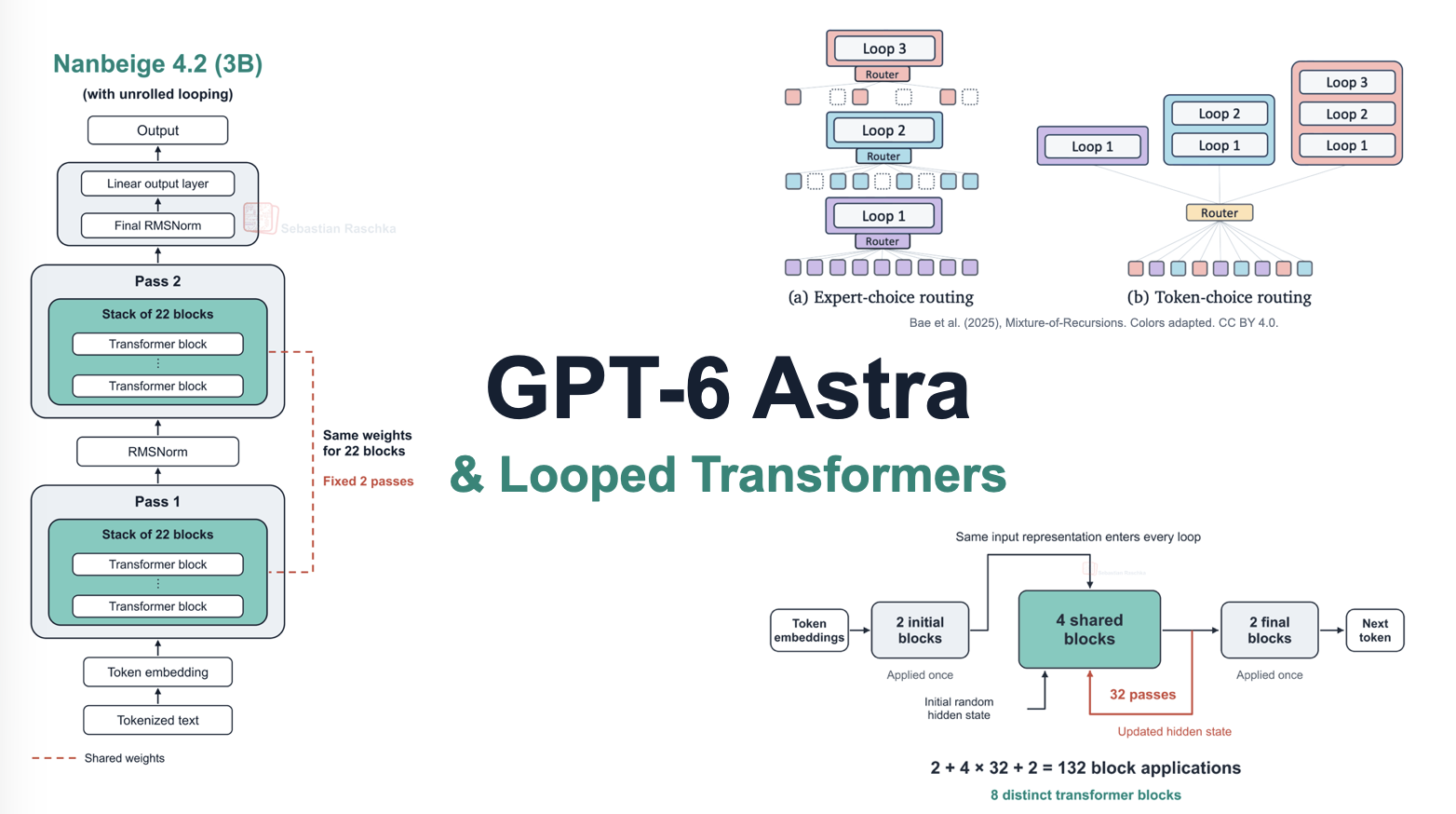
The article titled "GPT-6 Astra, Looped Transformers, and Hidden Reasoning" examines recent developments in transformer architecture, focusing on recurrent depth, hidden chains of thought, and the concept of looping transformer blocks. It discusses how these innovations aim to enhance the reasoning capabilities of language models by allowing deeper, more iterative processing of information. The piece highlights current research trends that explore the potential of these techniques to improve model performance and interpretability.
By Sebastian Raschka, PhD
arXiv:2606. 04032v1 Announce Type: cross Abstract: Transformers have become the standard solution for various AI tasks, with the query, key, and value (QKV) attention formulation playing a central role.
By Ali Kayyam, Anusha Madan Gopal, M Anthony Lewis
The paper "An Algebra of Transformers" proposes a formal algebraic framework for reasoning about transformer models, building on functional decomposition results. It introduces atomic actions based on these decompositions, along with sequential and parallel composition, recursion for feedback, and abstraction for hidden layers. This marks the first logical modeling attempt for transformers, enabling verification of transformer‑based applications.
By Yong Wang, Zhiyan Wang, Hexiao Kang
arXiv:2604. 15010v2 Announce Type: replace-cross Abstract: When do transformers commit to a decision, and what prevents them from correcting it?
By \'Eric Jacopin
Activation patching reveals how facts are stored, routed, and read out across transformer layers, and why the residual stream does most of the work The post A Three-Phase Factual Recall Circuit in Gemma-2B and Gemma-12B-IT appeared first on Towards Data Science .
By Subhanga Upadhyay
arXiv:2606. 17830v1 Announce Type: cross Abstract: Neural network parameter spaces are inherently non-injective, as distinct parameter configurations can realize identical functions through functional equivalence.
By Viet-Hoang Tran, Vinh Khanh Bui, Van-Hoan Trinh, Tan Lai Ngoc, Tan M. Nguyen
The paper examines how to allocate attention heads and head dimensions across Transformer layers to balance expressivity and efficiency. It provides a mathematical analysis of early layers’ role in information extraction and characterizes the trade‑off between head count and dimension under a fixed parameter budget. The authors prove a saturation effect of softmax activations, showing that increasing head dimensions yields diminishing returns, especially for long sequences, and propose strategies for efficient parameter allocation across layers.
By Ruoxi Yu, Haotian Jiang, Jingpu Cheng, Penghao Yu, Qianxiao Li, Zhong Li
arXiv:2610.22796v1 Announce Type: new
Abstract: Reusing a Transformer block across depth increases computation without replicating its parameters, but successive passes have no dedicated state throug...
By Ilia Zaznov