arXiv:2602. 07488v3 Announce Type: replace-cross Abstract: Despite the fact that experimental neural scaling laws have substantially guided empirical progress in large-scale machine learning, no existing theory can quantitatively predict the exponents of these important laws for any modern LLM trained on any natural language dataset.
By Francesco Cagnetta, Allan Ravent\'os, Surya Ganguli, Matthieu Wyart
arXiv:2602. 03685v2 Announce Type: replace-cross Abstract: Training large language models (LLMs) is computationally expensive, partly because the loss exhibits slow power-law convergence whose origin remains debatable.
By Yizhou Liu, Ziming Liu, Cengiz Pehlevan, Jeff Gore
arXiv:2606. 25008v1 Announce Type: new Abstract: Neural scaling laws describe how pre-training loss decays as power laws with training time, model size, and compute.
By Yizhou Liu, Jeff Gore
arXiv:2606. 24504v1 Announce Type: new Abstract: We discuss reasons why the scaling exponents of current Large Language Models (LLMs) applications are indicating an unsustainable regime in terms of energy resources.
By Sauro Succi, Peter V. Coveney, Alex Hansen
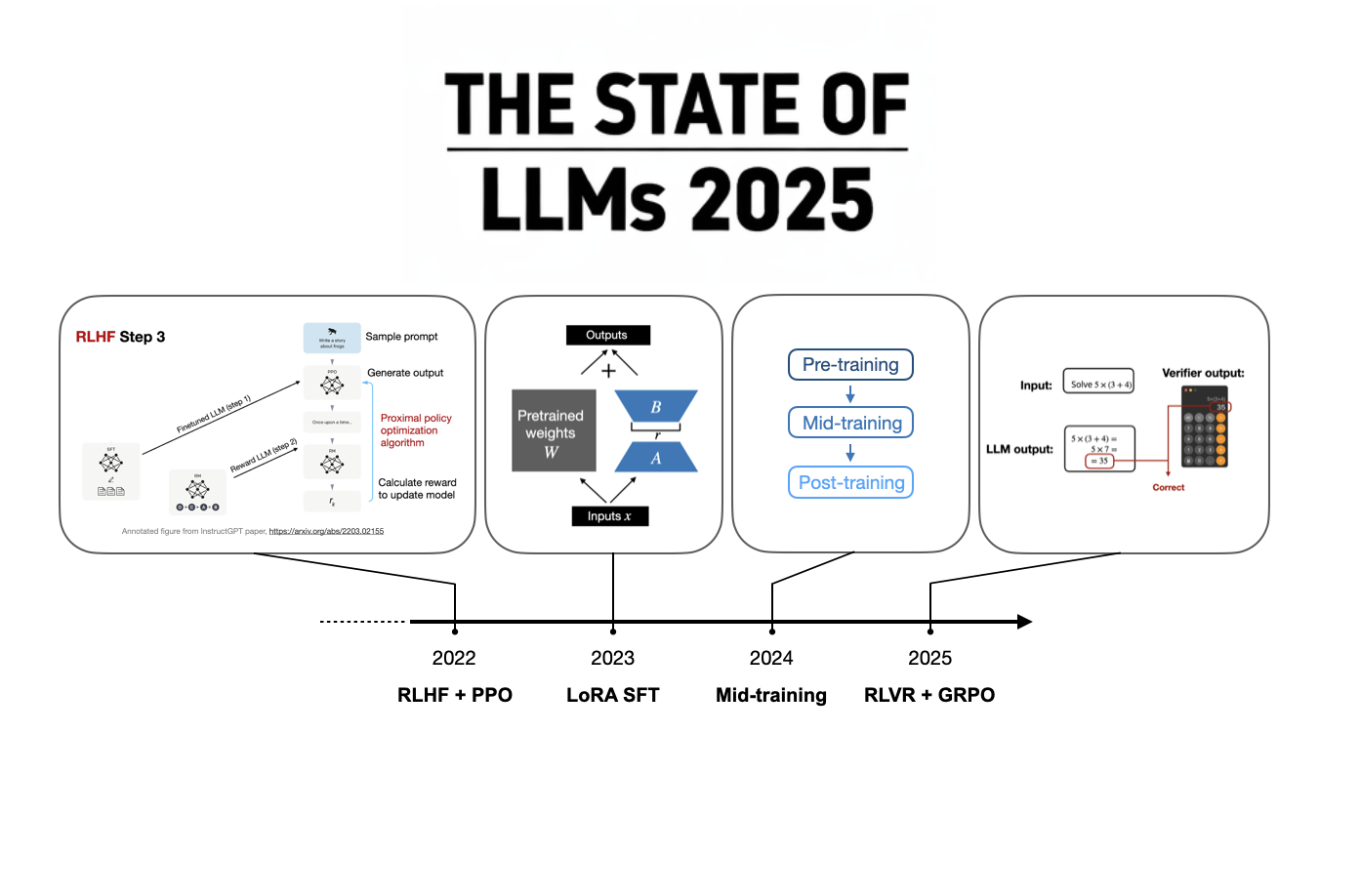
A 2025 review of large language models, from DeepSeek R1 and RLVR to inference-time scaling, benchmarks, architectures, and predictions for 2026.
By Sebastian Raschka, PhD
The paper investigates the often-overlooked scale vectors in large language models, showing that despite their tiny size they are crucial for pre‑training performance. The authors provide theoretical insights that scale vectors mainly aid optimization rather than expressivity, and they analyze how weight decay affects different normalization layers. Building on these findings, they propose lightweight improvements—branch‑specific heterogeneity, better placement, and magnitude‑direction reparameterization—that consistently reduce loss across a range of model sizes and training settings.
By Mingze Wang, Shuchen Zhu, Yuxin Fang, Binghui Li, Kai Shen, Shu Zhong
arXiv:2606. 03990v1 Announce Type: new Abstract: We investigate whether neuron populations within neural networks evolve predictably with scale, extending scaling laws beyond macroscopic observables such as loss.
By Amil Dravid, Yasaman Bahri, Alexei A. Efros, Yossi Gandelsman
We use GPT-4 to automatically write explanations for the behavior of neurons in large language models and to score those explanations. We release a dataset of these (imperfect) explanations and scores for every neuron in GPT-2.
The paper investigates how learning rate and batch size scale when pretraining dense large language models on English‑prevalent corpora, examining both jointly optimal and marginal evolutions across model capacity and data size. It explores the benefits of a Warmup‑Stable‑Decay learning‑rate schedule, assessing whether optimal hyperparameters transfer between stable and decay phases, and evaluates loss scaling forms that capture interactions between model capacity and dataset size. The study provides a baseline scaling procedure and releases the full set of pretraining runs for future OpenEuroLLM development.
By Niccol\`o Ajroldi, Diana Alexandra Onutu, Haider Al-Tahan, J\"org Franke, Sampo Pyysalo, Jenia Jitsev, Aaron Klein