Hugging Face Blog
Oct 3, 2022
arXiv:2607. 20434v1 Announce Type: cross Abstract: As the parameter size of language models continues to grow, effective model compression is required to reduce their computational and memory overhead.
arXiv:2606. 02328v1 Announce Type: new Abstract: We explore Riemannian optimization techniques for rank-factored matrix parameters, targeting contemporary deep learning applications.
The paper studies matrices built from block‑diagonal factors interleaved with fixed permutations, a structured family useful in deep learning for balancing expressivity and efficiency. By applying Riemannian geometry, the authors determine when this class forms a smooth manifold and develop Riemannian tools for the orthogonal two‑factor case. They propose efficient algorithms that use automatic differentiation, allow parameter sharing, and avoid dense matrix construction, testing them on matrix approximation and fine‑tuning large language models, while also exploring properties of factorizations with more factors.
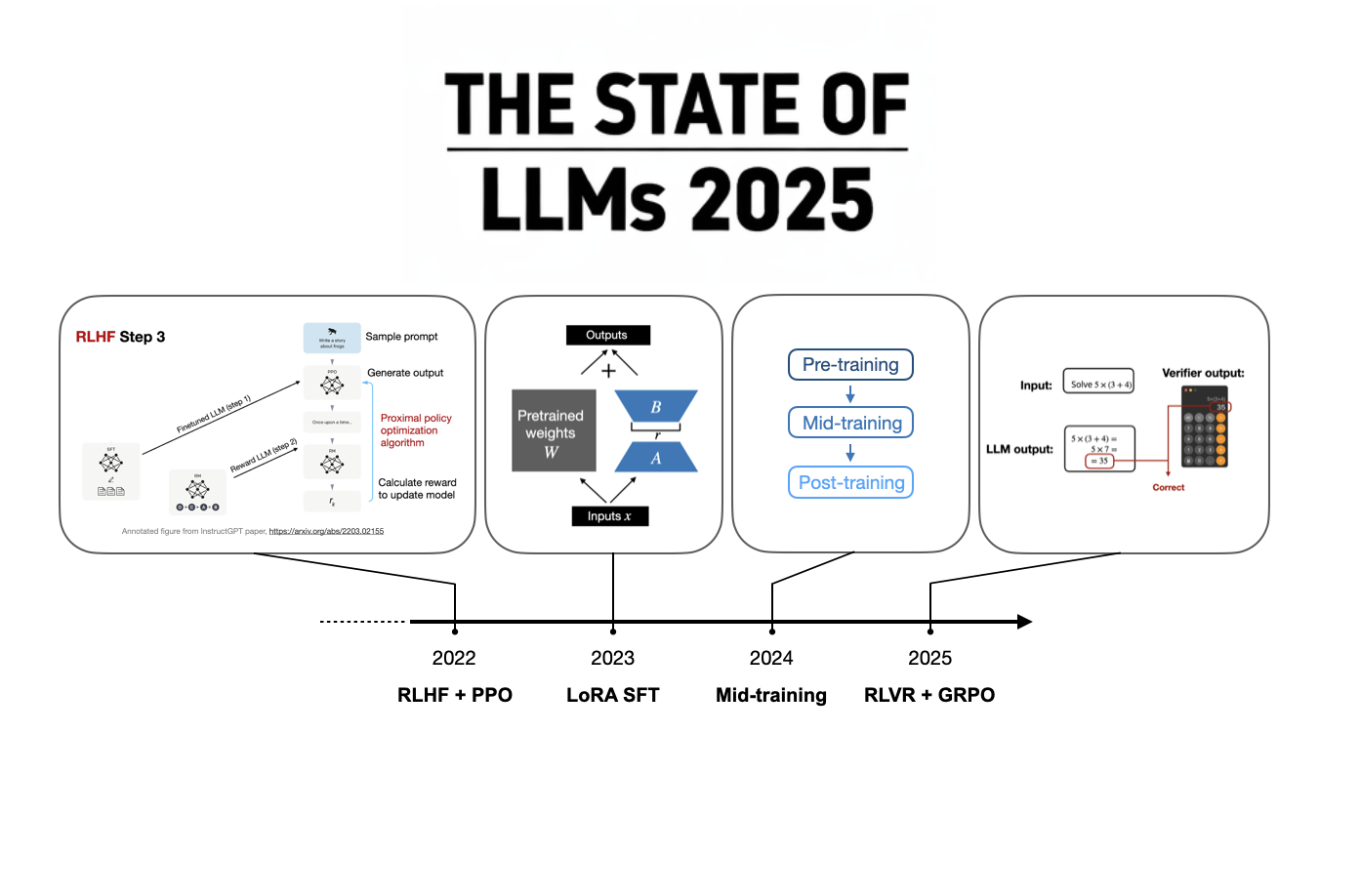
A 2025 review of large language models, from DeepSeek R1 and RLVR to inference-time scaling, benchmarks, architectures, and predictions for 2026.
Residual sparsification via output importance (PARSER) is a new compression technique for mixture-of-experts large language models that shifts the compression objective from minimizing isolated matrix errors to preserving the expert output error. By introducing output importance, PARSER measures each residual’s contribution to the final expert output and compresses accordingly. Experiments show that PARSER reduces the accuracy gap to the uncompressed model by 1.41× on Qwen and 1.44× on DeepSeek while achieving the same peak memory reduction.
arXiv:2609.12475v1 Announce Type: new Abstract: Comprehensive benchmark suites are essential for improving large language models (LLMs), but many widely used benchmarks are redundant, making evaluati...