Hugging Face Blog
Oct 27, 2023
The paper investigates whether reinforcement‑learning post‑training of code‑generating large language models can be done entirely offline using existing datasets, avoiding costly online code generation and GPU‑CPU communication. Experiments show that a few hours of offline RL can substantially boost zero‑shot code generation performance across models from 0.5 B to 7 B parameters, though the magnitude of improvement differs by model family.
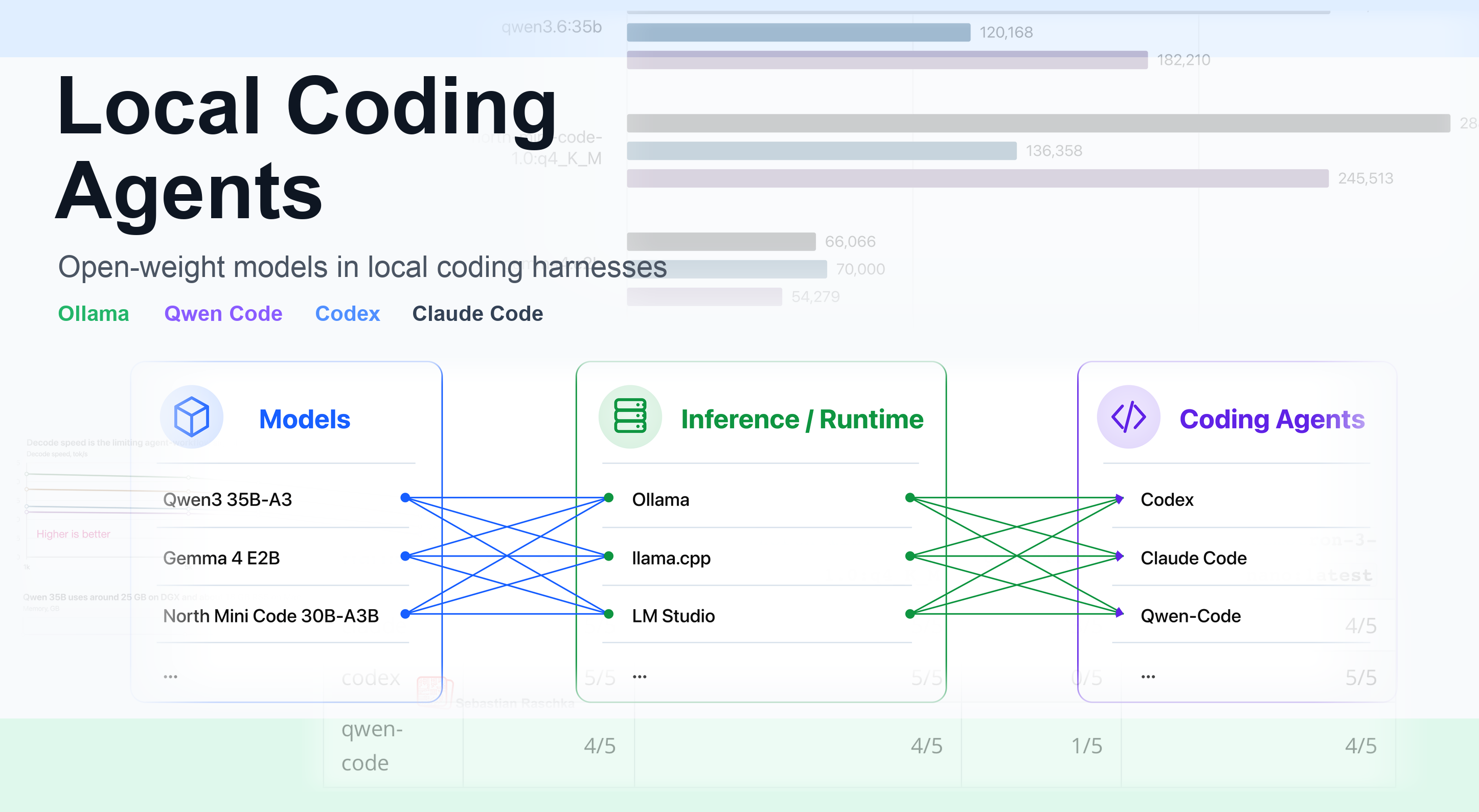
Using Open-Weight Models in Local Coding Harnesses as an Alternative to Claude Code and Codex Subscriptions
The paper investigates using synthetic natural-language descriptions to contrastively pretrain small transformer encoders for code representation. By pairing generated descriptions with code in a dual-encoder setup during training and discarding them at inference, the authors achieve significant improvements over traditional pretraining baselines on most evaluated tasks. When fine‑tuned, these models match or surpass much larger zero‑shot models and remain competitive with execution‑aware supervision, indicating a scalable alternative for code embeddings.
arXiv:2608. 15412v1 Announce Type: cross Abstract: Encoder-based code representation models remain widely deployed for discriminative tasks such as clone detection and code classification, where their small size and low inference cost are decisive.
arXiv:2609.22068v1 Announce Type: new Abstract: Training capable coding agents via reinforcement learning (RL) requires diverse tasks with reliable verifiers. Open-source codebases offer a rich sourc...
Context lengths of language models (LMs) have dramatically increased, driven by the demands for in-context learning, self-improvement, and long-horizon agentic workflows. Existing long-context corpora, however, are dominated by books, academic articles, and code repositories, which are finite resources and often scarce in long-distance dependencies.