arXiv:2602. 03685v2 Announce Type: replace-cross Abstract: Training large language models (LLMs) is computationally expensive, partly because the loss exhibits slow power-law convergence whose origin remains debatable.
By Yizhou Liu, Ziming Liu, Cengiz Pehlevan, Jeff Gore
arXiv:2610.04867v2 Announce Type: replace-cross
Abstract: Greedy block-wise local learning splits a network into gradient-isolated blocks trained by local auxiliary losses, deleting the backward pass...
By Jihwan Moon, Sheir A. Zaheer, Jinmyoung Lee, Gunhee Kim, Chan Y. Park
arXiv:2605. 13026v2 Announce Type: replace-cross Abstract: Masked diffusion models (MDMs) have emerged as a promising alternative to autoregressive models (ARMs) for language modeling.
By Chunsan Hong, Sanghyun Lee, Chieh-Hsin Lai, Satoshi Hayakawa, Yuhta Takida, Yuki Mitsufuji, Seungryong Kim, Jong Chul Ye
The paper investigates why large language models sometimes hallucinate when asked about facts in a language different from the one in which the facts were learned. By training small Transformer models on synthetic multilingual datasets, the authors show that the degree of correlation between facts and their learning language (informativeness) and the ease of language identification (extractability) determine whether models develop unified or separate representations across languages. Unified representations enable cross‑lingual fact transfer, while separate representations do not. The study proposes a unifying perspective on cross‑lingual transfer and suggests training methods to promote representational unification.
By Carter Blum, Katja Filippova, Ann Yuan, Asma Ghandeharioun, Julian Zimmert, Fred Zhang, Jessica Hoffmann, Tal Linzen, Martin Wattenberg, Lucas Dixon, Mor Geva
The paper presents quantitative generalization bounds for fixed‑precision transformer models, addressing both in‑distribution statistical generalization and length generalization. It derives guarantees based on model parameters, quantization space, and alphabet size, and shows how training length and sample size trade off, with longer training being exponentially more efficient. Experiments confirm the theoretical predictions.
By Marius Henry, Michael Rizvi-Martel, Michael Hahn
The paper proposes an information-weighted cross‑entropy loss that rescales token contributions using TF‑IDF statistics, thereby emphasizing semantically informative tokens and down‑weighting ubiquitous ones. Experiments on five decoder‑only language models (1.1B–13B parameters) show consistent reductions in memorized substring length while maintaining perplexity and downstream performance. The method is architecture‑agnostic, adds less than 3% computational overhead, and can be integrated into existing training pipelines.
By Zhijian Li, Stefan Larson, Kevin Leach
Large language models are typically trained under uniform token weighting, which allows frequent and low-information tokens to dominate learning and can increase the tendency to memorize surface-level...
arXiv:2607. 11760v1 Announce Type: new Abstract: A theoretical understanding of Transformers is crucial to better understand the capacities and limitations of large language models (LLMs).
By Michael Rizvi-Martel, Satwik Bhattamishra, Guillaume Rabusseau, Michael Hahn
arXiv:2606. 25777v1 Announce Type: cross Abstract: We initiate a resource-aware theory of \textit{language generation in the limit} under the minimal constraint of space efficiency.
By Nicolas Flammarion, Chirag Pabbaraju, Hristo Papazov, Miltiadis Stouras, Ola Svensson
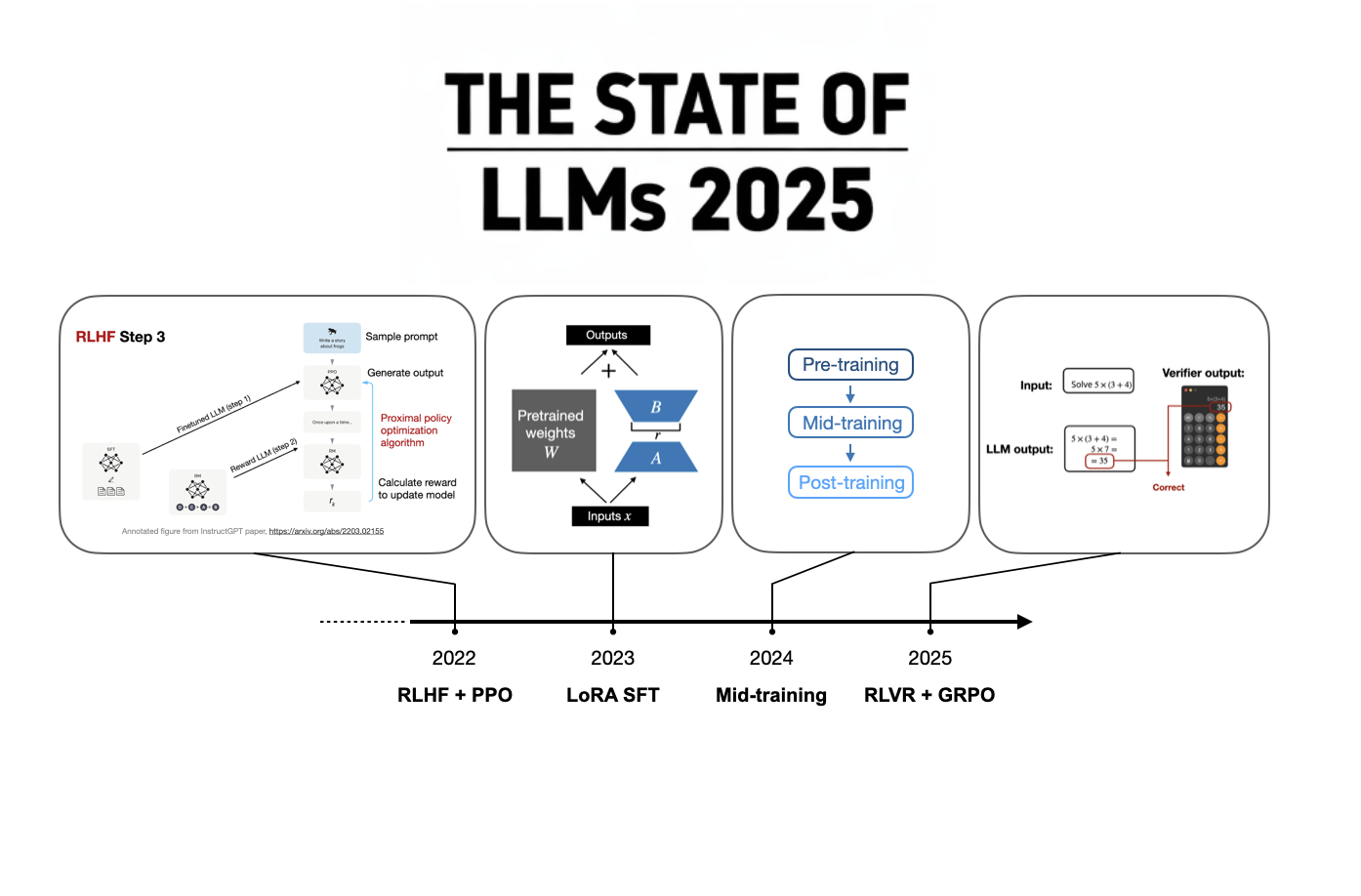
A 2025 review of large language models, from DeepSeek R1 and RLVR to inference-time scaling, benchmarks, architectures, and predictions for 2026.
By Sebastian Raschka, PhD
arXiv:2602. 07488v3 Announce Type: replace-cross Abstract: Despite the fact that experimental neural scaling laws have substantially guided empirical progress in large-scale machine learning, no existing theory can quantitatively predict the exponents of these important laws for any modern LLM trained on any natural language dataset.
By Francesco Cagnetta, Allan Ravent\'os, Surya Ganguli, Matthieu Wyart
The paper demonstrates that Large Language Models, despite their non‑linear components, exhibit a fundamental linearity property: when inputs from two distinct text streams are linearly combined, the model outputs a superposition of the individual next‑token distributions. This "Superposition Linearity Hypothesis" appears to be an intrinsic feature of the Transformer architecture, tends to weaken during pretraining, but can be largely restored with lightweight fine‑tuning. The authors also present a guided decoding method that separates the superposed outputs, allowing two coherent continuations to be generated from a single forward pass.
By Pavel Tikhonov, Anton Korznikov, Matvey Mikhalchuk, Nikita Dragunov, Temurbek Rahmatullaev, Polina Druzhinina, Anton Razzhigaev, Ivan Oseledets, Elena Tutubalina