arXiv:2608. 13826v1 Announce Type: cross Abstract: Machine learning is increasingly used to learn structure property relationships from spectroscopic and diffraction data, yet its adoption in materials discovery is often limited by poor interpretability of model predictions.
By Aditya Raghavan, Utkarsh Pratiush, Dalton A. Pearl, Jade Holliman Jr, Katharine Page, Philip D Rack, Sergei V Kalinin
arXiv:2609.06232v1 Announce Type: cross
Abstract: Ground-truth defect masks in industrial inspection datasets are typically reserved for evaluation. This paper repurposes them as spatial supervision...
By Sajjad Rezvani Boroujeni, Muskan Saraf, Gnana Tulasi Makineni, Tom Bush, Hossein Abedi
Sinter-PiNDiff is a retrainable physics‑integrated neural differentiable framework that predicts density and grain‑size evolution during sintering. It uses two neural networks to learn densification and grain‑growth coefficients within coupled rate equations, and a smooth saturation factor to limit densification near theoretical density. When trained on published data for MgO, Al‑doped ZnO, and CaO‑doped ThO₂, the model achieved the lowest mean errors across twelve material‑metric comparisons compared to multilayer perceptron and residual network baselines, demonstrating the importance of density‑dependent kinetic feedback and providing uncertainty estimates via deep ensembles.
By Zeping Chen, Ani Aprahamian, Khachatur V. Manukyan, Tengfei Luo
The paper introduces TEEP‑RCNN, a two‑stage detector that augments Faster R‑CNN with a Feature Pyramid Network backbone and an enhanced Convolutional Block Attention Module (CBAM) featuring dropout in the channel attention MLP and batch‑norm in the spatial attention branch. Training employs a differential learning‑rate schedule with cosine‑annealing warm‑up, and inference uses Test‑Time Augmentation combined with Weighted Box Fusion to stabilize localization of elongated and boundary‑adjacent defects. On the NEU‑DET benchmark, TEEP‑RCNN attains 73.3 % mAP@50 and 37.9 % mAP@50‑95 in only ten epochs on a single GPU, matching or surpassing YOLOv11m while excelling on the rolled‑in‑scale defect category under the COCO metric.
By Kirtan Rajesh
arXiv:2606. 08161v1 Announce Type: new Abstract: As capacitance extraction accuracy of rule-based pattern matching becomes difficult to sustain at advanced nodes, a growing trend emerges to develop deep-learning-based 2D capacitance models.
By Jiechen Huang, Hector R. Rodriguez, Dingcheng Yang, Zuochang Ye, Yibo Lin, Wenjian Yu
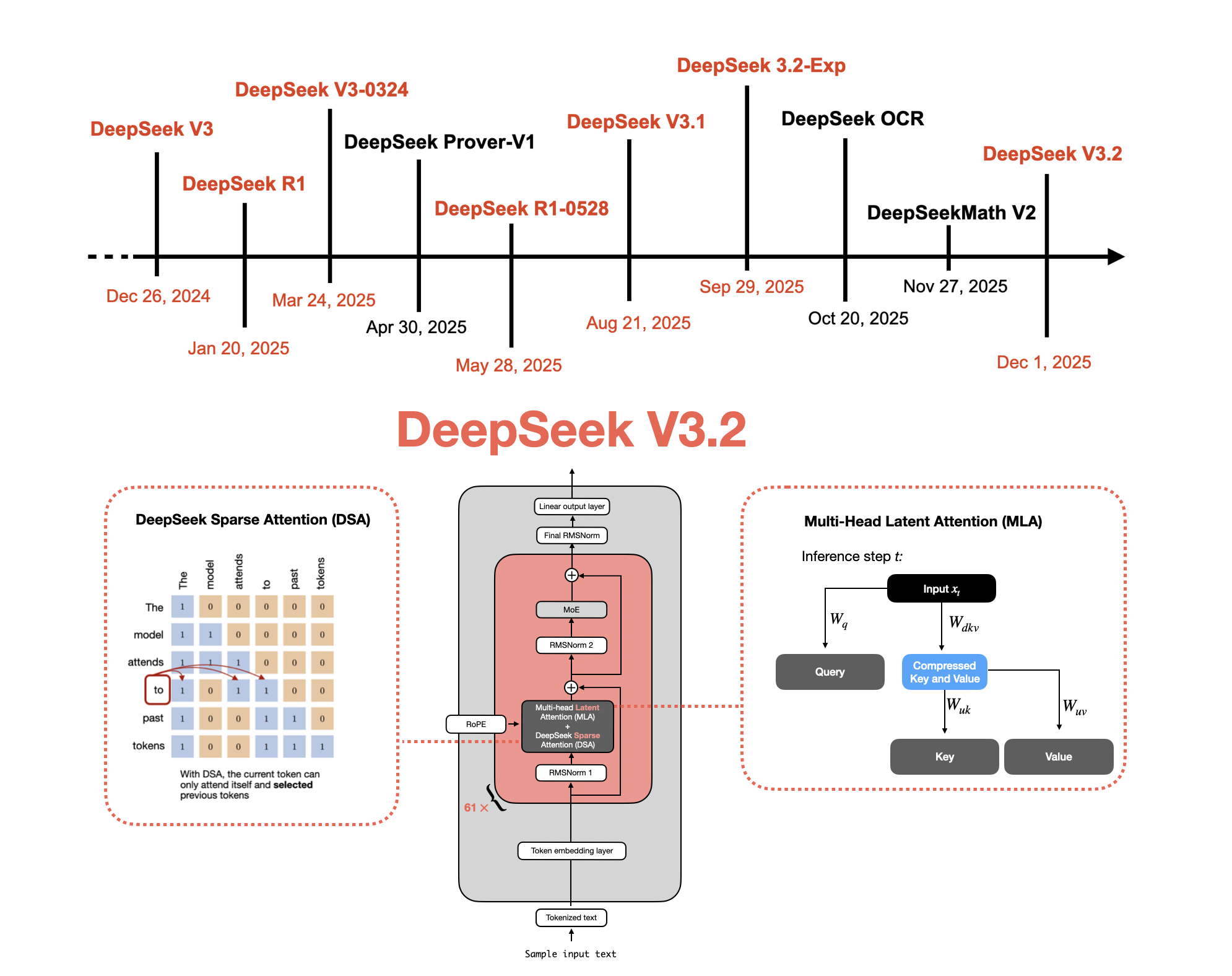
Understanding How DeepSeek's Flagship Open-Weight Models Evolved
By Sebastian Raschka, PhD