Sebastian Raschka
Jun 17, 2025
Understanding and Coding the KV Cache in LLMs from Scratch
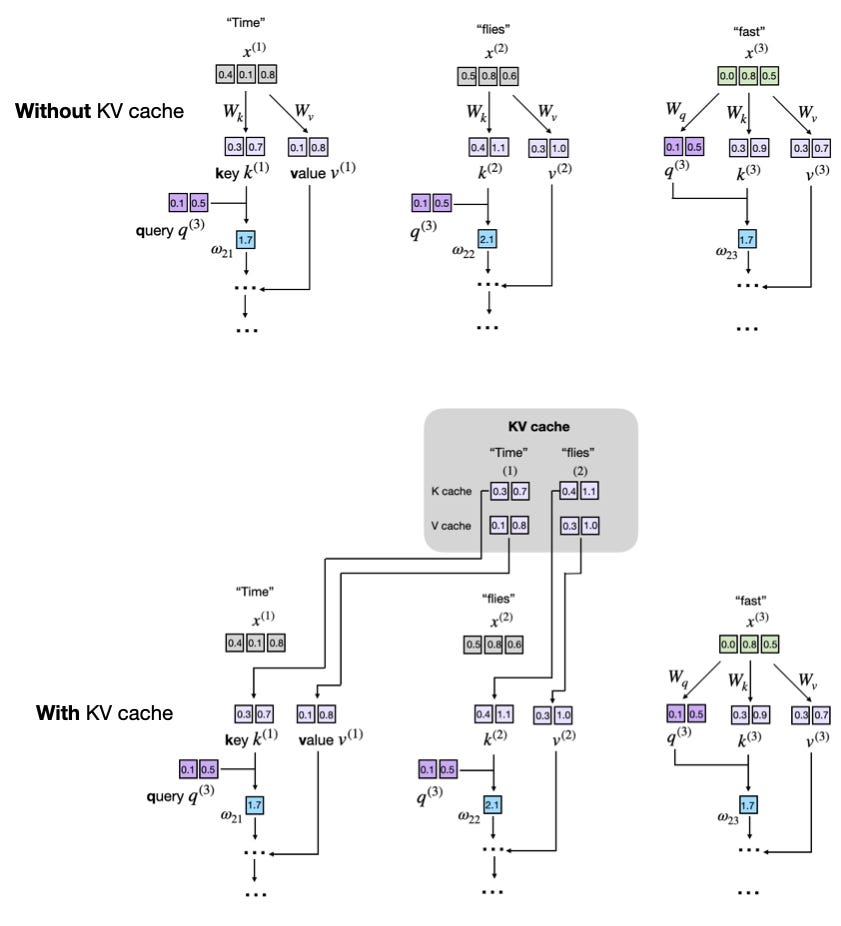
KV caches are one of the most critical techniques for efficient inference in LLMs in production.
KV caches are one of the most critical techniques for efficient inference in LLMs in production.
arXiv:2609.10266v1 Announce Type: new Abstract: LLM serving systems already reuse KV caches, but only when the reused text sits at the very start of the prompt. Two growing workloads break this condi...
arXiv:2609.05764v1 Announce Type: cross Abstract: The key-value (KV) cache is the dominant memory bottleneck in long-context large language model (LLM) decoding: every step reads it entirely, so deco...
The paper presents py‑kvcache, a new KV offload connector for vLLM that uses asynchronous direct I/O, bounded shared staging, and scheduler‑aware preloading to improve external KV caching performance on NVMe SSDs. Experiments across synthetic workloads, long‑context benchmarks, and production traces show that py‑kvcache can load 80k‑token prefixes 2.0× faster than LMCache, with preloading contributing an additional 1.34× speedup, and achieves overall performance within 4% of native vLLM KV Offload. The study highlights that cache effectiveness depends on transfer granularity, intermediate memory use, and scheduling timing rather than just device bandwidth, indicating that external KV caching should be considered a setup‑specific admission decision.
arXiv:2605. 09735v2 Announce Type: replace-cross Abstract: Static-graph LLM decoders provide predictable launches, fixed tensor shapes, and low submission overhead, but online decoding exposes highly irregular KV-cache behavior: request lengths differ, EOS events arrive asynchronously, and logical histories fragment over time.
The paper investigates whether key‑value (KV) cache eviction strategies should vary across Transformer layers. By combining existing eviction methods in different layer configurations and profiling their performance, the authors find that heterogeneous, layer‑wise routing consistently outperforms homogeneous policies on LongBench tasks. Even with a fixed set of methods, the placement of each method strongly influences overall quality, and a single well‑chosen route surpasses all nine standalone baselines across multiple cache budgets.
arXiv:2604.05012v2 Announce Type: replace-cross Abstract: Efficient inference with Large Language Models (LLMs) increasingly relies on Key-Value (KV) caches to store previously computed key and value...
arXiv:2606. 13361v1 Announce Type: new Abstract: Right now, across the world, AI agents are repeating the same absurd act: to read one document, they each recompute it from scratch.
arXiv:2608. 08684v1 Announce Type: cross Abstract: Long-context LLM inference is bottlenecked by KV cache memory, yet distributing a limited cache budget across layers remains challenging.
The paper discusses position‑independent KV cache reuse, a technique designed to cut latency in retrieval‑augmented generation by reusing chunk‑level KV caches across prompts. It argues that current evaluation methods overstate the accuracy of such reuse because they do not accurately capture the loss of accuracy, and that existing datasets lack the necessary reuse dynamics for thorough testing. To remedy this, the authors propose a new evaluation methodology that unambiguously measures accuracy loss and introduce Boxoffice, a tool that programmatically creates datasets with challenging KV cache reuse patterns.
arXiv:2608. 01247v1 Announce Type: cross Abstract: Query-agnostic KV cache eviction compresses a context once and reuses the resulting cache for arbitrary future queries, but performance can collapse under tight budgets.
Query-agnostic KV cache eviction compresses a context once and reuses the resulting cache for arbitrary future queries, but performance can collapse under tight budgets. Existing methods primarily improve which original KV pairs are retained.