arXiv:2608. 19981v1 Announce Type: new Abstract: We present HealMed, an expert-reviewed benchmark for multilingual evaluation of large language models in medicine.
By Yingjian Chen (Drew), Fan Gao (Drew), Sherry T. Tong (Drew), Haoyu Zhang (Drew), Aosong Feng (Drew), Kevin W. Jin (Drew), Xing Wu (Drew), Jinghui Lu (Drew), Abdul Samad (Drew), Akbar Faruqi (Drew), Cesar Caraballo (Drew), Cibele Brand\~ao (Drew), Dhruva (Drew), Gupta, Eunji Jeon, Gabriel Madera-Santiago, Geon Lee, Hugo Toshio Itikawa, Insook Cho, Isabelli Martins, Isarar Siddique, Israr Ahmed, Jihyo Kwak, Kanyakorn Veerakanjana, Luis Guilherme Cardoso, Minjin Kim, Piyalitt Ittichaiwong, Renee Dua, Santiago Gudi\~no-Rosales, Xiujie Chen, Zeo Lapalus, Zixin Xu, Michihiro Yasunaga, Rex Ying, Heuiseok Lim, Jaewoo Kang, Chanjun Park, Hang Jiang, Ethan Goh, Hyunjae Kim, Edison Marrese-Taylor, Yusuke Iwasawa, Yutaka Matsuo, Qingyu Chen, Irene Li
arXiv:2606. 03157v1 Announce Type: new Abstract: Large language models (LLMs) have been widely adopted in healthcare, yet they still encounter significant challenges in complex clinical decision-making scenarios.
By Ruihui Hou, Siyi Zhu, Ziyue Huai, Guangya Yu, Yongqi Fan, Chunming Wang, Tong Ruan
arXiv:2505. 14107v5 Announce Type: replace-cross Abstract: The emergence of groundbreaking large language models capable of performing complex reasoning tasks holds significant promise for addressing various scientific challenges, including those arising in complex clinical scenarios.
By Yakun Zhu, Zhongzhen Huang, Linjie Mu, Yutong Huang, Wei Nie, Jiaji Liu, Shaoting Zhang, Pengfei Liu, Xiaofan Zhang
arXiv:2609.34780v2 Announce Type: replace
Abstract: The use and applicability of artificial intelligence (AI) in medical research and clinical practice has received increasing attention in the litera...
By Erik Aerts
arXiv:2609.14819v1 Announce Type: cross
Abstract: Large language models (LLMs) have a growing range of applications in medicine, and their evaluation is critical for ensuring they provide benefit and...
By Suzannah E McKinney, Phuc Vu, Samuel A Justice, Christopher Humphries, Alyssa Pradhan, Timothy J Keyes, Bernardo C Bizzo, Keith J Dreyer, Sarah F Mercaldo, James M Hillis
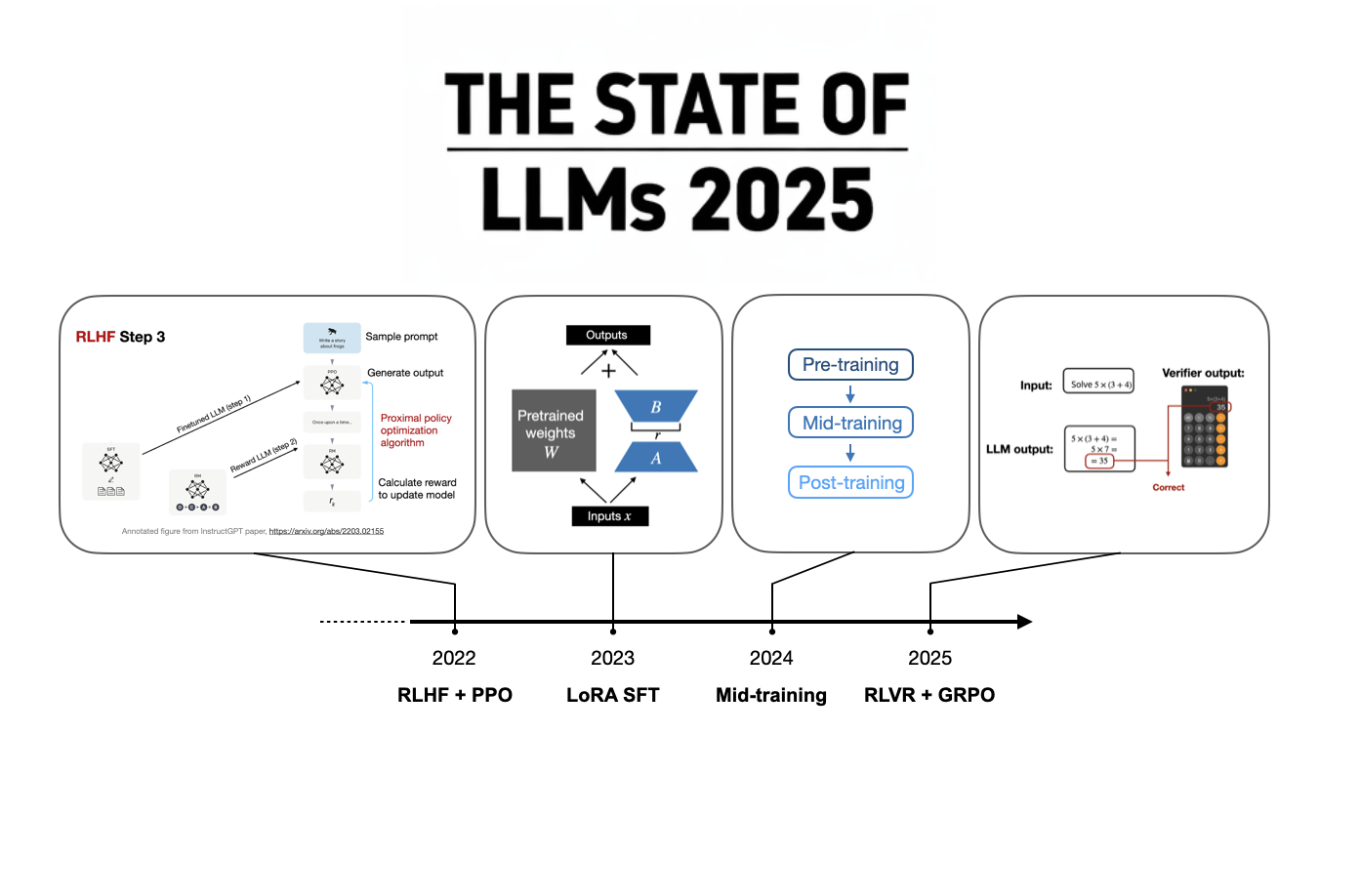
A 2025 review of large language models, from DeepSeek R1 and RLVR to inference-time scaling, benchmarks, architectures, and predictions for 2026.
By Sebastian Raschka, PhD
arXiv:2608.23248v1 Announce Type: cross
Abstract: Traditional clinical prediction models rely on task-specific pipelines and curated, structured data, which scale poorly and underutilize unstructured...
By Siri Willems, James Butterworth, Lore Goetschalckx, Peter Vrancx, Philippe Modard, Elke Giets, Ludovic Denoyer
arXiv:2512. 01241v3 Announce Type: replace-cross Abstract: Large language models (LLMs) are routinely used by physicians and patients for medical advice, yet their clinical safety profiles remain poorly characterized.
By David Wu, Fateme Nateghi Haredasht, Saloni Kumar Maharaj, Priyank Jain, Jessica Tran, Matthew Gwiazdon, Arjun Rustagi, Jenelle Jindal, Jacob M. Koshy, Vinay Kadiyala, Anup Agarwal, Bassman Tappuni, Brianna French, Sirus Jesudasen, Christopher V. Cosgriff, Rebanta Chakraborty, Jillian Caldwell, Susan Ziolkowski, David J. Iberri, Robert Diep, Rahul S. Dalal, Kira L. Newman, Kristin Galetta, J. Carl Pallais, Nancy Wei, Kathleen M. Buchheit, David I. Hong, Vartan Pahalyants, Ernest Y. Lee, Allen Shih, Tamara B. Kaplan, Vishnu Ravi, Sarita Khemani, Thomas A. Buckley, April S. Liang, Daniel Shirvani, Advait Patil, Nicholas Marshall, Kanav Chopra, Joel Koh, Adi Badhwar, Anastasia Perez, Austin J. Schoeffler, Mahbuba Tusty, Chase M. Walton, Liam G. McCoy, David J. H. Wu, Yingjie Weng, Sumant Ranji, Kevin Schulman, Nigam H. Shah, Jason Hom, Arnold Milstein, Arjun K. Manrai, Adam Rodman, Jonathan H. Chen, Ethan Goh
The paper introduces a benchmark of over 6,000 clinical triage scenarios, 7,000 physician annotations, and 225,000 large language model (LLM) responses to assess how LLMs perform under realistic variations in clinical text. The study finds that LLMs tend to recommend unnecessary care more often than physicians, especially when the input text is perturbed, and that LLM recommendations are more sensitive to gender and tone changes than human recommendations. These findings underscore the importance of deployment‑oriented evaluations that reflect expert physician behavior.
By Abinitha Gourabathina, Haoran Zhang, Yuexing Hao, Walter Gerych, Marzyeh Ghassemi
arXiv:2607. 22566v1 Announce Type: new Abstract: MedLoCoMo is a Medical Long-Context Memory benchmark for patient-specific clinical reasoning over multi-admission medical dialogue.
By Zeyu Zhang, Ziqing Wang, Kaize Ding
arXiv:2603. 14771v3 Announce Type: replace Abstract: Large Language Model (LLM)-based Collective Intelligence (CI) presents a promising approach to overcoming the data wall and continuously boosting the capabilities of LLM agents.
By Peigen Liu, Rui Ding, Yuren Mao, Ziyan Jiang, Yuxiang Ye, Yunjun Gao, Ying Zhang, Renjie Sun, Longbin Lai, Zhengping Qian