The paper introduces Seq-Drifting, a new framework that enables diffusion language models to generate an entire text sequence in a single forward pass. By applying a drift field to continuous token representations, the model learns a direct mapping from Gaussian noise to text, using attraction to guide outputs toward contextually plausible tokens and repulsion to prevent repetition and collapse. Experiments show that Seq-Drifting achieves a perplexity of 36.01 on LM1B and performs competitively in unconditional, conditional, translation, summarization, and reasoning tasks.
By Jiayu Liu, Ruizhi Zhao, Tianyun Ji, Yee Whye Teh, Zhenya Huang, Ning Miao
arXiv:2604. 06543v2 Announce Type: replace-cross Abstract: In this work, we demonstrate that reliable stochastic sampling is a fundamental yet unfulfilled requirement for Large Language Models (LLMs) operating as agents.
By Xiangming Gu, Soham De, Michalis Titsias, Larisa Markeeva, Petar Veli\v{c}kovi\'c, Razvan Pascanu
arXiv:2310.04363v3 Announce Type: replace
Abstract: Autoregressive large language models (LLMs) compress knowledge from their training data through next-token conditional distributions. This limits t...
By Edward J. Hu, Moksh Jain, Eric Elmoznino, Younesse Kaddar, Guillaume Lajoie, Yoshua Bengio, Esmeralda S. Whitammer
arXiv:2503. 02368v4 Announce Type: replace-cross Abstract: While guided decoding, especially value-guided methods, has emerged as a cost-effective alternative for controlling language model outputs without re-training models, its effectiveness is limited by the accuracy of the value function.
By Zhenhua Liu, Lijun Li, Ruizhe Chen, Yuxian Jiang, Tong Zhu, Zhaochen Su, Wenliang Chen, Jing Shao
The paper offers a unified probabilistic framework for large language models, describing them as probability measures over token sequences defined by autoregressive conditional distributions. Training is cast as maximum‑likelihood estimation solved via stochastic gradient methods, while generation is treated as sequential simulation of the resulting stochastic process. It also explores how the asymmetry of the Kullback–Leibler divergence relates to hallucination and the distinction between plausibility and truth, and extends the perspective to diffusion models that generate data by simulating a reverse‑time stochastic process.
By Adnan Aboulala\^a
arXiv:2508. 10875v3 Announce Type: replace-cross Abstract: Diffusion Language Models (DLMs) are rapidly emerging as a powerful and promising alternative to the dominant autoregressive (AR) paradigm.
By Tianyi Li, Mingda Chen, Bowei Guo, Zhiqiang Shen
arXiv:2606. 19264v1 Announce Type: new Abstract: The knowledge encoded in large language models (LLMs) can serve as a substrate for structured reasoning over variables describing a complex world, but accessing this knowledge in a probabilistically coherent manner poses a difficult inference problem.
By Sanghyeok Choi, Henry Gouk, Esmeralda S. Whitammer
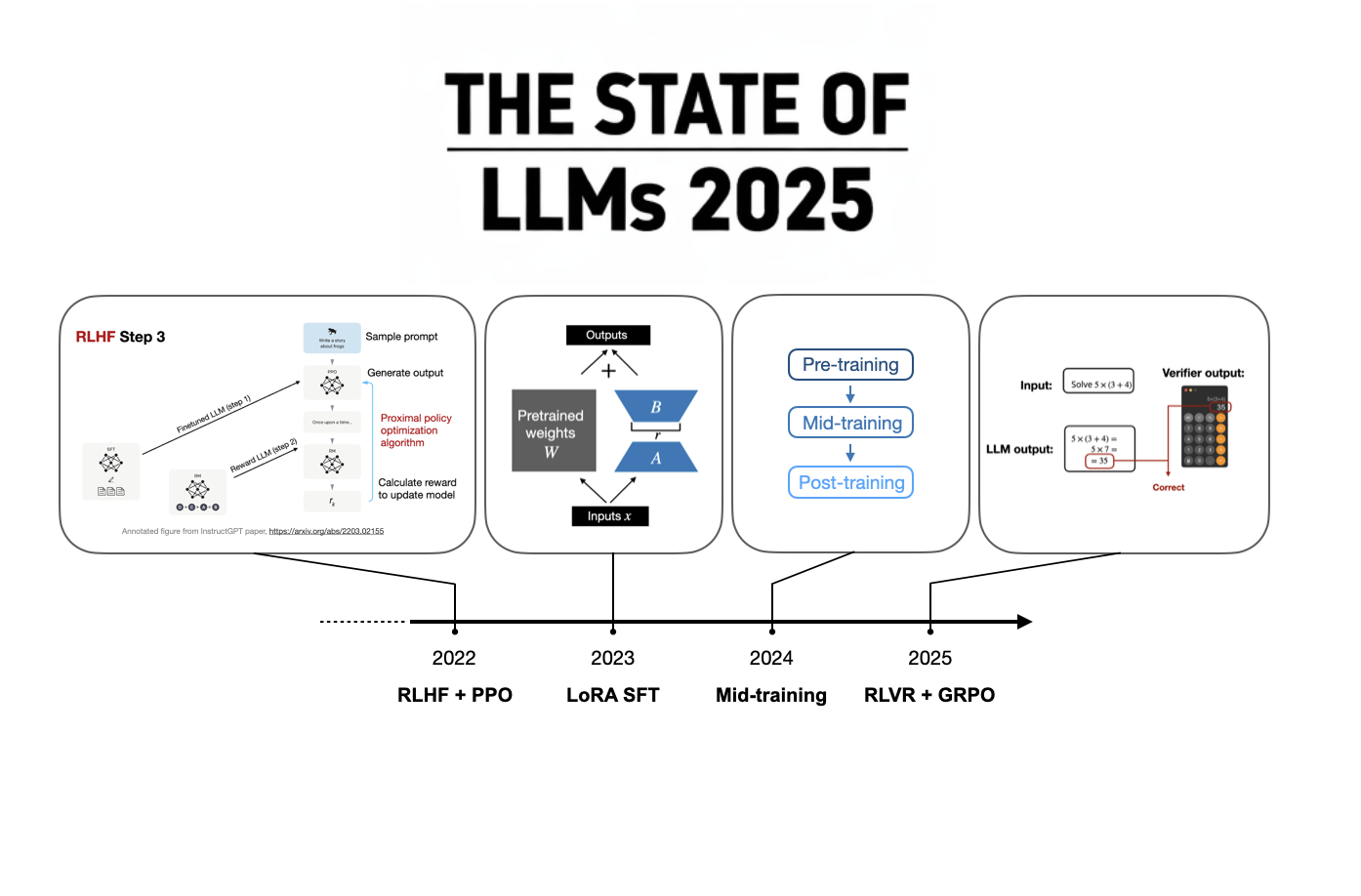
A 2025 review of large language models, from DeepSeek R1 and RLVR to inference-time scaling, benchmarks, architectures, and predictions for 2026.
By Sebastian Raschka, PhD
arXiv:2601.21647v2 Announce Type: replace-cross
Abstract: Discrete Diffusion Language Models (DLMs) offer a promising non-autoregressive alternative for text generation, yet effective mechanisms for...
By Eden Avrahami, Eliya Nachmani
arXiv:2406. 05335v3 Announce Type: replace-cross Abstract: Generation of text and speech in natural languages can be modeled as a stochastic process.
By Kai Nakaishi, Yoshihiko Nishikawa, Koji Hukushima
arXiv:2607. 29378v1 Announce Type: cross Abstract: Large language models (LLMs) generate text by auto-regressively sampling the next token.
By Pirzada Suhail, Nagasai Saketh Naidu, Atanu R Sinha, Amit Sethi
arXiv:2507.05723v1 Announce Type: cross
Abstract: The emergence of Large Language Models (LLMs) with increasingly sophisticated natural language understanding and generative capabilities has sparked...
By Lo\"is Vanh\'ee, Melania Borit, Peer-Olaf Siebers, Roger Cremades, Christopher Frantz, \"Onder G\"urcan, Franti\v{s}ek Kalvas, Denisa Reshef Kera, Vivek Nallur, Kavin Narasimhan, Martin Neumann