Le Chonk provides advanced model control for Mistral Studio, enabling users to build and deploy enterprise agents, workflows, and applications more quickly. The integration offers full control over models, data, and infrastructure, streamlining the development process for businesses.
Mistral has released a preview of its new Mistral Large 4 model, a 1 trillion‑parameter, 49 billion‑active‑parameter language model trained on a cluster of 3,800 NVIDIA Grace‑Blackwell GPUs. The preview is available through their API, with two reasoning levels—"none" and "high"—and the company plans to release the open‑weights version by the end of the month. In preliminary tests, the model scores 38 on Artificial Analysis, outperforming last year’s Mistral Large 3 and approaching the performance of larger competitors.
Omni-Embed-Mini is a 0.9B‑parameter model that embeds text, speech, audio, images, video, and visually‑rich documents into a single shared cosine space without updating any text‑side parameters. It uses a dense cascaded caption as a teacher signal, allowing the teacher and student to share identical backbone weights and requiring only lightweight projectors and phased LoRA adapters for alignment. The model achieves strong text retrieval performance (49.57 nDCG@10 on MTEB‑v2 BEIR‑8) while extending to five additional modalities and is significantly smaller than other open omni‑modal embedders.
By Mohammed Irfan Kurpath, Jaseel Muhammad Kaithakkodan, Sahal Shaji Mullappilly, Ivan Laptev, Hisham Cholakkal
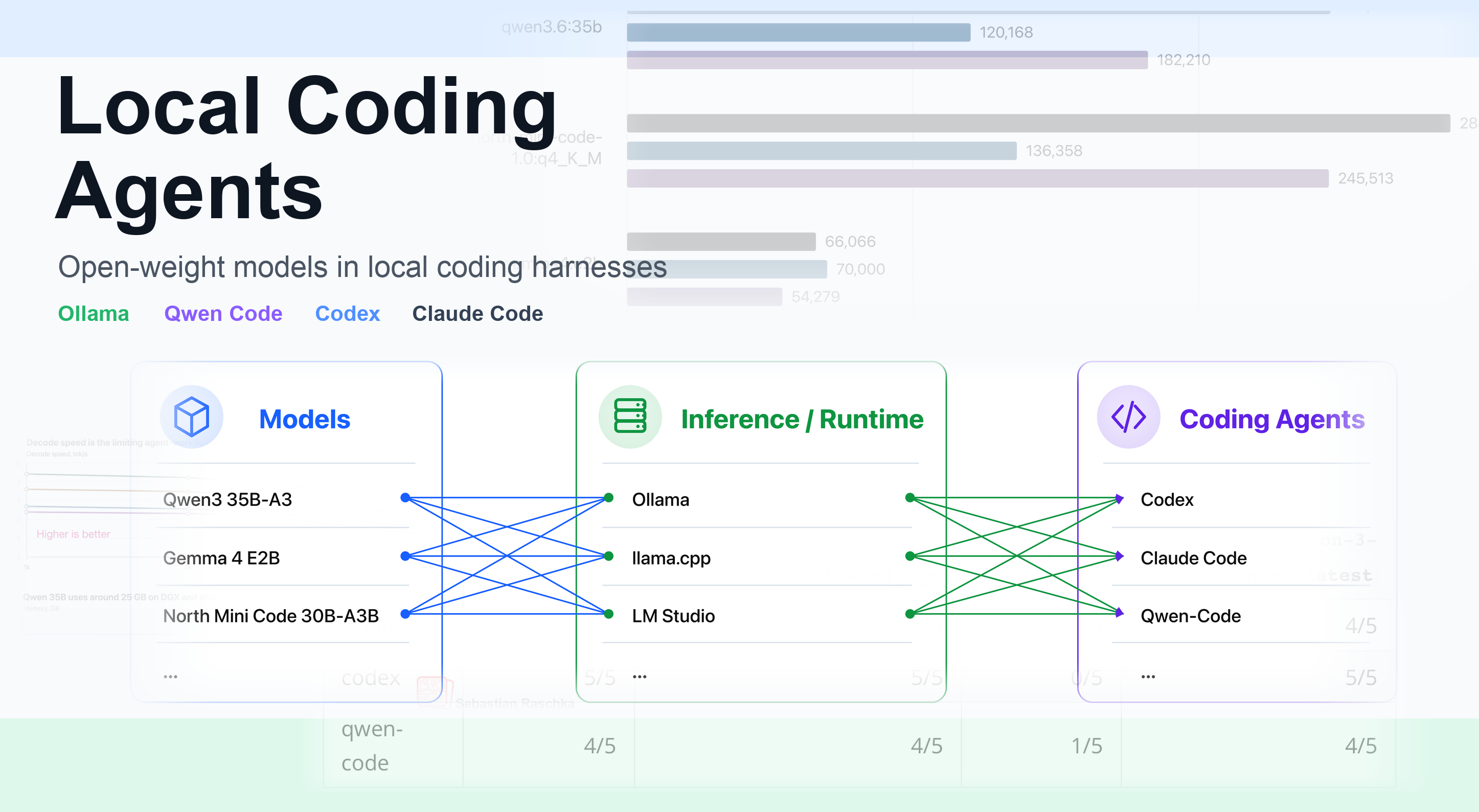
Using Open-Weight Models in Local Coding Harnesses as an Alternative to Claude Code and Codex Subscriptions
By Sebastian Raschka, PhD
Youtu-Parsing-Omni is an omni‑modal parser that transforms documents, images, audio, and video into structured records grounded in space and time, enabling agents to read, locate, and cite evidence across modalities. It uses a single encoder—initialized from a pre‑trained language model—to encode all modalities with shared weights in a unified space‑time coordinate system, while a few fusion layers allow video frames to attend to concurrent audio for cross‑modal fusion and temporal alignment. The system unifies ten parsing tasks under one schema, employing a self‑evolving post‑training procedure called OmniSchema‑Aware On‑Policy Distillation (OSAD) that co‑evolves the parser and its supervision, achieving state‑of‑the‑art performance on OmniDocBench v1.6 and leading open‑weight models on OmniParsingBench, with strong results on audio, video, chart‑parsing, and chemical‑fingerprint agreement.
Writing Answer Set Programming (ASP) theories from scratch is a difficult and time-consuming task. We take a neurosymbolic approach to study whether a model can distill complete and correct theories, given a fixed agent harness with the solver in the loop.