arXiv:2603.29396v2 Announce Type: replace
Abstract: Standard evaluations of Large language models (LLMs) focus on task performance, offering limited insight into whether correct behavior reflects app...
By Zo\"e Prins, Samuele Punzo, Frank Wildenburg, Giovanni Cin\`a, Sandro Pezzelle
The paper introduces a fine-grained method called interactions to analyze prompt sensitivity in large language models (LLMs). By decomposing output scores into nonlinear interactions, the authors show that subtle prompt changes can destabilize these interactions even when overall outputs stay unchanged. They propose an Interaction-based Prompt Sensitivity (IPS) metric and use it to evaluate 50 open-source LLMs, finding that supervised fine‑tuning, larger model scales, dense architectures, and few‑shot learning all reduce prompt sensitivity, primarily by stabilizing low‑order interactions.
By Ruiyang Qin, Qingzhuo Wang, Tian Wang, Zhihua Wei, Wen Shen
arXiv:2608. 16627v1 Announce Type: cross Abstract: Natural language explanations (NLEs) are increasingly used as inputs, for example, as few-shot rationales that influence model behavior in in-context learning (ICL).
By Mahdi Dhaini, Adam Dejl, Juraj Vladika, Volkan \"Ozer, Barbara Plank, Gjergji Kasneci
The paper introduces a bias depth score to differentiate between stable model preferences (Deep biases) and prompt‑dependent responses (Shallow biases) in large language models. By analyzing 4,442 opinion prompts across four models, it finds that only about a quarter of concentrated preferences persist after scenario reframing, indicating that most are shallow. The study shows Deep biases are more often inherited from pretraining and harder to remove through fine‑tuning or prompt‑based debiasing, highlighting the need to distinguish learned biases from prompt artifacts.
By An Vo, Vy Tuong Dang, Khai-Nguyen Nguyen, Emilio Villa-Cueva, Thamar Solorio, Anh Totti Nguyen, Daeyoung Kim
The paper proposes the interlingua hypothesis, suggesting that large language models translate by encoding a source sentence into a latent, task‑agnostic feature space and then decoding a target sentence from that space. Three lines of evidence support this: (1) BLEU variance across language pairs is largely explained by language‑specific competences without pair‑specific interactions; (2) many model components influence both monolingual and translation tasks; and (3) fine‑tuning on monolingual data recovers most translation gains seen with aligned documents. These findings converge to support the hypothesis and point toward new ways to understand and improve LLM translation.
By Jacob Brinton, Jannik Brinkmann, Mark Crovella, Aaron Mueller
arXiv:2606. 09525v1 Announce Type: cross Abstract: During instruction fine-tuning (IFT), large language models (LLMs) learn to follow instructions by using the provided context to answer a query.
By Nadya Yuki Wangsajaya, Haeun Yu, Isabelle Augenstein
The paper investigates whether adding Abstract Meaning Representation (AMR) data to large language models (LLMs) improves performance on downstream tasks. By reproducing recent studies and applying a consistent hyperparameter protocol, the authors find that text-only baselines match or surpass AMR-augmented models. A perplexity-based probe shows that AMR does not provide LLMs with additional relational knowledge, suggesting no clear benefit from AMR augmentation.
By Hoa Quynh Nhung Nguyen, Jacopo Staiano, Michael Sullivan
arXiv:2606. 28615v1 Announce Type: cross Abstract: Large language models (LLMs) are increasingly deployed in high-stakes domains, where free-text explanations such as chain-of-thought and post-hoc rationales are used to justify model outputs.
By Nhi Nguyen, Shauli Ravfogel, Rajesh Ranganath
The paper investigates whether large language models can learn and reproduce annotator‑specific label‑explanation behavior, using two sentence‑pair tasks with four annotators each. It finds that individual annotator patterns are weak at the single‑annotation level but become detectable after reducing input‑content effects and aggregating across annotators. The authors propose cross‑annotator preference optimization (CAPO), which improves upon prompting and supervised fine‑tuning by better capturing annotator‑specific reasoning while maintaining stable attribution.
By Beiduo Chen, Pingjun Hong, Ziyun Zhang, Benjamin Roth, Anna Korhonen, Barbara Plank
arXiv:2601.03199v2 Announce Type: replace-cross
Abstract: Diffusion language models (DLMs) have shown strong potential for general natural language tasks with in-context examples. Existing In-Context...
By Yang Li, Han Meng, Chenan Wang, Zhenyu Bi, Xuan Wang, Haipeng Chen
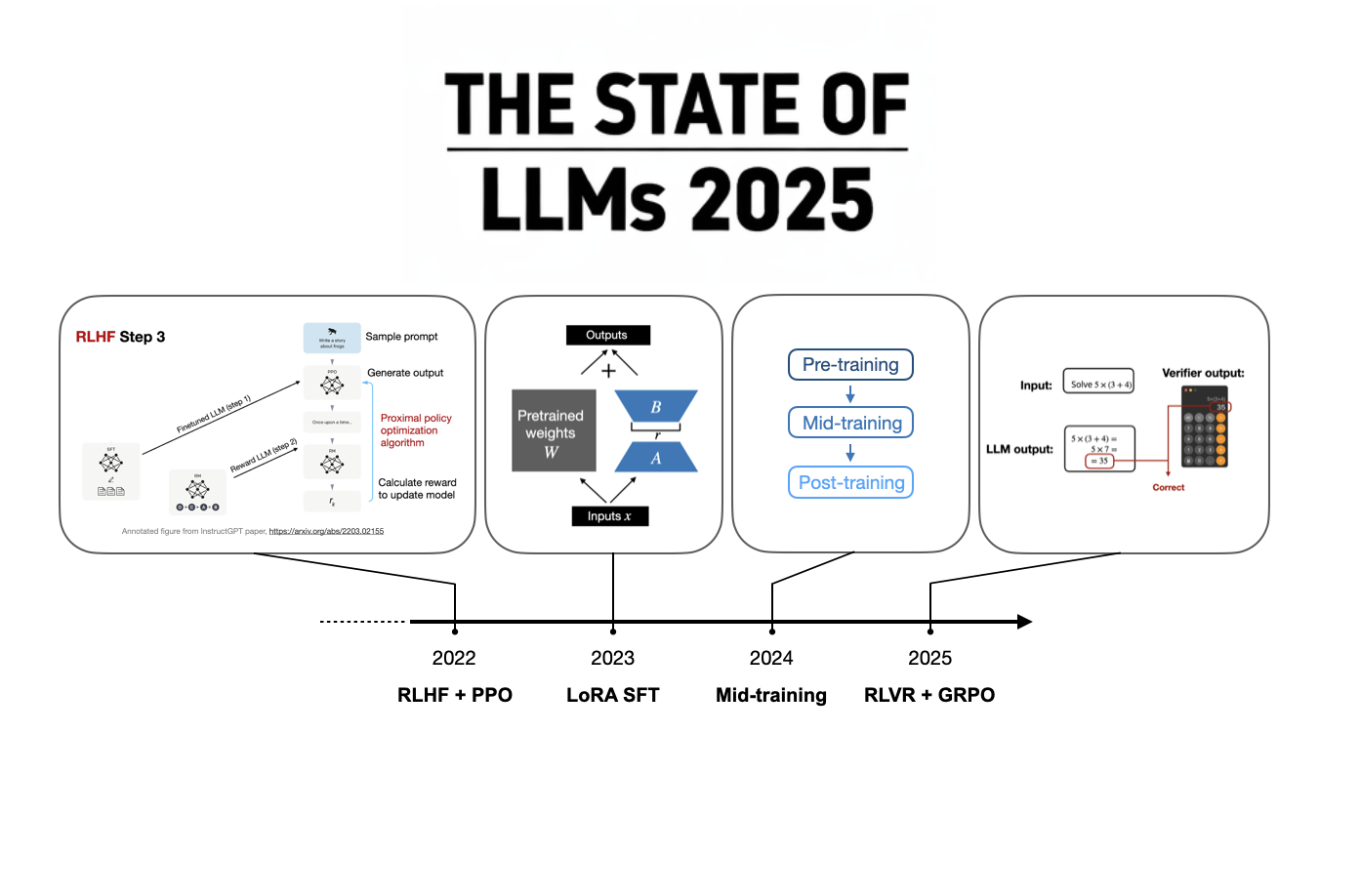
A 2025 review of large language models, from DeepSeek R1 and RLVR to inference-time scaling, benchmarks, architectures, and predictions for 2026.
By Sebastian Raschka, PhD
As large language models (LLMs) grow more capable, they are increasingly deployed in context-rich settings where task inputs are often accompanied by long, partially irrelevant context. In a controlled setting, we find that state-of-the-art models often appear robust to task-irrelevant context at the aggregate level: prepending it to benchmark questions causes little change in overall accuracy.