The paper investigates whether recent attention‑mechanism improvements—specifically gated attention, Kimi K3, Kimi Delta Attention, and Attention Residuals—effectively eliminate the attention‑sink problem when scaling language models to a one‑million‑token context window. Using a new diagnostic suite called SinkProbe, the authors evaluate sink mass, massive activation, position‑resolved recall, and the recency gap across four small models that vary only in token mixing and depth. Their findings show that the training objective, rather than the architecture, drives the emergence of attention sinks; gating did not replicate its previously reported benefits at the larger scale, and sink mass, activations, and positional bias behaved independently.
By Sara Rizwan, Samaanah Abdus Salam
arXiv:2608. 13578v1 Announce Type: cross Abstract: Transformer architectures rely on dense self-attention to model long-range dependencies, but this mechanism exhibits quadratic complexity with respect to sequence length.
By Rachid Arezki
arXiv:2510. 01718v2 Announce Type: replace Abstract: Attention is a core operation in large language models (LLMs).
By Jialin Zhao
arXiv:2608. 09307v1 Announce Type: new Abstract: We present a linearized form of 2-simplicial attention by rewriting the trilinear score as an inner product between a composite query and a key, so that the sum over one token axis takes the same form as ordinary softmax attention.
By Aritra Das, Dhruman Gupta, Debayan Gupta
arXiv:2603. 06591v2 Announce Type: replace Abstract: Transformers frequently allocate disproportionate attention to specific tokens, a phenomenon known as attention sinks.
By Runyu Peng, Ruixiao Li, Mingshu Chen, Yunhua Zhou, Qipeng Guo, Xipeng Qiu, Yucheng Lu, Chen Zhao
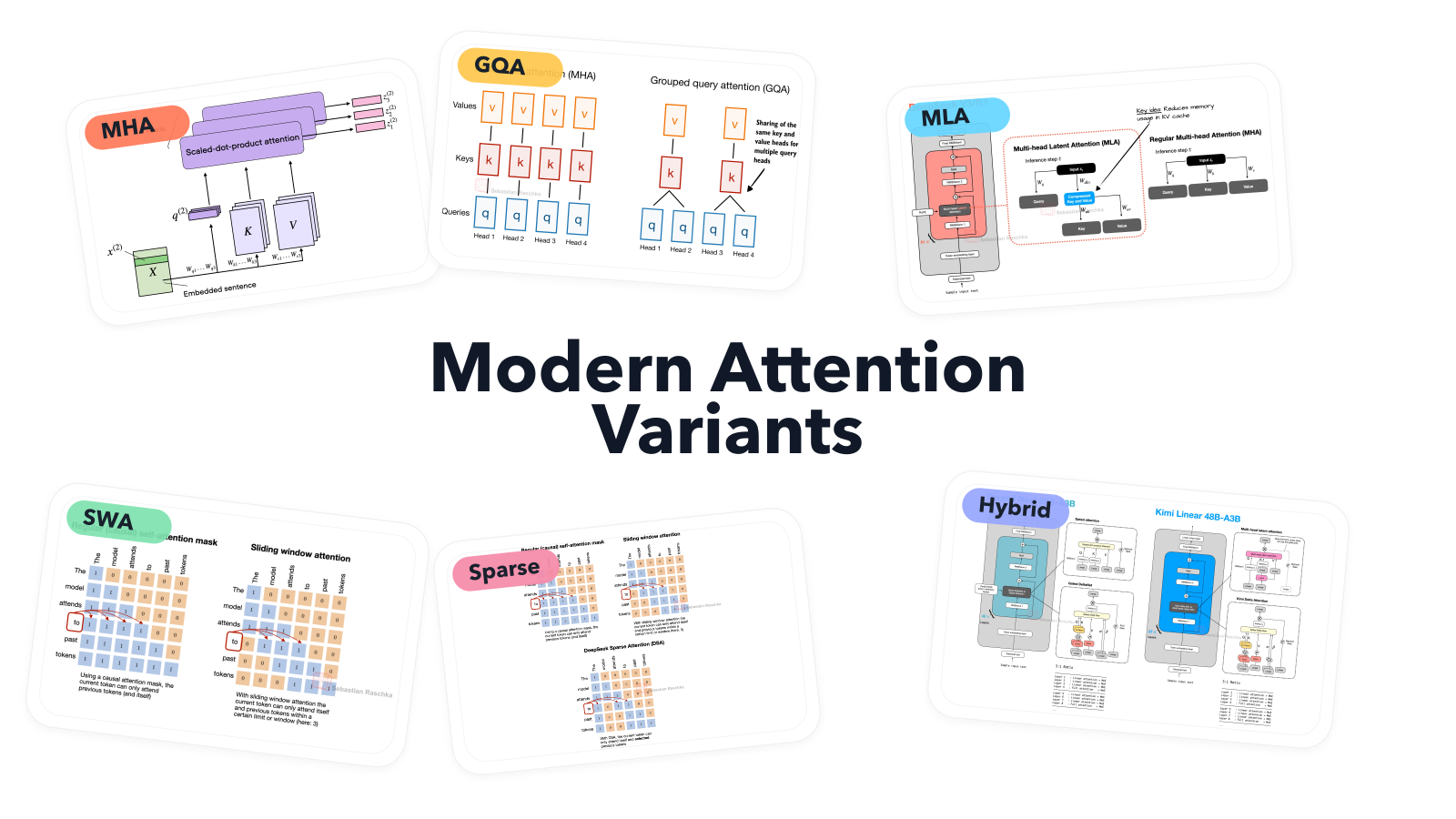
From MHA and GQA to MLA, sparse attention, and hybrid architectures
By Sebastian Raschka, PhD
arXiv:2606. 09862v1 Announce Type: cross Abstract: The Softmax Attention operation in Transformer language models has a quadratic complexity in the sequence length and a growing state size in the form of KV cache, which becomes a bottleneck in long context scenarios.
By Axel Laborieux, Christos Sourmpis, Juan Gabriel Kostelec, Qinghai Guo
arXiv:2602. 14209v2 Announce Type: replace Abstract: Block diffusion LLMs are an emerging paradigm for parallel language generation, but their KV caching makes memory access the dominant bottleneck in long-context inference.
By Omin Kwon, Yeonjae Kim, Doyeon Kim, Minseo Kim, Yeonhong Park, Jae W. Lee
Language models typically construct attention values from contextual hidden states, even when some of their content may be reusable across contexts. We investigate whether token-indexed memory can rep...
The paper investigates how attention dynamics evolve across recurrent depth in language models, finding that attention support stabilizes early while hidden states and outputs take longer. It proposes WISE, a training‑free method that uses full attention in early steps and then reuses the discovered sparse working set for later steps, preserving performance on multi‑hop QA tasks. Experiments show that WISE maintains quality up to 2K context, offers measurable speedups, and highlights the importance of recurrent discovery of attention support.
By Ke Wan, Chen Chen
arXiv:2604. 00004v2 Announce Type: replace-cross Abstract: The extension of context windows in Large Language Models is typically facilitated by scaling positional encodings followed by lightweight Continual Pre-Training (CPT).
By Ning Yang, Hengyu Zhong, Wentao Wang, Baoliang Tian, Haijun Zhang, Jun Wang