arXiv:2606. 25008v1 Announce Type: new Abstract: Neural scaling laws describe how pre-training loss decays as power laws with training time, model size, and compute.
By Yizhou Liu, Jeff Gore
The paper investigates the often-overlooked scale vectors in large language models, showing that despite their tiny size they are crucial for pre‑training performance. The authors provide theoretical insights that scale vectors mainly aid optimization rather than expressivity, and they analyze how weight decay affects different normalization layers. Building on these findings, they propose lightweight improvements—branch‑specific heterogeneity, better placement, and magnitude‑direction reparameterization—that consistently reduce loss across a range of model sizes and training settings.
By Mingze Wang, Shuchen Zhu, Yuxin Fang, Binghui Li, Kai Shen, Shu Zhong
arXiv:2606. 16112v1 Announce Type: cross Abstract: Residual architectures are ubiquitous in deep learning, but they suffer from a subtle structural limitation: the norm of the residual stream can grow rapidly with depth.
By Tom\'as Figliolia, Beren Millidge
arXiv:2410. 13077v2 Announce Type: replace-cross Abstract: Transformer-based Large Language Models (LLMs) traditionally rely on final-layer loss for finetuning and final-layer representations for predictions, potentially overlooking the predictive power embedded in late layers.
By Haoyan Luo, Lucia Specia
arXiv:2403.04545v4 Announce Type: replace
Abstract: Scaling factors in residual branches have emerged as a prevalent method for boosting neural network performance, especially in normalization-free a...
By Zixiong Yu, Guhan Chen, Jianfa Lai, Bohan Li, Songtao Tian
The paper critiques the common practice of evaluating depth usage in depth‑recurrent language models by truncating depth during inference and measuring performance decline. It argues that this method conflates three distinct effects—fewer block applications, reduced computation, and an out‑of‑distribution readout—yet is usually interpreted as measuring only the second. To address this, the authors introduce the Depth Control Protocol (DCP), a suite of positive and negative controls that isolate each factor, along with a training intervention to confirm causality, specifically tailored for depth‑wise weight‑sharing architectures.
By Ha Van Dau, Thanh Tung Khuat, Nguyen Thanh Dung
arXiv:2602. 03685v2 Announce Type: replace-cross Abstract: Training large language models (LLMs) is computationally expensive, partly because the loss exhibits slow power-law convergence whose origin remains debatable.
By Yizhou Liu, Ziming Liu, Cengiz Pehlevan, Jeff Gore
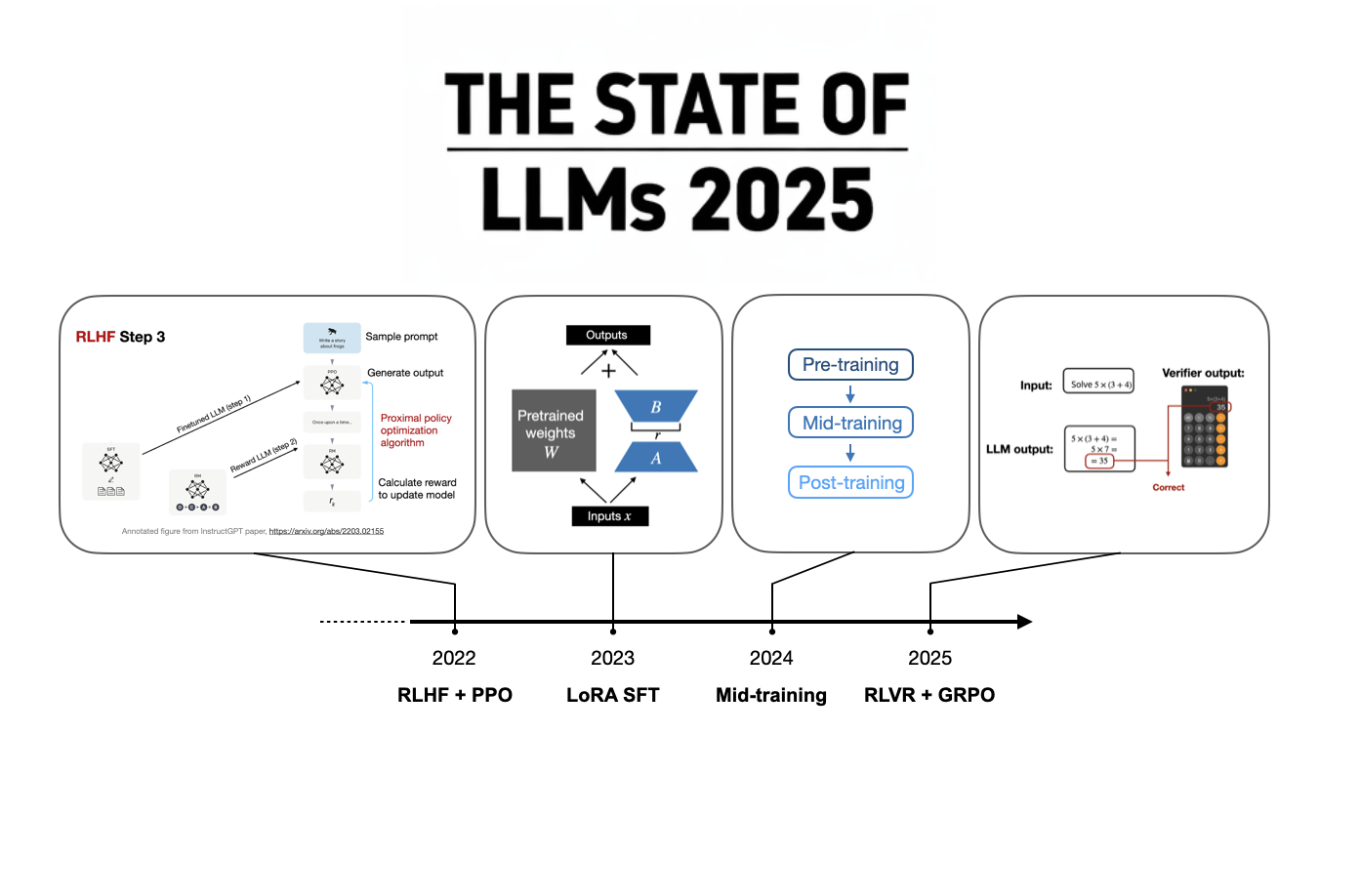
A 2025 review of large language models, from DeepSeek R1 and RLVR to inference-time scaling, benchmarks, architectures, and predictions for 2026.
By Sebastian Raschka, PhD
arXiv:2607. 07884v1 Announce Type: new Abstract: In this short note we consider the gradient descent dynamics of deep scalar linear networks, $f(x) = \prod_{l=1}^L w_l x$, which enjoy exact time-course solutions for any integer depth.
By Yedi Zhang, Peter E. Latham, Leena Chennuru Vankadara, Andrew Saxe
arXiv:2607. 14018v1 Announce Type: cross Abstract: We investigate how each component of the Transformer feedforward block architecture design determines how much rank survives across depth at initialization.
By Katie Everett
arXiv:2607. 27731v1 Announce Type: new Abstract: Modern deep learning typically keeps the batch size static throughout training, thus overlooking the joint effect of learning rate and batch size on the training dynamics.
By Jiaxiang Li, Zhiqi Bu, Shiyun Xu
arXiv:2506. 07406v3 Announce Type: replace-cross Abstract: Understanding the internal representations of large language models (LLMs) is a central challenge in interpretability research.
By Yifan Luo, Zhennan Zhou, Bin Dong