arXiv:2608. 02975v1 Announce Type: cross Abstract: Large language models (LLMs) have demonstrated impressive performance in MQM-based translation quality (TQ) evaluation, and recent advances in large reasoning models (LRMs) promise even greater improvements.
By Bhavin Jawade, Cameron R. Wolfe
arXiv:2606. 07410v1 Announce Type: cross Abstract: The emergence of "Aha moments" in large language models, particularly DeepSeek-R1-0120, has raised the question of whether these systems genuinely reason or merely imitate the appearance of reasoning.
By Yuxiang Chen, Jun Wang
arXiv:2606. 31048v1 Announce Type: cross Abstract: This paper investigates knowledge distillation from a large reasoning model (DeepSeek-R1) to a compact student model (Qwen2.
By Gaurab Baral, Aaditya Khanal, Yangyang Tao, Junxiu Zhou
arXiv:2606. 26797v1 Announce Type: new Abstract: Supervised fine-tuning (SFT) on a small, high-quality set of long reasoning traces is an effective approach for eliciting strong reasoning capabilities in Large Language Models (LLMs).
By Hongyi Henry Jin, Wenhan Yang, Meysam Ghaffari, Carlos Morato, Baharan Mirzasoleiman
The paper investigates how large language models (LLMs) balance capability and efficiency when using Chain-of-Thought reasoning on arithmetic and algorithmic tasks. It finds that while larger models solve more problems correctly, the improvement follows an exponential decay that slows with scale, indicating diminishing returns. Additionally, the length of reasoning output grows with problem size but does not improve with larger models, suggesting efficiency does not benefit from scaling.
By Moritz Laber, Zohair Shafi, Germans Savcisens, Brennan Klein, Matteo Chinazzi, Samuel V. Scarpino, Albert-L\'aszl\'o Barab\'asi, Tina Eliassi-Rad
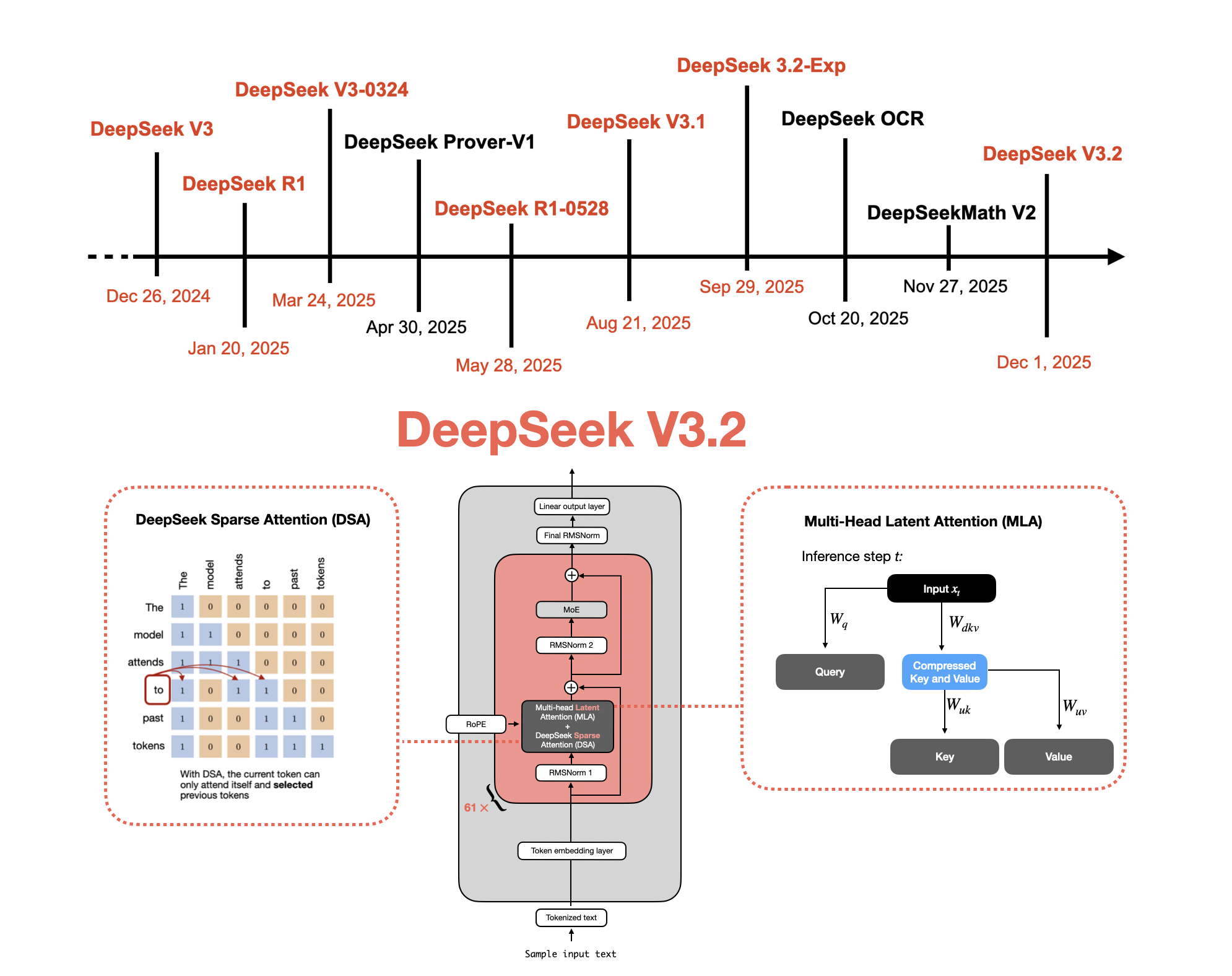
Understanding How DeepSeek's Flagship Open-Weight Models Evolved
By Sebastian Raschka, PhD