arXiv:2608. 02975v1 Announce Type: cross Abstract: Large language models (LLMs) have demonstrated impressive performance in MQM-based translation quality (TQ) evaluation, and recent advances in large reasoning models (LRMs) promise even greater improvements.
By Bhavin Jawade, Cameron R. Wolfe
arXiv:2606. 07410v1 Announce Type: cross Abstract: The emergence of "Aha moments" in large language models, particularly DeepSeek-R1-0120, has raised the question of whether these systems genuinely reason or merely imitate the appearance of reasoning.
By Yuxiang Chen, Jun Wang
arXiv:2606. 31048v1 Announce Type: cross Abstract: This paper investigates knowledge distillation from a large reasoning model (DeepSeek-R1) to a compact student model (Qwen2.
By Gaurab Baral, Aaditya Khanal, Yangyang Tao, Junxiu Zhou
arXiv:2606. 26797v1 Announce Type: new Abstract: Supervised fine-tuning (SFT) on a small, high-quality set of long reasoning traces is an effective approach for eliciting strong reasoning capabilities in Large Language Models (LLMs).
By Hongyi Henry Jin, Wenhan Yang, Meysam Ghaffari, Carlos Morato, Baharan Mirzasoleiman
The paper investigates how large language models (LLMs) balance capability and efficiency when using Chain-of-Thought reasoning on arithmetic and algorithmic tasks. It finds that while larger models solve more problems correctly, the improvement follows an exponential decay that slows with scale, indicating diminishing returns. Additionally, the length of reasoning output grows with problem size but does not improve with larger models, suggesting efficiency does not benefit from scaling.
By Moritz Laber, Zohair Shafi, Germans Savcisens, Brennan Klein, Matteo Chinazzi, Samuel V. Scarpino, Albert-L\'aszl\'o Barab\'asi, Tina Eliassi-Rad
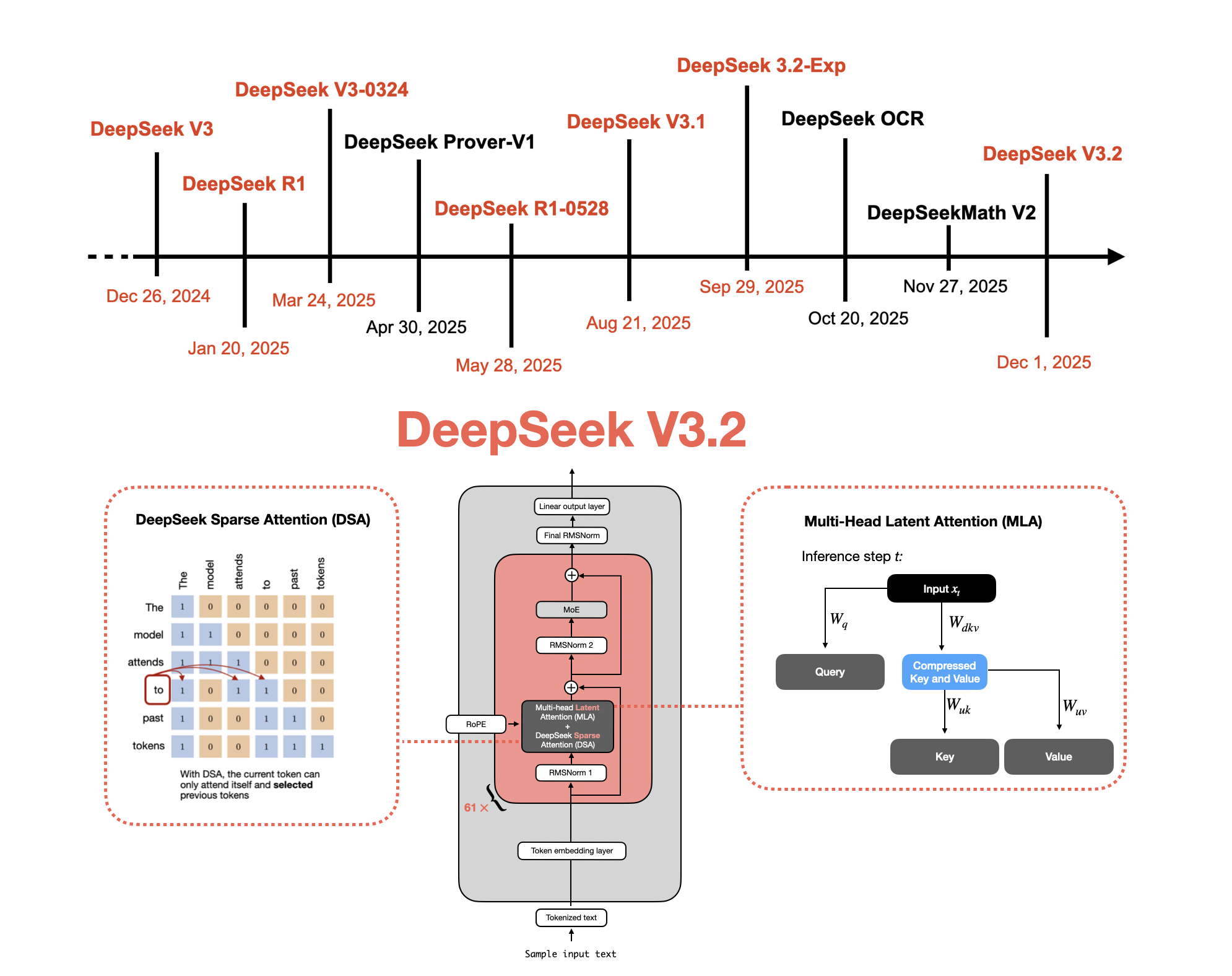
Understanding How DeepSeek's Flagship Open-Weight Models Evolved
By Sebastian Raschka, PhD
arXiv:2506. 17104v2 Announce Type: replace Abstract: Large language models (LLMs) have shown promising first-order logic (FOL) reasoning capabilities with applications in various areas.
By Chuxue Cao, Mengze Li, Juntao Dai, Jinluan Yang, Zijian Zhao, Shengyu Zhang, Weijie Shi, Chengzhong Liu, Sirui Han, Yike Guo
Supervised fine-tuning (SFT) on a small, high-quality set of long reasoning traces is an effective approach for eliciting strong reasoning capabilities in Large Language Models (LLMs). However, existing methods for curating high-quality SFT data rely heavily on strong reasoning models to filter examples based on diversity and difficulty, making the curation process costly while often yielding suboptimal data quality.
arXiv:2607. 22602v1 Announce Type: new Abstract: Inference-time scaling has emerged as a powerful paradigm for improving large language model reasoning, often delivering larger gains on difficult reasoning tasks than parameter scaling alone.
By Tingxin Yang, Zefeng Wang, Mengyue Wang, Xingcheng Zhou, Yunpu Ma
arXiv:2609.37066v1 Announce Type: cross
Abstract: Post-training is central to mathematical reasoning in modern large language models (LLMs), but endpoint pass@1 alone underidentifies what has changed...
By Hongyang Li, Yiming Zhu, Xiao Li, Caesar Wu, Said Mammar, Pascal Bouvry
The paper surveys efficient reasoning in large language models, contrasting fast intuitive (System 1) and slow deep (System 2) reasoning. It analyzes why System 2 is computationally costly yet more accurate, and why System 1 is efficient but less effective. The survey covers causes of inefficiency, patterns of reasoning behavior, and potential solutions to balance performance and computational budgets, offering actionable insights and an open‑source repository for ongoing research.
By Rui Wang, Hongru Wang, Boyang Xue, Jianhui Pang, Shudong Liu, Yi Chen, Jiahao Qiu, Derek Fai Wong, Heng Ji, Kam-Fai Wong
arXiv:2606. 16152v1 Announce Type: new Abstract: Knowledge distillation from powerful reasoning models is widely used to improve Small Language Models (SLMs) on mathematical reasoning, often assuming that traces with higher reward model scores provide more useful supervision.
By Haolong Qian, Xianliang Yang, Yinuo ma, Lirong Che, Feng Lu, Ye Guo, Lei Song, Jiang Bian, Chun Yuan