Qwen3.8-Flash-Next is an open‑weights multimodal Mixture‑of‑Experts (MoE) model previewing the architecture of Qwen4. It contains 125 B tokens with only 6 B active, giving a performance boost. The author has tested it on a DGX Spark with Unsloth quantized models, exploring variants like UD‑IQ1_S and UD‑Q2_K_XL, and highlighted a high‑reasoning‑effort example from UD‑Q2_K_XL.
The release of llm-gemini 0.34 introduces the new Gemini 3.8‑Flash model, available in low, medium, and high thinking levels, and fixes an issue where async responses failed to record the resolved model version. The update also notes that Google has released Gemini 3.8‑Flash (and a restricted 3.8 Flash Cyber version) today, with example outputs (pelicans) demonstrating the model’s performance across the different thinking levels. The author highlights Gemini Flash’s speed, low cost, and competence in generating HTML, JavaScript, and Markdown‑SVG content, citing a 13‑second, 1.8‑cent example of an HTML output.
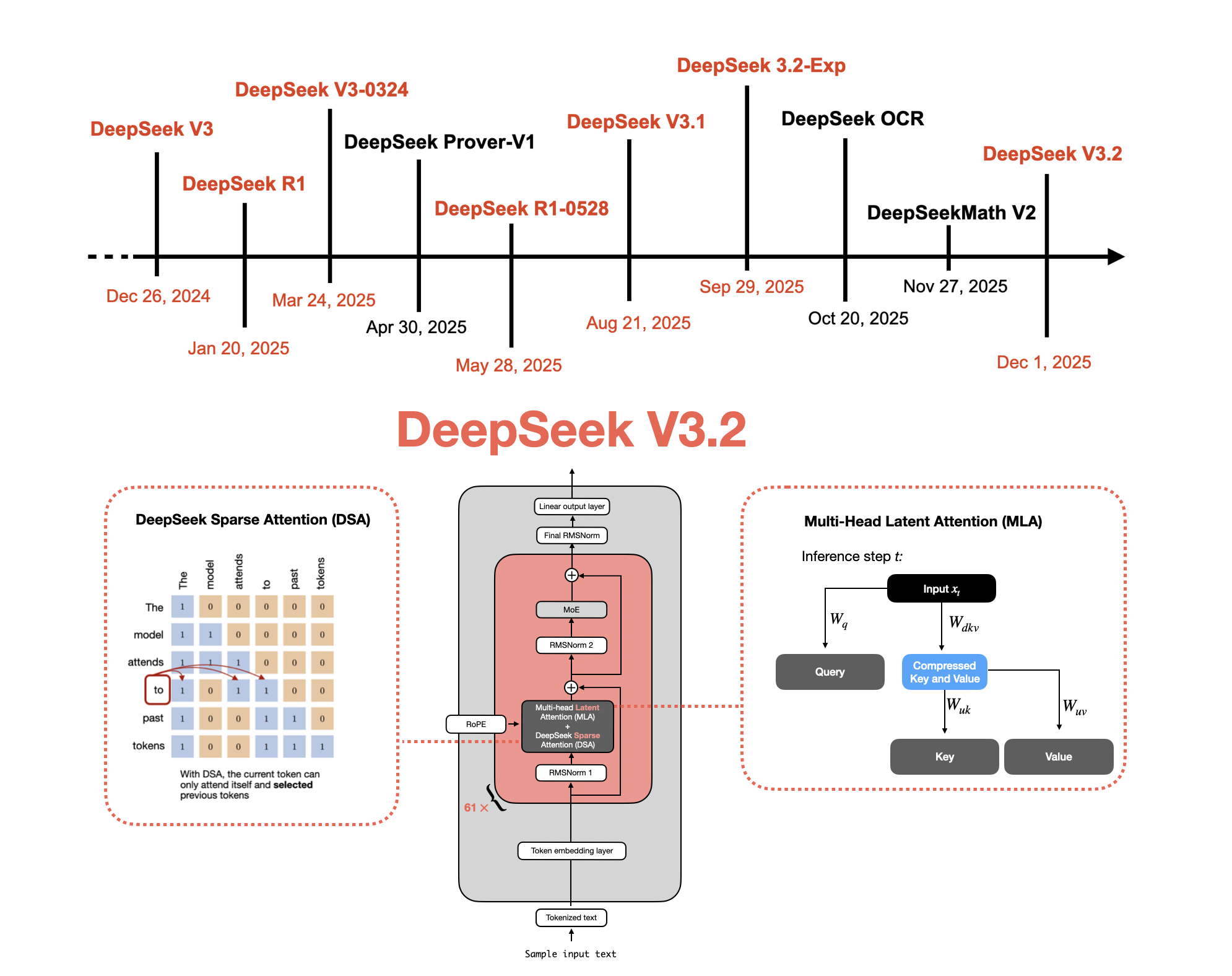
Understanding How DeepSeek's Flagship Open-Weight Models Evolved
By Sebastian Raschka, PhD
Qwen 3. 8 27B scores 52 on the Artificial Analysis Intelligence Index That's the same score as GPT-5.
Simon Willison comments on GPT 6.1‑Sol, describing it as "Near‑Astra intelligence for a fifth of the price." He notes that the model’s pelican illustrations are similar to those of the GPT‑6 family and provides links to the live‑blog of the keynote and to the pelican images. The post is tagged with AI, OpenAI, generative‑AI, LLMs, and playful references to pelican‑riding‑a‑bicycle.
Friday's big release was Qwen 3. 8 27B , an Apache 2 licensed 27B parameter vision-capable LLM from Alibaba's Qwen research lab.
Introducing Muse Glimmer Meta are back in the open weights game! Muse Glimmer is a brand new 30B model under a clean Apache 2.
The article reports the release of new AI models: Claude Opus 5.5 by Anthropic and GPT‑6 Sol and GPT‑6 Luna by OpenAI, noting that GPT‑6 variants are priced at half the cost of their GPT‑5.6 counterparts. It provides a detailed pricing table comparing input, cached input, and output costs across several models, highlighting how GPT‑6 Luna is among the cheapest ever offered by OpenAI. The author also comments on visual differences in model outputs, noting that GPT‑6 outputs are more muted compared to GPT‑5.6.
Simon Willison tested GPT‑6 Astra by generating SVG pelicans riding bicycles at various reasoning levels and compared the results to GPT‑5.6 Sol, Terra, and Luna. The Astra pelicans consistently outperformed the other models, especially at low and xhigh reasoning levels, and even the Astra max version produced high‑quality images. Astra also used fewer tokens and was roughly twice as expensive as Sol, yet its low‑level output was cheaper and superior to any Sol model.
arXiv:2608. 02991v1 Announce Type: new Abstract: Matrix spectral optimizers reshape weight-update spectra but usually delegate vector-valued biases to a separate optimizer.
By Gongyue Zhang, Honghai Liu
Release: llm-gemini 0. 33 It's been a while since the last llm-gemini release.
arXiv:2609.14715v1 Announce Type: new
Abstract: We scale our conventional sub-150M pretraining recipe from 53.5M to 109.7M parameters, holding the method fixed (Qwen3-style decoder with grouped-query...
By Dushyant Rajput (AltSlate Labs LLP), Nirdesh Chauhan (AltSlate Labs LLP), Siddharth Kosaraju (AltSlate Labs LLP)