arXiv:2605. 29223v3 Announce Type: replace Abstract: The parameter counts of the most widely used large language models (LLMs) are often withheld by their developers, leaving model size -- a primary reference point for interpreting capabilities and costs -- largely undisclosed.
By Ivica Nikolic
arXiv:2606. 07616v1 Announce Type: cross Abstract: Scaling laws provide a fundamental framework for understanding the performance of Language Models (LMs), yet deriving them requires prohibitively expensive evaluations across thousands of checkpoints or millions of inference samples.
By Sang Truong, Yuheng Tu, Rylan Schaeffer, Sanmi Koyejo
arXiv:2607. 11052v1 Announce Type: new Abstract: Machine learning progress is often attributed to scaling model size and dataset volume, yet the composition of data can be just as consequential.
By Kimia Hamidieh, Lester Mackey, David Alvarez-Melis
arXiv:2607. 03377v1 Announce Type: cross Abstract: The rapidly growing repository of publicly available large language models (LLMs) presents significant challenges for systematic management and quantification at scale, such as model lineage tracing, licensing, and evaluation.
By Zhuoying Zhang, Ishan V. Prasad, Yuanzhe Hu, Zihang Liu, Hengrui Luo, Pu Ren, Yaoqing Yang
arXiv:2604. 01206v2 Announce Type: replace-cross Abstract: We present RELISH (REgression with a Latent Iterative State Head), a novel, lightweight architecture designed for text regression with large language models.
By Yiheng Su, Matthew Lease
The paper introduces Power‑Law Entropy Search (PLES), a computational‑cost‑aware acquisition function that uses multi‑fidelity Bayesian optimization to efficiently estimate optimal hyperparameter scaling laws for large language model training. PLES focuses on reducing the overall uncertainty of scaling law estimates rather than optimizing a single objective, selecting configurations that maximize uncertainty reduction per unit computational cost. Experiments on synthetic benchmarks, surrogate models, and real LLM pre‑training runs show that PLES converges to accurate scaling laws using less than one‑tenth of the computational budget required by conventional grid search and other baselines.
By Zhiliang Chen, Sebastian Ament, David Eriksson, Maximilian Balandat, Eytan Bakshy, Jihao Andreas Lin
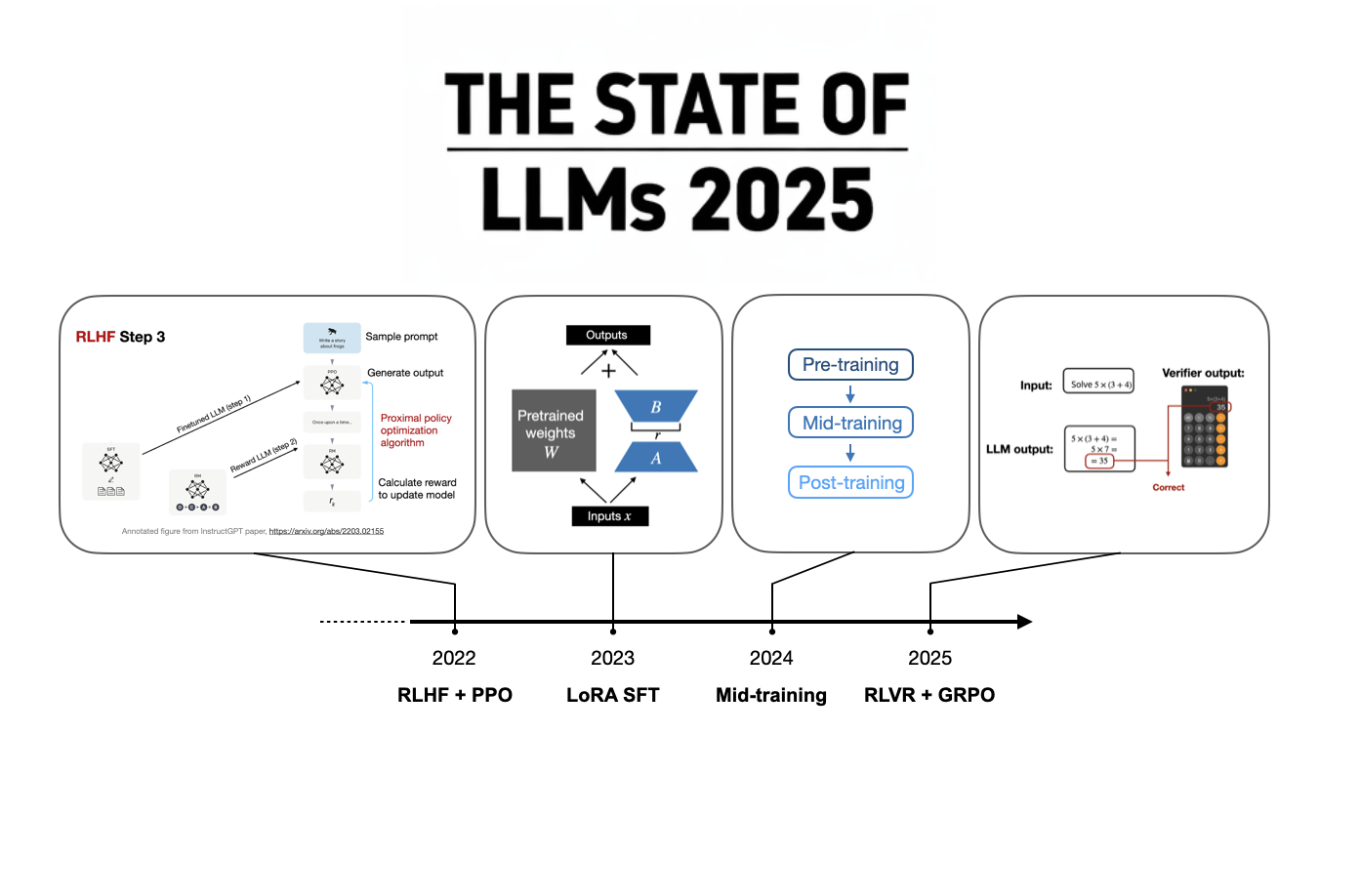
A 2025 review of large language models, from DeepSeek R1 and RLVR to inference-time scaling, benchmarks, architectures, and predictions for 2026.
By Sebastian Raschka, PhD
The paper investigates the often-overlooked scale vectors in large language models, showing that despite their tiny size they are crucial for pre‑training performance. The authors provide theoretical insights that scale vectors mainly aid optimization rather than expressivity, and they analyze how weight decay affects different normalization layers. Building on these findings, they propose lightweight improvements—branch‑specific heterogeneity, better placement, and magnitude‑direction reparameterization—that consistently reduce loss across a range of model sizes and training settings.
By Mingze Wang, Shuchen Zhu, Yuxin Fang, Binghui Li, Kai Shen, Shu Zhong
arXiv:2511. 20639v3 Announce Type: replace-cross Abstract: Multi-agent systems (MAS) extend large language models (LLMs) from independent single-model reasoning to coordinative system-level intelligence.
By Jiaru Zou, Ruizhong Qiu, Gaotang Li, Xiyuan Yang, Katherine Tieu, Pan Lu, Ke Shen, Hanghang Tong, Yejin Choi, Jingrui He, James Zou, Mengdi Wang, Ling Yang
The paper investigates how to effectively pre‑train language models when the data budget is limited but compute is plentiful. It shows that increasing model size only improves performance up to an optimal point, after which overfitting degrades generalization, and that this optimal size varies with both the data budget and downstream tasks. To overcome the inefficiencies of standard Transformers in this regime, the authors propose recursive Transformers that reuse a shared block across depth and employ factorized embeddings, achieving better results than standard models on 10M–100M word pre‑training budgets and competitive performance with BabyLM Challenge 2025 winners.
By Serdar G\"ulbahar, Lukas Edman, Alexander Fraser
The paper proposes the interlingua hypothesis, suggesting that large language models translate by encoding a source sentence into a latent, task‑agnostic feature space and then decoding a target sentence from that space. Three lines of evidence support this: (1) BLEU variance across language pairs is largely explained by language‑specific competences without pair‑specific interactions; (2) many model components influence both monolingual and translation tasks; and (3) fine‑tuning on monolingual data recovers most translation gains seen with aligned documents. These findings converge to support the hypothesis and point toward new ways to understand and improve LLM translation.
By Jacob Brinton, Jannik Brinkmann, Mark Crovella, Aaron Mueller
arXiv:2608.03446v2 Announce Type: replace
Abstract: Multilingual large language models (LLMs) have been shown to perform better on non-English classification tasks when the representations of the giv...
By Adnan Al Ali, Kathy H\"ammerl, Jind\v{r}ich Libovick\'y, Alexander Fraser